SightingCold War
MiG-19 Intercept over Mount Tomorr — Albania, 1963
c. 1963
Mount Tomorr, Skrapar, Albania
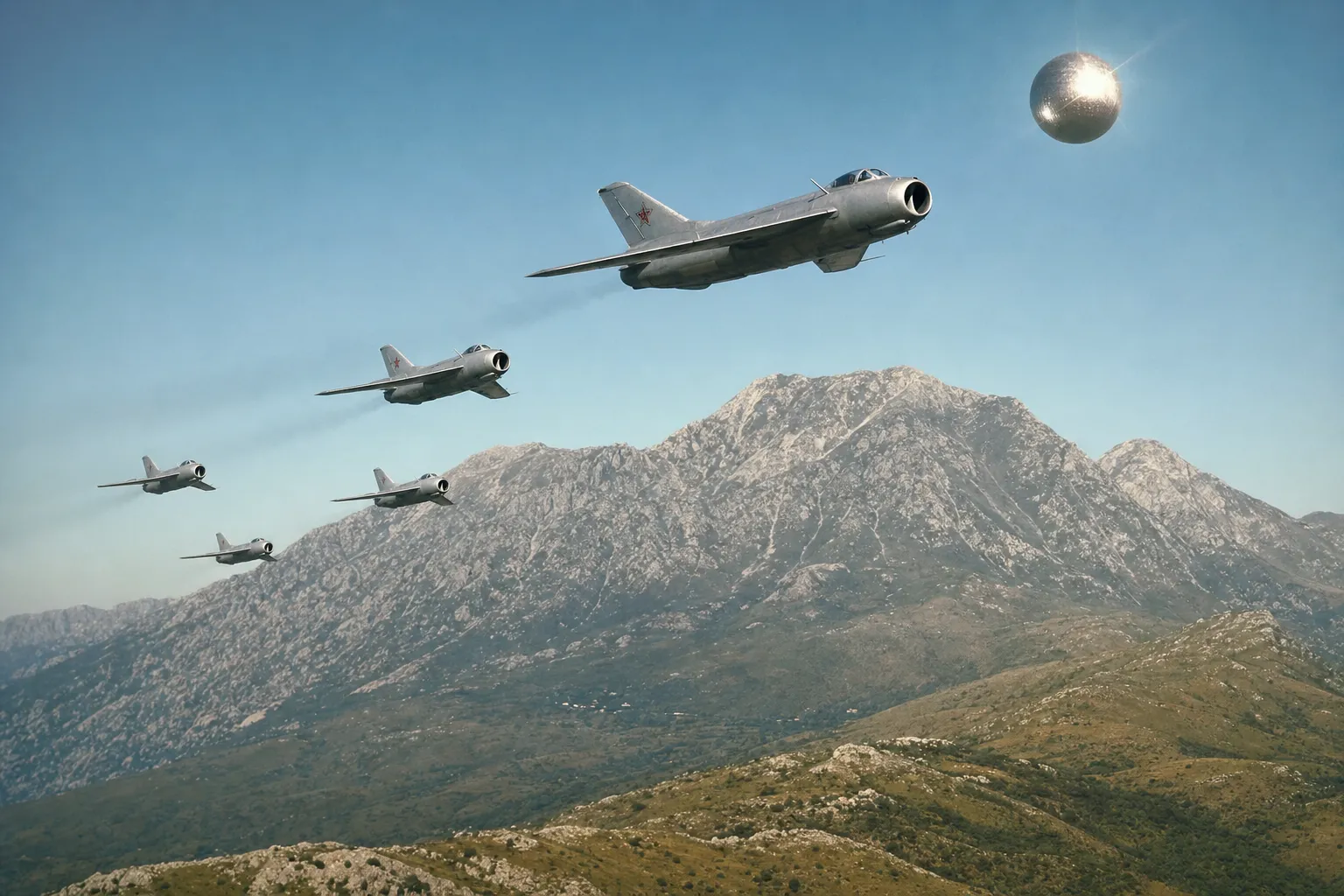
AI-rendered impression — Albanian Air Force MiG-19 fighter jets over Mount Tomorr, Skrapar, pursuing a glittering spherical object during the early 1960s intercept that ended with one aircraft downed — UAP Archive / AI-generated (image generation pending API key)
Credibility Assessment
Low
Military WitnessMultiple WitnessesHistorical DocumentPhysical EvidenceOfficial Report
Event Description
Observed Shape
Sphere
Craft morphology

Non-Human Intelligence (NHI)
Reported Entities
No NHI encounter documented for this event.
Sometime in the early 1960s — most accounts identify approximately 1963, though exact date records remain classified or destroyed — five MiG-19 fighter jets of the Albanian People's Air Force were scrambled from Kuçova Military Airport in south-central Albania. Their target was an unidentified luminous object detected in the airspace above Mount Tomorr, a sacred 2,416-meter peak in Skrapar county. The object, described by the intercept pilots as a bright, glittering sphere, would trigger the most thoroughly suppressed UAP event in Albanian history — one that ended with a downed aircraft, a classified State Security investigation, and decades of enforced official silence under Enver Hoxha's isolationist regime.
The intercept was carried out by a full five-aircraft formation, meaning four additional military pilots were airborne witnesses to the event besides lead pilot Veiz Lamë. Lamë, from Skrapar county — the same district as Mount Tomorr — was the designated lead for the intercept. He maintained radio contact with the control tower at Kuçova Military Airport throughout the approach phase. The other four pilots, whose names have not entered the public record, later corroborated the visual sighting of the spherical object. Ground-based witnesses in the vicinity of the mountain reported seeing the MiG formation in pursuit of an anomalous object. Albanian State Security (Sigurimi i Shtetit) officers subsequently conducted a post-incident investigation, their findings summarized in internal documents submitted directly to Central Committee Secretary Hysni Kapo and Party official Gogo Nushi. The case was later partially documented by writer Ilir Malindi and novelist Ben Shehu, the latter having accessed documents from former State Security files.
Pilots in the formation reported a glittering, spherical object that appeared to be capable of sustained flight without visible propulsion. Its exact size was not established from surviving accounts, though witnesses described it as "dazzling" — sufficiently bright in the visible spectrum to temporarily impair normal vision. The object appeared to react to the aircraft's approach, maintaining separation from the intercept formation rather than following a fixed course. Veiz Lamë, as lead pilot, closed to the shortest distance and was in active radio contact with Kuçova control tower as he maneuvered for weapons release. Multiple pilots reported that the object disrupted onboard instruments — compasses and avionics — during close approach, consistent with electromagnetic interference patterns documented in other Cold War-era intercept cases. Communication with Lamë's aircraft was abruptly lost at the point at which he was ordered to open fire.
The most striking anomaly of this case is the physical condition of Lamë's recovered aircraft. When his MiG-19 was located on the slopes of Mount Tomorr, investigators found that the fuselage had been divided immediately behind the cockpit with an exceptionally clean cut — described by those who examined it as resembling the work of a precision cutting tool rather than the torn metal, fire, or impact deformation characteristic of conventional aerial accidents. The cockpit section was intact; the pilot was inside. Accounts diverge on whether Lamë survived the crash, but the nature of the fuselage damage — a straight, clean separation — is physically inconsistent with conventional MiG-19 failure modes, which include engine fire, structural fatigue, and aerodynamic breakup, all of which produce characteristic jagged or heat-damaged fractures. The simultaneous disruption of instruments across multiple aircraft during the approach phase — without any corresponding ground-based electromagnetic event — is also anomalous.
Multiple pilots in the formation reported instrument disruption during close approach to the object, specifically affecting navigational and communications systems. Lamë's own aircraft displayed the most severe physical consequence: the clean structural cut behind the cockpit. Ground witnesses described the sphere as emitting a light intense enough to be described as blinding at close range. There are no surviving radar records in the public domain; it is unknown whether Kuçova Military Airport's radar tracked the object independently of the pilots' visual reports, though the scramble order implies at minimum a radar or optical detection trigger.
The Albanian State Security service (Sigurimi i Shtetit) conducted the post-incident investigation and classified all findings. Reports were delivered to two of the highest figures in Hoxha's Albania: Central Committee Secretary Hysni Kapo and official Gogo Nushi. The investigation concluded that the object was not a NATO aircraft — a finding that carried significant weight given Albania's extreme Cold War isolation and its border proximity to Greece, a NATO member. The official finding thus specifically excluded the most politically convenient explanation. No public statement was ever issued. Albania's media was entirely state-controlled under Hoxha, and no domestic press coverage of the event appeared. The aircraft crash on Tomorr Mountain may have been attributed to pilot error or mechanical failure for any official records accessible to non-security personnel. Details only emerged through the post-communist period when former Sigurimi documents were partially accessed by researchers and writers.
Under Hoxha's government (1944–1985), Albania operated one of the most complete information-control systems in the world — more hermetically sealed than the Soviet Union. No independent verification of classified events was possible domestically. Witnesses from the military and Sigurimi who were privy to the incident would have been bound by state security obligations that carried the threat of imprisonment or execution for violations. The families of those involved received no public accounting of events. The suppression apparatus was the Albanian state itself; no specific disinformation narrative was required because information simply did not reach the public. Post-communist Albania's archives remain incomplete, and the specific Sigurimi documents cited in Ben Shehu's account have not been independently reproduced or verified by external researchers as of the time of writing.
The Mount Tomorr incident occupies a unique position in the Cold War UAP record. Albania under Hoxha was the most isolated country in Europe — more closed than Stalinist-era USSR — which means the documented features of this case cannot be attributed to Western intelligence fabrication or Cold War psychological operations designed to deceive the enemy. The case was reported to the top of the Albanian communist hierarchy and specifically cleared of NATO origin, making it a rare instance of a Warsaw Pact-adjacent state acknowledging, in internal documents, an anomalous aerial event that defied conventional identification. The physical evidence — the clean fuselage cut — is either the most compelling physical trace of a UAP intercept in the Cold War military record, or an extraordinary coincidence of metallurgical failure, and neither explanation has been established by any published analysis. As the Albanian state opens its archives, this case merits rigorous forensic and documentary re-examination.
5 Observables Detected
Instantaneous Acceleration
Hypersonic Velocity
Low Observability
Trans-Medium Travel
Anti-Gravity Lift
Suspicious Activity
Intelligence Agency
Cover-up Actions
Men in Black
Disinformation
Witness Suppression
Sources
mediaWikipedia — 'UFO sightings in Albania' (citing writer Ilir Malindi and Ben Shehu's book 'They Should Not Know')mediaMyUFOPhotos — 'Albania UFO Files (Disclosure Documents)' (citing Sigurimi documents referenced in post-communist accounts)mediaGrokipedia — 'UFO Sightings in Albania' (summarizing the Tomorr Mountain incident)