SightingCold War
Two Police Officers Observe Stationary Light for Three Consecutive Nights — Ammasalik, Greenland, 1983
October 21–23, 1983
Between Kulusuk and Kuummiit, Ammasalik, East Greenland
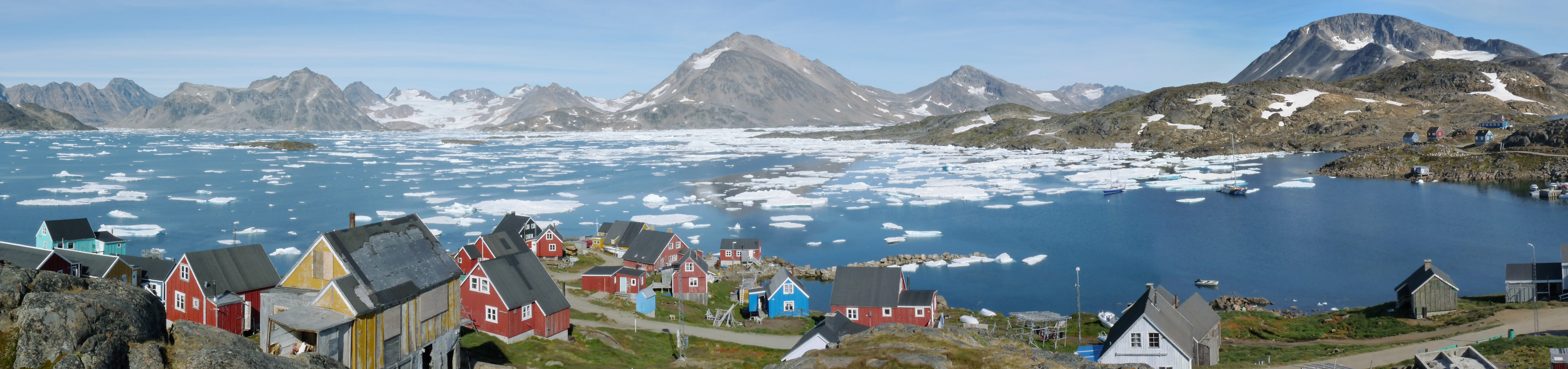
Kulusuk settlement, Ammasalik district, East Greenland — the area between Kulusuk and Kuummiit where two police officers observed a large stationary light for three consecutive nights in October 1983 — Wikimedia Commons / public domain
Credibility Assessment
Low
Law EnforcementMultiple WitnessesPhoto Evidence
Event Description
Observed Shape
Orb
Craft morphology

Non-Human Intelligence (NHI)
Reported Entities
No NHI encounter documented for this event.
In the third week of October 1983, the remote East Greenland coastal settlement of Ammasalik — an isolated Inuit community accessible only by sea or air, far from any major military installation — became the site of a three-night UAP encounter involving two on-duty police officers. On the night of October 21, the first officer transmitted a radio call to his colleague: "I see a UFO between Kulusuk and Kuummiit." This unambiguous report, made by a law enforcement officer in the field to a fellow officer, initiated an observation that would be independently corroborated by the second officer, repeated across three consecutive nights, and documented with photographs and film — photographic evidence that was subsequently absorbed into the Greenland military command structure and never returned.
The Ammasalik case is notable within the Danish Greenland UAP archive for its multi-night persistence, its two-witness law enforcement corroboration, and the specific chain of custody failure that removed physical evidence from the reporting channel. The case was documented in Danish UFO magazine Ufo-Nyt through access to Greenlandic police station records and was included in the corpus of Danish Air Force UAP-related documentation later reported by Sermitsiaq.AG.
Both witnesses were Greenlandic police officers, whose names were withheld in the published source. Greenlandic police in this period operated under a system in which local officers were responsible for vast geographic jurisdictions in an environment that demands exceptional practical judgment and situational awareness. Police officers are trained observers: they are specifically required to produce accurate, detailed reports, to note times and durations precisely, to assess whether natural or conventional explanations are available, and to distinguish genuine anomalies from everyday events. The first officer's radio call — immediately reporting the observation to a colleague rather than remaining silent — is consistent with professional conduct and with genuine uncertainty about the nature of what was seen. The second officer drove to the location to observe the phenomenon directly, providing independent corroboration at the scene rather than relying on his colleague's report alone. The fact that the phenomenon persisted across three consecutive nights, allowing both officers to observe it under the same conditions on multiple occasions, substantially reduces the probability of misidentification by either witness.
The observed phenomenon was a bright light located in the airspace between the communities of Kulusuk and Kuummiit, two small settlements separated by open East Greenlandic coastal terrain. The light was characterized as significantly larger and brighter than any star or planet visible in the October sky — a meaningful comparison in the context of East Greenland, where October nights are cold, clear, and free from the light pollution that compromises such comparisons at lower latitudes. The contrast between the object and the stellar background would have been easy to assess in the exceptional clarity of a Greenlandic autumn night. The phenomenon was stationary. It did not drift with the apparent motion of stars, did not fluctuate or scintillate as Venus or bright stars do near the horizon, and did not move along any trajectory consistent with a passing aircraft. It remained in place for approximately one hour on each of the three nights of observation before disappearing. The disappearance was abrupt rather than a gradual fade or movement over the horizon. This three-night repetition, with the phenomenon appearing in the same location each night and remaining for roughly the same duration, is a distinctive behavioral signature not consistent with natural or conventional explanations: aircraft do not park over remote Greenlandic coastlines for an hour each night; weather balloons drift; astronomical objects traverse predictable arcs; this object did none of those things. Photographs were taken and film negatives were exposed by the witnessing officers, creating a physical documentation record of the observation.
The primary anomaly is the combination of stationary behavior, extended duration, and three-night repetition. A hovering light source capable of remaining fixed in the sky for one hour in October over East Greenland in 1983 would require a powered aerial platform with endurance and station-keeping capability far beyond any known 1983 drone or remotely piloted vehicle. No search-and-rescue, naval, or meteorological airship operation was recorded in the area for those dates in available sources. The light's departure — described as disappearing rather than flying away — is consistent with rapid acceleration to a point beyond visible range or an instantaneous termination of luminosity, both of which are anomalous. The three-night pattern suggests either an artificial object engaged in systematic observation of the area, or a natural phenomenon with a precise 24-hour return cycle consistent with orbital mechanics — but no satellite of 1983 vintage produced a stationary, hours-long light at low apparent elevation over East Greenland.
No instrument effects were documented in the available record. The observations were purely visual. The only physical evidence produced was photographic: the officers took photographs and exposed film negatives during the sightings. These materials were subsequently submitted through official channels and lost to the public record, precluding any post-hoc photographic analysis.
The photographs and film negatives were submitted to police headquarters in Nuuk, the administrative capital of Greenland, following the standard police reporting protocol. From Nuuk headquarters, the materials were forwarded upward in the institutional chain to Greenland Command at Grønnedal — the Danish military headquarters responsible for Greenlandic territorial defense. At that point the trail goes cold. The photographs were never returned to the Danish UFO magazine that reported the case, and there is no indication they were returned to the reporting officers. No official analysis of the photographs was ever published. Greenland Command issued no public statement about the case.
The permanent retention of the photographic evidence by Greenland Command constitutes a documented case of official document suppression. The photographs and film negatives were the only physical evidence produced by the three-night observation. Their submission to military authority and subsequent non-return removed from the public domain the one piece of evidence capable of providing objective, instrument-based analysis of what the officers saw. The mechanism is not necessarily conspiratorial — military bureaucracies routinely classify and retain materials without deliberate intent to deceive — but the practical effect is indistinguishable from intentional suppression: the physical evidence record of this event does not exist in any publicly accessible form. The Danish UFO community documented this chain-of-custody failure when reporting the case. No FOIA-equivalent request has recovered the materials from Danish or Greenlandic military archives.
The Ammasalik case contributes two elements to the broader UAP record that are independently significant. First, it adds to a pattern of UAP activity over East Greenland in the Cold War period — a region that, while remote from the Soviet-American confrontation axis, lies along polar routes of strategic importance. Second, and more broadly, it provides a documented instance of photographic evidence moving into a military institutional channel and failing to return — a pattern that recurs in UAP cases across multiple national jurisdictions and that represents one of the most concrete mechanisms by which physical evidence of anomalous phenomena is removed from independent scientific scrutiny. The case has not been resolved, and the photographs remain unlocated.
5 Observables Detected
Instantaneous Acceleration
Hypersonic Velocity
Low Observability
Trans-Medium Travel
Anti-Gravity Lift
Suspicious Activity
Intelligence Agency
Cover-up Actions
Men in Black
Disinformation
Witness Suppression
Sources
governmentDanish UFO magazine Ufo-Nyt via Greenlandic police station records (Danish UFO archive)
mediaSermitsiaq.AG — Greenlandic news report referencing the Ammasalik 1983 case