SightingCold War
Soviet Air Defence Radar Intercept — Yerevan, Armenia, 1977
c. 1977
Yerevan, Armenian SSR, USSR
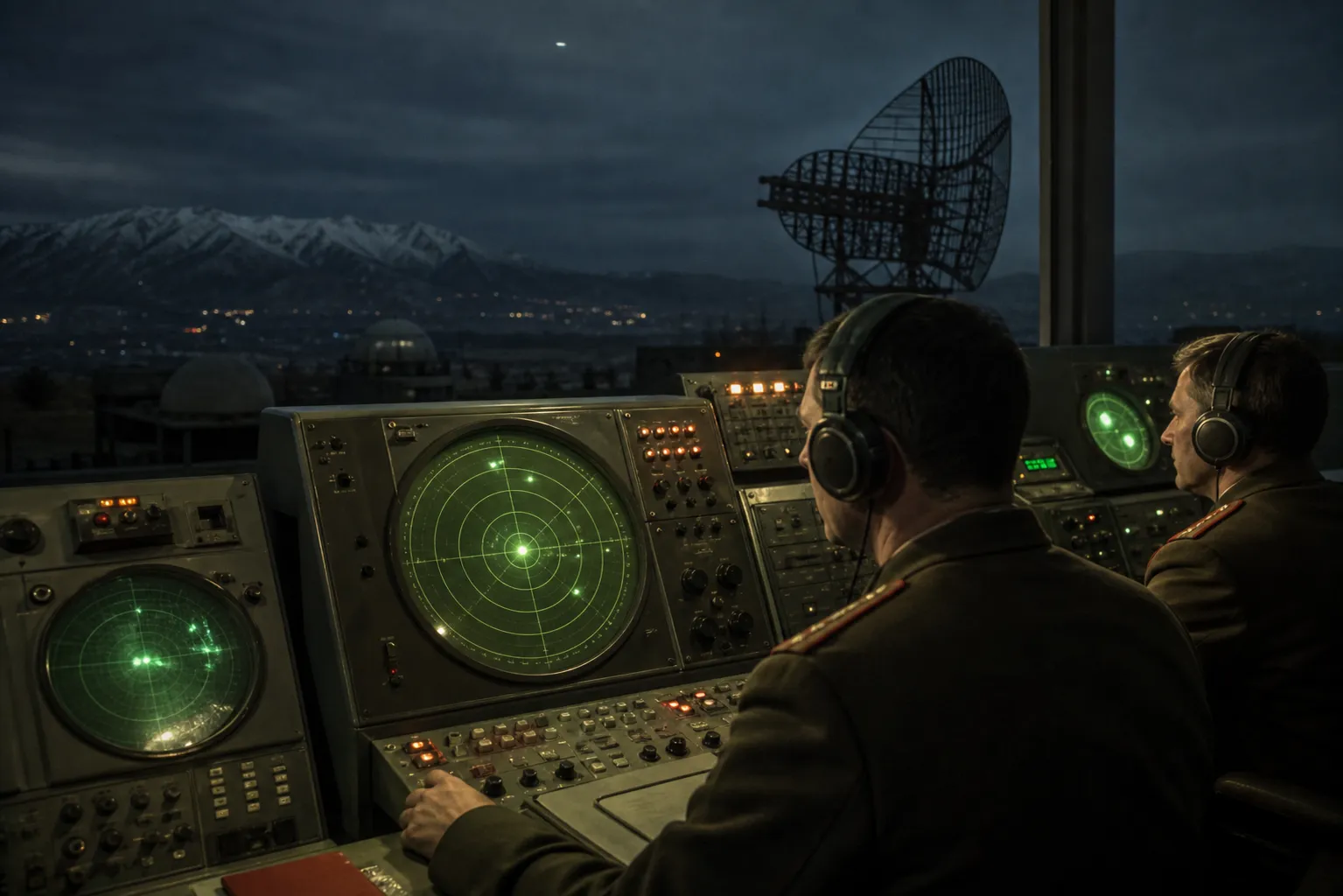
AI-rendered impression — Soviet Air Defence Forces radar operators at a PVO station near Yerevan, Armenian SSR, tracking a large unidentified aerial object on multiple radar systems along the sensitive NATO-Turkey border, 1977 — UAP Archive / openai (gpt-image-1)
Credibility Assessment
Moderate
Military WitnessMultiple WitnessesRadar CorroboratedOfficial Report
Event Description
Observed Shape
Disc
Craft morphology

Non-Human Intelligence (NHI)
Reported Entities
No NHI encounter documented for this event.
The Armenian Soviet Socialist Republic in 1977 occupied one of the most strategically sensitive positions in the entire Soviet Union. Bordering Turkey — a NATO member with substantial U.S. military facilities including radar stations and nuclear weapons storage — and Iran to the south, the Armenian SSR was covered by a dense layer of Soviet Air Defence Forces (PVO Strany) radar installations. Any unidentified aerial contact over Armenian airspace was processed not merely as an anomaly but as a potential NATO incursion or reconnaissance overflight — an event warranting immediate escalation to the highest command levels. It is within this context of maximum radar vigilance and institutional hair-trigger alert that the 1977 Yerevan incident must be understood.
Soviet Air Defence Forces radar operators — trained on the most sophisticated Soviet early-warning and tracking radar systems of the period, including the P-14 Lena and PRV-11 height-finding radars — tracked the object across multiple stations. The military discipline of Soviet PVO units was among the most rigorous in the Soviet armed forces; operators who filed anomalous reports did so under the knowledge that false reports or reporting failures had severe consequences. Visual confirmation was provided by at least two officers at an air defence command post who observed the object through optical instruments when it descended to visible altitude. The incident was reported up the PVO chain of command to the regional headquarters and subsequently to the Ministry of Defence's special UAP investigation unit, established under the scientific oversight of Dr. Felix Zigel of the Moscow Aviation Institute and formalized as the SETKA programme in 1978.
The object appeared as a large, stable radar return that did not correspond to any scheduled flight, military exercise, or known atmospheric target. It was described by visual observers as disc-shaped or lens-shaped, with a diffuse luminescence visible at altitude. The object executed heading changes that were inconsistent with any aircraft in the Soviet or NATO inventory at the time, including the Mach-3+ MiG-25 interceptor. Witnesses described the object as substantially larger than a conventional aircraft — radar returns suggested an object of 50–100 metres or larger, though the uncertainty of radar size estimation was acknowledged.
The object's flight profile — sudden directional changes without deceleration, altitude transitions exceeding any known aircraft's rate of climb or descent, and static hovering at high altitude — constituted the primary anomalies. Soviet PVO doctrine required that any unidentified contact be classified as either a NATO aircraft, a Soviet aircraft off-course, or an unknown. The first two categories were definitively excluded through coordination with Soviet Air Force flight control and intelligence. The contact was therefore formally classified as unknown — the most consequential designation available in PVO operational protocol, triggering a multi-level investigation. The absence of any transponder signal, radio communication, or exhaust signature from an object that produced a substantial radar return was also anomalous.
Multi-radar confirmation from geographically separated stations is the primary instrument record. The object appeared on both search radar and height-finding radar, providing three-dimensional tracking data. No communications interference or electronics disruption is documented in available sources. The correlation between the independent radar tracks and the visual observation from the command post established the object as a genuine physical phenomenon rather than a single-system artifact.
The incident was reported through PVO channels to the Ministry of Defence in Moscow and entered the classified investigation system that would be formalized as SETKA (and its civilian component GALAKTIKA) the following year. SETKA, run under the auspices of the Soviet Academy of Sciences and the Ministry of Defence, collected over 3,000 military UAP reports between 1978 and 1990. After the Soviet collapse, portions of the SETKA files were made available to Russian researchers and foreign investigators. The Armenian SSR incident entered this archive as a confirmed radar-visual case without conventional explanation.
Soviet UAP investigation was conducted at the highest classification levels. SETKA was classified Top Secret, and personnel involved in reporting were bound by military secrecy obligations. Public disclosure of anomalous aerial events — particularly over strategically sensitive border regions — was prohibited. The proximity of the Armenian SSR to NATO Turkey meant that acknowledging unknown aerial phenomena over this border region would have had geopolitical implications the Soviet military had no interest in advertising. After 1991, glasnost and the collapse of Soviet classification structures allowed partial disclosure, but the full SETKA archive has never been comprehensively released.
The 1977 Yerevan incident is significant for three reasons. First, the Armenian SSR's strategic border position meant that Soviet radar coverage in this region was among the most intense in the USSR — an unidentified object surviving multiple classification attempts in this environment is a genuinely anomalous datum. Second, the case was processed by the same Soviet military infrastructure that produced the SETKA programme's most thoroughly documented cases, meaning it was evaluated by professional scientists and military analysts rather than dismissed. Third, the case contributes to the documented pattern of 1977 Soviet UAP activity that included the famous Petrozavodsk jellyfish event and several other classified military encounters — establishing that 1977 was as significant for Soviet military UAP observation as 1952 was for the U.S.
5 Observables Detected
Instantaneous Acceleration
Hypersonic Velocity
Low Observability
Trans-Medium Travel
Anti-Gravity Lift
Suspicious Activity
Intelligence Agency
Cover-up Actions
Men in Black
Disinformation
Witness Suppression
Sources
governmentSETKA programme files — Soviet Ministry of Defence UAP investigation archive, partially released post-1991 (referenced in Paul Stonehill & Philip Mantle, 'Russia's USO Secrets')
mediaPaul Stonehill & Philip Mantle, 'Russia's USO Secrets' (2010) — documents Soviet PVO radar UAP contacts in border republics
mediaFelix Zigel (Moscow Aviation Institute) — published summary of Soviet military UAP classification categories, 1979 (samizdat)