Crash / RetrievalCold War
Aztec UFO Crash
March 25, 1948
Hart Canyon, Aztec, New Mexico, USA
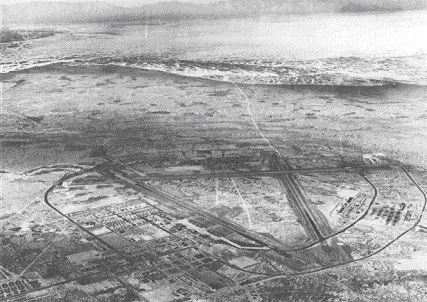
Holloman Air Force Base, New Mexico, 1944 — the Four Corners region of New Mexico was the setting for multiple early Cold War UAP reports including the 1948 Aztec case — US Air Force / Public Domain
Credibility Assessment
Anecdotal
Multiple Witnesses
Event Description
Observed Shape
Disc
Craft morphology

Non-Human Intelligence (NHI)
Reported Entities
Unknown

16 BeingsObserved
Sixteen small humanoid bodies approximately 36-42 inches tall found charred inside the craft. NOTE: This case is a documented hoax — Newton and Gebauer were convicted of fraud.
In late March 1948 — approximately nine months after the Roswell incident — a story began circulating within certain intelligence and aviation circles that a second crash-retrieval event had occurred near Aztec, New Mexico, a small town in San Juan County in the Four Corners region. The account described a structured craft approximately 100 feet in diameter that had come to rest on a flat mesa outside town, with 16 small humanoid bodies recovered, and the craft subsequently transported to Wright-Patterson Air Force Base for study.
The primary sources were Silas Newton, an oil prospector with a colorful background, and Leo GeBauer, who represented themselves to researcher Frank Scully as possessing inside government knowledge of the recovery. Scully published the account in his 1950 book 'Behind the Flying Saucers' — the first commercially published book to describe in detail the alleged recovery of a crashed craft and non-human bodies. The book reached a mass audience and established a narrative template that would recur in UAP crash-retrieval claims for decades.
Subsequent investigation by True magazine reporter J.P. Cahn revealed that Newton and GeBauer were operating an oil field equipment fraud scheme and had fabricated technical details of their account — including the fictitious scientific credentials they claimed. The Aztec case was effectively destroyed as an evidential claim and largely dismissed by researchers for decades. Its primary sources had been demonstrably unreliable, and Cahn's exposé stood as one of journalism's cleaner UAP debunkings.
However, in the 1980s and 1990s, researchers William Steinman and Wendelle Stevens conducted new investigations, locating additional alleged witnesses including William Murphy, who claimed first-hand knowledge of the recovery independent of Newton and GeBauer. The Aztec case was revisited at length by journalist and author Scott and Suzanne Ramsey, whose multi-decade investigation identified what they regarded as corroborating testimony from individuals with no connection to the original sources. The case remains genuinely contested: its original sources were fraudsters, but the specificity of the account — predating similar claims by alleged government insiders by decades — has kept it under active scholarly examination.
5 Observables Detected
Instantaneous Acceleration
Hypersonic Velocity
Low Observability
Trans-Medium Travel
Anti-Gravity Lift
Suspicious Activity
Intelligence Agency
Cover-up Actions
Men in Black
Disinformation
Witness Suppression
Sources
mediaFrank Scully, Behind the Flying Saucers (1950) — primary published account
mediaJ.P. Cahn, San Francisco Chronicle (1952–53) — debunking investigation; metal sample = common aluminum
governmentColorado court conviction: Newton and Gebauer, fraud and conspiracy, December 1953