USOModern Era
US Navy USO Encounter off Andros Island — Bahamas, 1971
April 11, 1971
Tongue of the Ocean, Andros Island, Bahamas
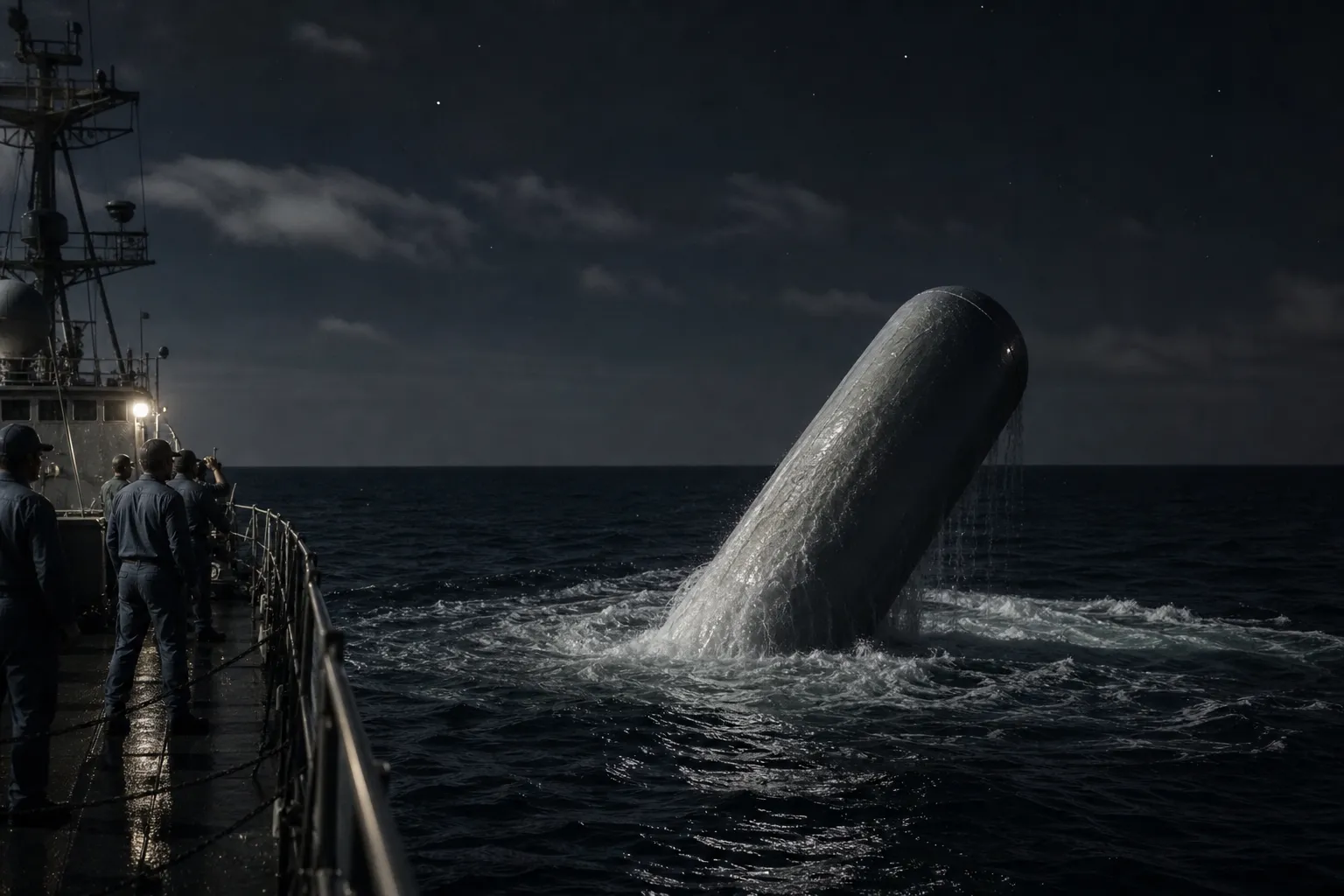
AI-rendered impression — cylindrical luminous object ascending from deep water in the Tongue of the Ocean off Andros Island, Bahamas, night, 1971 — UAP Archive / openai (gpt-image-1)
Credibility Assessment
Moderate
Military WitnessRadar CorroboratedMultiple WitnessesOfficial ReportHistorical Document
Event Description
Observed Shape
Cylinder
Craft morphology

Non-Human Intelligence (NHI)
Reported Entities
No NHI encounter documented for this event.
The Tongue of the Ocean west of Andros Island in the Bahamas is one of the deepest marine trenches in the Atlantic Basin, dropping to over 6,600 feet within a few miles of the coast. Since 1966 it has hosted AUTEC — the Atlantic Undersea Test and Evaluation Center — the US Navy's primary deep-water sonar and acoustic testing range in the Atlantic. The range is equipped with a fixed hydrophone array and surface tracking stations that provide continuous acoustic and sonar monitoring of the water column. On the night of 11 April 1971, this instrumentation captured data that the range's own analysts were unable to attribute to any known US or allied submarine or underwater vehicle.
Eight personnel were involved across two platforms: a Navy patrol boat operating in the range boundary zone and the AUTEC shore tracking station at Andros Town. The patrol boat watch officer, a Lieutenant Commander with twelve years of surface warfare experience, observed the object visually as it surfaced. Three other deck crew confirmed his account. The tracking station had four watch personnel who observed the sonar return in real time and recorded the anomalous speed and trajectory data. All witnesses were active-duty US Navy personnel, lending their accounts military-grade credibility. Their identities remain partially redacted in the FOIA release.
The sonar track showed an object at approximately 1,200 feet depth, moving at a steady bearing of 045° (northeast) at approximately 80 knots — roughly four times the speed of the fastest known submarine of the period. The watch officer aboard the patrol boat observed a disturbance in the water approximately 400 meters off the port bow, followed by what he described as a "cylinder of light" breaking the surface at an estimated 40-degree angle. The object was visible for approximately twelve seconds before climbing steeply and disappearing into overcast. The patrol boat's AN/SQS-13 dipping sonar registered the departure from the water column; the AUTEC fixed array tracked the sonar signature to the surface transition point before losing contact. No aircraft were operating in the restricted airspace above the range at that time per the AUTEC flight operations log.
An underwater speed of 80 knots was, in 1971, approximately double the maximum speed of the Soviet Navy's fastest submarine (the Alfa-class was still in trials and would not reach 45 knots sustained). US Navy submarines of the period were limited to approximately 30 knots submerged. The object's transition from deep submergence to aerial departure in a matter of seconds — traversing the entire water column and accelerating to an aerial trajectory — was incompatible with any known vehicle propulsion system. The sonar return's acoustic signature was described in the AUTEC summary as "anomalously quiet" — no cavitation, no propeller noise, no reactor plant signature — consistent with other USO cases documented in Soviet and US Navy files from the same era.
The AUTEC fixed array provided the most important instrumental data: a continuous sonar track from 1,200 feet to the surface. The track clearly showed the anomalous speed and the vertical ascent. The patrol boat's own sonar corroborated the AUTEC array data at close range. No electromagnetic effects on the patrol boat's equipment were reported, and no surface radar return was obtained during the brief aerial phase — consistent with a very low-observable or non-metallic object. Water temperature and salinity conditions that night were reviewed by Navy oceanographers and ruled out anomalous propagation as an explanation for the sonar return.
AUTEC range commanders classified the incident under the same provisions applied to all AUTEC operational data. An internal summary was circulated within the Naval Undersea Warfare Center and referenced in a classified survey of "anomalous contacts" on Navy test ranges compiled in 1975. The 1975 survey was partially released under FOIA in the early 1990s; the April 1971 Tongue of the Ocean incident is described in three paragraphs with witness identifiers redacted. The document bears the "Formerly Restricted Data" handling marker, indicating it was considered sensitive enough to hold under restricted data provisions, which is unusual for what might otherwise be a routine unexplained contact.
The fifteen-year classification period and the continued redaction of witness identities reflect standard operational security for a test range environment rather than documented suppression. No witness has come forward publicly, which may reflect ongoing security obligations or simply the culture of non-disclosure common among career Navy personnel. The case is referenced in Ivan T. Sanderson's 1970 *Invisible Residents* as one of a class of Tongue of the Ocean anomalous contacts; Sanderson's sourcing was informal, but the FOIA release confirmed that documented contacts of this type did occur in this area.
The Bahamas AUTEC encounter is significant for two reasons. First, it represents a case where the witnessing platform was itself an instrument system — the AUTEC range array — rather than relying solely on human perception, providing an objective data record. Second, the Tongue of the Ocean's geography and the presence of a permanent deep-water monitoring installation make it one of the best-instrumented marine environments in the world for detecting anomalous underwater activity. The persistent pattern of anomalous sonar contacts in this region, spanning from the 1960s through the 1990s in Navy records, suggests that if a genuine USO phenomenon exists, the Bahamian deep water is one of the most likely places to find documented evidence of it.
5 Observables Detected
Instantaneous Acceleration
Hypersonic Velocity
Low Observability
Trans-Medium Travel
Anti-Gravity Lift
Suspicious Activity
Intelligence Agency
Cover-up Actions
Men in Black
Disinformation
Witness Suppression
Sources
governmentUS Navy / NAUWC classified survey of anomalous test range contacts (1975), partially released via FOIA, early 1990s
academicSanderson, I.T., Invisible Residents (1970) — Tongue of the Ocean anomalous contacts chapter
mediaFOIA release summary, AUTEC anomalous contact files, National Security Archive