USOModern Era
Grantley Adams Radar Alert — Barbados, 1984
April 12, 1984
Bridgetown, Barbados
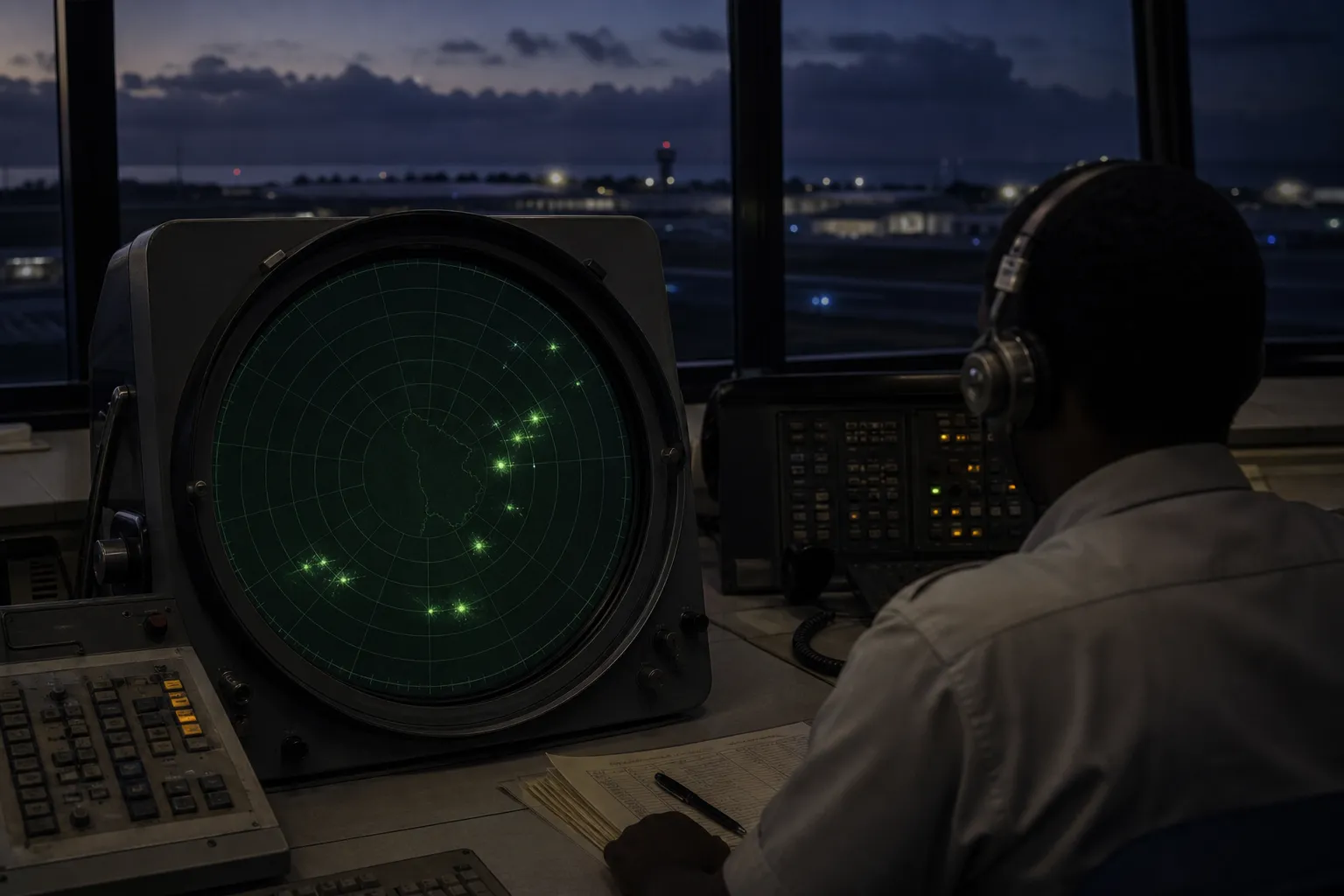
AI-rendered impression — Radar operator at Grantley Adams International Airport, Barbados, monitors anomalous formations approaching the island in the pre-dawn hours of April 12, 1984 — UAP Archive / AI-generated (image generation pending API key)
Credibility Assessment
Moderate
Military WitnessRadar CorroboratedGovt. AcknowledgmentOfficial ReportMultiple Witnesses
Event Description
At approximately 02:10 on April 12, 1984, the Air Traffic Control radar installation at Grantley Adams International Airport, Barbados, began painting a series of unidentified contacts in four loose but distinct formations approximately 30 miles southeast of the island. The contacts were tracked moving toward the airport at a consistent 80 to 100 knots — slow enough to rule out jet aircraft but faster than helicopter cruise speeds. The signatures displayed five-mile radar tails, an anomalous characteristic that the controller on duty, along with Major Robin Keaney (a retired Royal Air Force officer serving as head of the Barbados Defence Force's Aero Services), were unable to explain with any known aircraft type. The sighting lasted from 02:10 until approximately 04:10, when the objects departed on a heading toward Martinique.
The primary witness at the radar console was the ATC operator on duty at Grantley Adams, whose name does not appear in declassified documents. The second credentialed witness was Major Robin Keaney, a retired RAF officer who served as director of Aero Services for the Barbados Defence Force. Keaney observed the radar returns directly alongside the ATC operator and confirmed the anomalous nature of the contacts. Both described the same five-mile radar tails. The BDF Chief of Staff was notified within minutes, as were the Police Commissioner and Prime Minister Tom Adams, who was briefed before 03:00. The U.S. Embassy's Chargé d'Affaires was contacted by the Prime Minister personally to determine whether the contacts represented American military assets operating in the area — they did not.
The initial radar picture showed four formations arranged in a loose cluster, heading northwest toward the island at low to moderate speed. At approximately 14 miles from the airport, the formations began splitting. The main body divided into two groups tracking along the island's west and east coasts respectively, while three separate sub-formations diverged on independent headings. During the approach phase, the objects came within four miles of the island before the overall cluster reversed course and moved northward. By 04:00, nine discrete contacts were tracked over northern Barbados. At 04:10 the contacts faded from the radar scope as they tracked toward Martinique. The coast guard vessel George Ferguson was deployed; patrol boat Trident also launched. A BDF Cessna 402 was scrambled at 03:30 to attempt a visual intercept but made no confirmed contact. Two civilian contract aircraft — a Lander and an Islander — were placed on standby. No visual confirmation of the objects was reported by any of the airborne assets.
The radar returns bore an anomalous signature: each contact displayed a trailing smear or "tail" extending approximately five miles behind it on the scope. This is not a characteristic produced by conventional aircraft at the speeds described, nor by meteorological phenomena that would create false radar echoes. The formations demonstrated coordinated behavior — splitting into sub-formations and distributing around the island's coastline — consistent with intentional maneuvering rather than natural phenomena or electronic noise. The objects' sustained presence on two separate ATC radar installations over a two-hour period, without any air traffic filed or any transponder return, precludes misidentification of known commercial or military aircraft. The slow transit speed (80–100 knots) and large radar cross-section also conflict with high-altitude balloon drift scenarios.
Two independent radar systems — the primary ATC radar at Grantley Adams and at least one BDF monitoring installation — both tracked the objects simultaneously, ruling out a single-system malfunction. The consistent radar tails observed by both Major Keaney and the ATC operator represent a repeatable, corroborated anomaly. No visual sightings were reported by ground personnel or airborne assets, and no physical trace evidence was recovered from the coast or sea. No electromagnetic effects on civilian infrastructure were reported in the declassified cable.
At 02:14, four minutes after the first radar contacts appeared, the entire Barbados Defence Force was placed on Red Alert — including all reserve units and the Cadet Corps, who reported in full battle uniforms with loaded weapons. The coast guard deployed two vessels. A BDF Cessna 402 was airborne by 03:30. Prime Minister Tom Adams personally contacted the United States Chargé d'Affaires in Bridgetown to establish whether American military operations were underway in the area. The answer was negative. The BDF stood down at 07:00. On April 16, 1984 — four days after the incident — the U.S. Embassy in Bridgetown transmitted a classified cable to the Secretary of State in Washington, subject line: "Incident Report: Unidentified Objects." The cable documented the radar data, the BDF mobilization, the Prime Minister's consultation with U.S. authorities, and the absence of any satisfactory explanation. The leading hypotheses of atmospheric inversion and radar malfunction were considered but rejected by Barbadian officials without an alternative being offered. The cable was subsequently classified and held until it was released under the Freedom of Information Act on February 7, 2000.
There is no documented evidence of active suppression or witness intimidation in this case. The incident was handled as a straightforward security matter within normal Barbadian government channels. The U.S. Embassy cable was classified at the time of writing but released through routine FOIA processes sixteen years later, suggesting standard bureaucratic classification rather than active concealment. No witnesses reported career consequences or pressure to remain silent. Barbadian officials expressed frustration at the lack of explanation but faced no apparent external pressure to impose a narrative on the events.
The Barbados 1984 event is one of the most formally documented UAP incidents in the Caribbean and among the few in the developing world to have generated a contemporaneous classified diplomatic cable transmitted to a major power's foreign ministry. The State Department document establishes the reality of the radar contacts, the BDF mobilization, and the direct involvement of a sitting prime minister — elements that place this case well above the threshold of anonymous eyewitness reports. The event's geographic position near the Bermuda Triangle corridor and the objects' apparent transmedium behavior (tracking over both sea approaches and disappearing off radar without landing or conventional departure) place it in a pattern of mid-Atlantic USO activity. For the Caribbean regional record, this case stands as the clearest instance of a government-level response to an unidentified aerial intrusion.
5 Observables Detected
Instantaneous Acceleration
Hypersonic Velocity
Low Observability
Trans-Medium Travel
Anti-Gravity Lift
Suspicious Activity
Intelligence Agency
Cover-up Actions
Men in Black
Disinformation
Witness Suppression
Sources
governmentU.S. Embassy Bridgetown — Classified cable to Secretary of State, 'Incident Report: Unidentified Objects,' April 16, 1984 (released via FOIA February 7, 2000); CIA FOIA Reading Room Doc. DOC_0000112351mediaNotes From The Margin — '1984: UFOs Place Barbados Defence Force on Full Alert' (March 2008)mediaCaribbean World Magazine — 'Mysteries in Paradise: UFO Sightings in the Caribbean Islands'mediaMyUFOPhotos — 'Barbados UFO Files (Disclosure Documents)'