SightingCold War
Belgian UFO Wave
Nov 1989–Apr 1990
Belgium
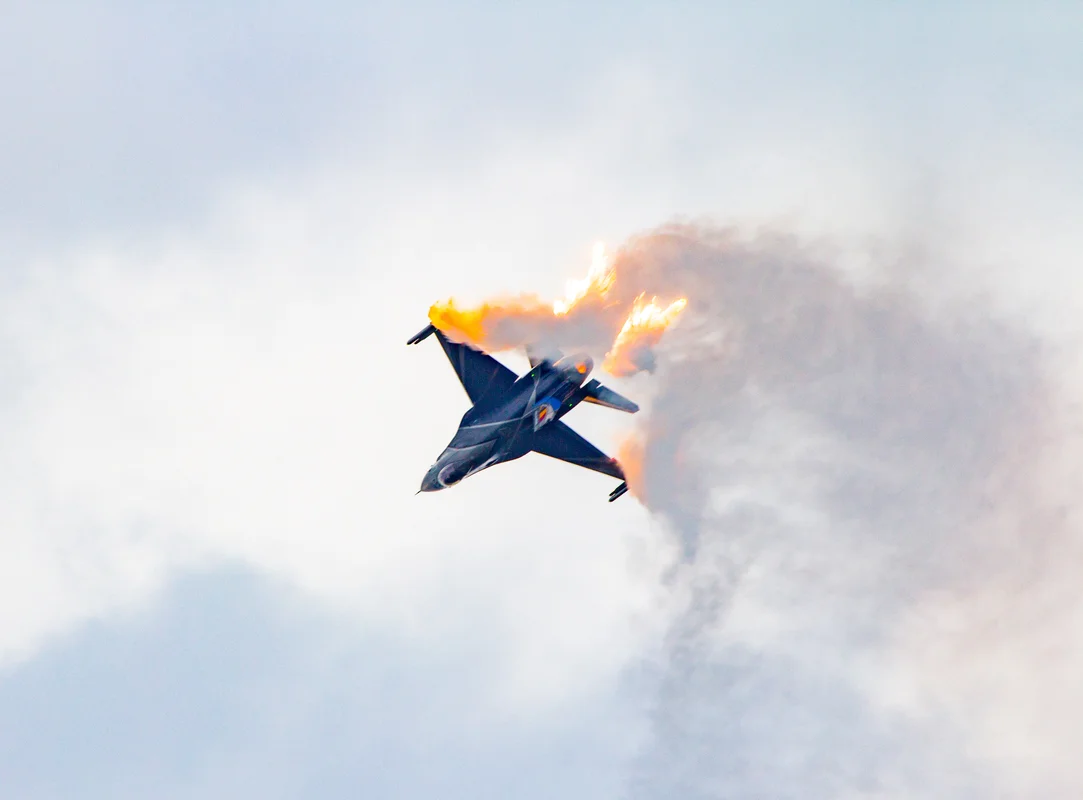
Belgian Air Force F-16 fighter jet, the type scrambled to intercept UFOs during the 1989–1990 Belgian Wave — Wikimedia Commons / Public Domain
Credibility Assessment
Exceptional
Military WitnessMultiple WitnessesRadar CorroboratedPhoto EvidenceOfficial ReportGovt. Acknowledgment
Event Description
Observed Shape
Triangle
Craft morphology

Non-Human Intelligence (NHI)
Reported Entities
No NHI encounter documented for this event.
The Belgian UFO Wave began on the evening of November 29, 1989, when approximately 140 witnesses including 13 police officers across the Liège region observed a large, silent, triangular craft with brilliant white lights at each apex and a central red pulsating light. The craft moved slowly — under 40 mph — at low altitude and made no sound. The Belgian Gendarmerie filed official reports. Over the following months, the Belgian Air Force received over 2,600 official reports from members of the public, police, and military personnel.
The most significant military engagement occurred on the night of March 30–31, 1990, when the Belgian Air Force scrambled two F-16 Fighting Falcon jets based at Beauvechain Air Base. Ground radar at Glons and Semmerzake tracked three anomalous targets. The F-16s achieved radar lock on one of the objects on nine separate occasions. Each time a lock was established, the object performed extreme evasive maneuvers: within 2 seconds it accelerated from approximately 280 km/h to over 1,800 km/h, dropped from 3,000 meters to 1,500 meters, then to 200 meters — performing changes in velocity that would generate forces exceeding 40G, far beyond human or conventional aircraft tolerance. The F-16 pilots never achieved visual contact; the radar returns suggested an object smaller than a conventional aircraft.
Brigadier General Wilfried De Brouwer of the Belgian Air Force held an extraordinary press conference on July 11, 1990, releasing the F-16 radar data to the public and confirming that the Belgian Air Force had engaged unidentified objects that performed maneuvers outside the capability of any known aircraft. He stated: 'The day will come undoubtedly that the phenomenon will be observed with technological means of detection and collection of data such that a precise and definitive explanation will be possible.' De Brouwer remained a publicly credible voice on the subject for the remainder of his career.
The Belgian UFO Wave involved the largest number of official government witnesses of any UAP event on record. The Belgian Air Force never officially explained the objects. In 1993, Sociedad de Investigation SOBEPS published a two-volume scientific analysis of the wave in cooperation with Belgian academic institutions. The Petit-Rechain photograph, widely circulated as evidence, was admitted as a hoax in 2011 by its creator — however, this has no bearing on the thousands of independent witness reports or the F-16 radar data, both of which remain officially unresolved.
5 Observables Detected
Instantaneous Acceleration
Hypersonic Velocity
Low Observability
Trans-Medium Travel
Anti-Gravity Lift
Suspicious Activity
Intelligence Agency
Cover-up Actions
Men in Black
Disinformation
Witness Suppression