Close EncounterCold War
Byelokoroviche ICBM Activation Incident
Oct 4, 1982
Byelokoroviche, Zhytomyr Oblast, Ukraine
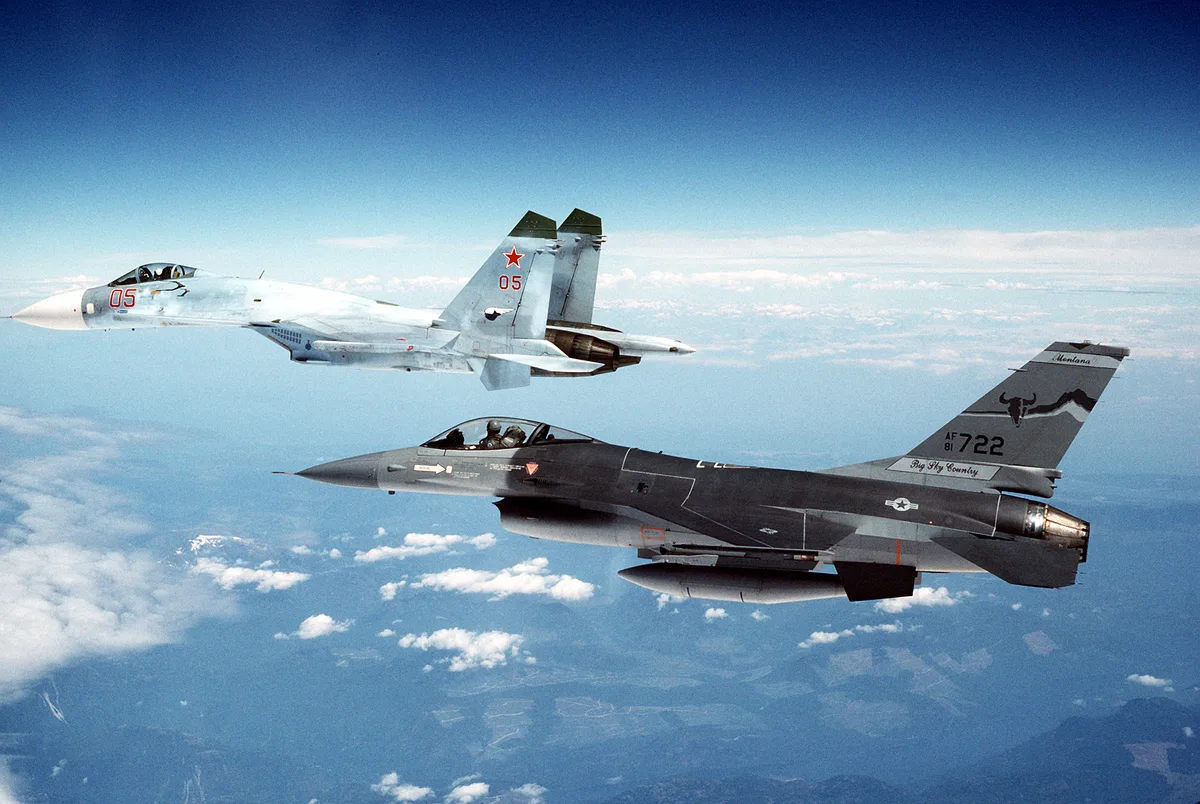
Soviet Su-27 interceptor alongside a NATO F-16 — the Byelokoroviche base was home to SS-18 ICBMs; jet interceptors were not scrambled during the incident — US DoD / Public Domain
Credibility Assessment
High
Military WitnessMultiple WitnessesOfficial ReportGovt. Acknowledgment
Event Description
Observed Shape
Sphere
Craft morphology

Non-Human Intelligence (NHI)
Reported Entities
No NHI encounter documented for this event.
On October 4, 1982, at a Soviet strategic missile base near Byelokoroviche in the Ukrainian Soviet Socialist Republic, personnel stationed at the facility observed a large disc-shaped craft hovering at low altitude above the installation. The base housed SS-18 Satan intercontinental ballistic missiles — each capable of delivering ten independently targeted nuclear warheads with yields up to 750 kilotons, making the facility one of the most dangerous single points in the Soviet nuclear arsenal.
During the observation period, which lasted several minutes, automated systems at the missile launch control facility began detecting unauthorized command sequences cycling through the ICBM launch system. Launch preparation commands advanced through automated stages without any human input from the duty crew — moving the launch sequence toward an authorized fire command. The duty officer and crew attempted to override the system and were unable to do so for a period of tense seconds during which the sequence continued to advance. The unauthorized sequence terminated on its own before reaching the point of actual missile launch. Simultaneously, outside observers reported the disc-shaped object positioned directly above the facility.
The incident was classified immediately at the highest levels of Soviet military security and remained secret throughout the Cold War and Soviet period. It first became publicly known through post-Soviet disclosures by former Soviet military officers in interviews conducted by Russian investigative journalists in the 1990s. Subsequent reporting confirmed the incident's basic structure through multiple independent former military sources.
The structural parallel to the 1967 Malmstrom Air Force Base incident — where the simultaneous appearance of a UAP above the facility coincided with the unauthorized shutdown of ten Minuteman ICBM launch systems — is precise and chilling. Where the Malmstrom event involved apparent deactivation, Byelokoroviche involved apparent activation: an unauthorized launch sequence initiated without human command and terminated without human intervention. The Byelokoroviche incident represents arguably the most dangerous known interaction between an unidentified aerial phenomenon and nuclear weapons systems, and occurred at the height of Cold War nuclear tension during a year in which the Soviet nuclear alert posture was at its most elevated since the Cuban Missile Crisis.
5 Observables Detected
Instantaneous Acceleration
Hypersonic Velocity
Low Observability
Trans-Medium Travel
Anti-Gravity Lift
Suspicious Activity
Intelligence Agency
Cover-up Actions
Men in Black
Disinformation
Witness Suppression