SightingCold War
French Military Observer UAP Report — Yaoundé, Cameroon, 1968
c. 1968
Yaoundé, Cameroon
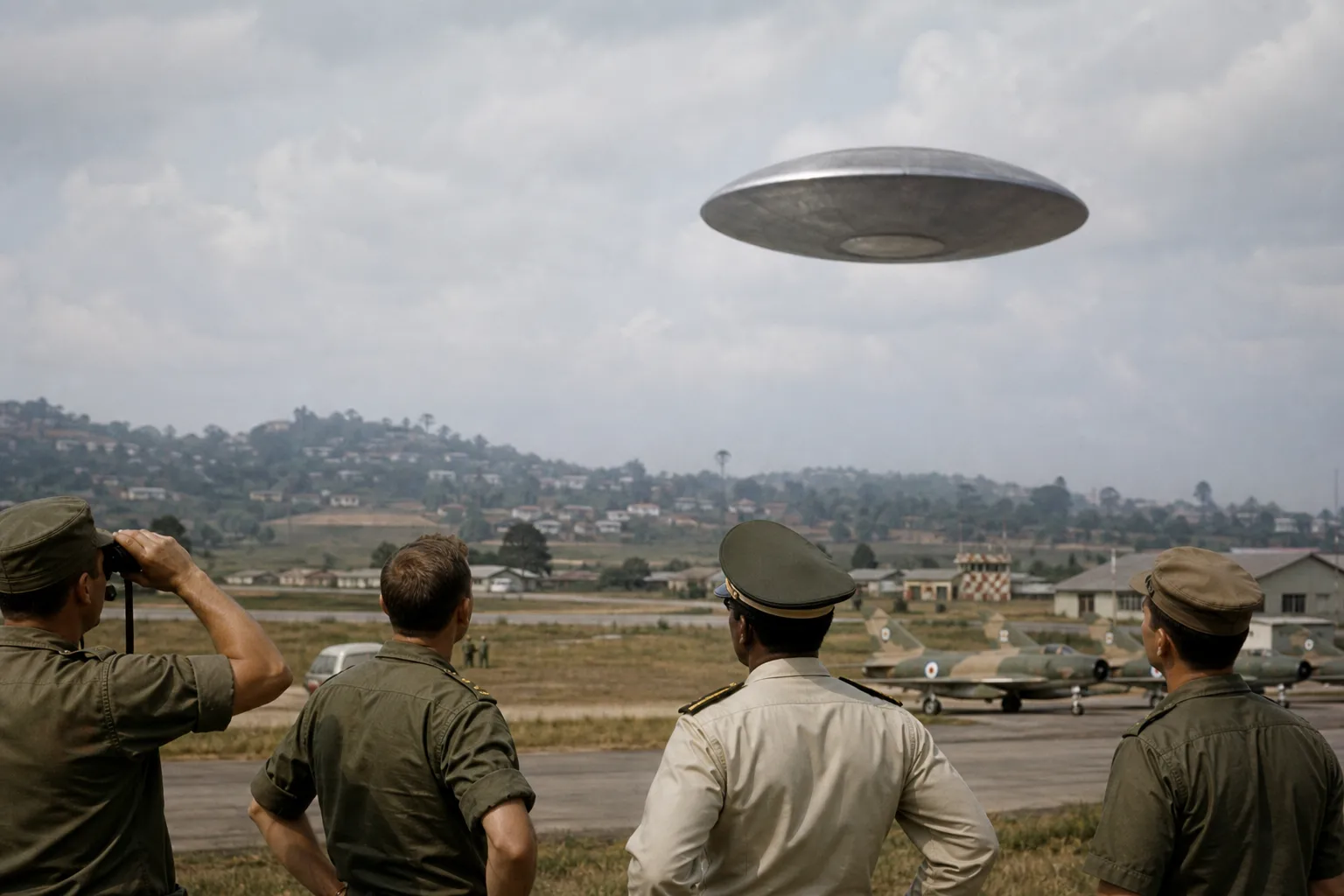
AI-rendered impression — French military advisors and a Cameroonian Air Force officer near Yaoundé-Nsimalen Air Base observing a large reflective disc executing sharp maneuvers over the capital before departing vertically, 1968 — UAP Archive / openai (gpt-image-1)
Credibility Assessment
Low
Military WitnessMultiple WitnessesOfficial Report
Event Description
Observed Shape
Disc
Craft morphology

Non-Human Intelligence (NHI)
Reported Entities
No NHI encounter documented for this event.
Cameroon in 1968 was an independent republic under President Ahmadou Ahidjo, but French military presence — under the extensive Françafrique bilateral defence agreements — was substantial. French military advisors trained the Cameroonian armed forces, staffed key installations including the air base at Yaoundé-Nsimalen, and maintained parallel reporting chains to Paris independent of Cameroonian national command structures. France's own domestic UAP investigation programme — which would eventually be formalized as GEPAN (Groupe d'Études des Phénomènes Aérospatiaux Non-identifiés) at CNES in 1977 — was in development during the late 1960s, and French military advisors in Africa were informally encouraged to report anomalous aerial events through military intelligence channels.
French military advisors — officers of the French Army or Air Force on secondment to the Cameroonian military — were the primary witnesses. A Cameroonian Air Force officer flying with French supervision independently observed the object from an aircraft. The combination of French military professionals and their Cameroonian counterpart as independent observers from air and ground provides multi-angle corroboration. All witnesses were operating under formal military discipline when the sighting occurred. The French advisors' report entered the French Defence Ministry's intelligence system, eventually contributing to the database that informed GEPAN's founding.
The object was described as a large disc, metallic and reflective in daylight, observed performing a series of sharp directional changes over Yaoundé before ascending rapidly. The Cameroonian Air Force officer reported it from an airborne position, confirming its disc shape at close range. Ground observers — the French advisors — described it as substantially larger than any conventional aircraft. The object was silent and left no contrail or exhaust signature.
The disc shape, silent operation, sharp-angle maneuvers, and vertical high-speed departure were the primary anomalies. Yaoundé in 1968 saw no known aircraft with these characteristics. The corroboration between airborne and ground-based observers from different positions established the object as a genuine physical phenomenon rather than an optical artifact.
No radar tracking is documented. The primary evidence is the dual-source visual observation. No instrument effects are recorded.
The French military advisory chain reported the incident to the French Defence Ministry in Paris. French military intelligence files from the African theatre in the late 1960s contributed to the data collection that preceded GEPAN's establishment. The Cameroonian Air Force also retained an informal record. No public statement was issued.
French military classification and the Françafrique framework's general opacity toward public scrutiny ensured non-disclosure. The Cameroonian press was not notified. No specific disinformation effort is documented.
The Cameroon 1968 case is significant for its French military documentary chain — France's systematic approach to UAP investigation, which would become the world's most institutionally committed national UAP research programme through GEPAN and its successor SIGMA, was built on a foundation of exactly these field reports from military observers in Africa and elsewhere. The presence of experienced French military officers as witnesses, with reporting chains leading directly to Paris, means this case was evaluated by the same institutional infrastructure that produced the GEPAN programme. It establishes Cameroon's presence in the French military UAP archive and contributes to the documented pattern of UAP activity across French-aligned African states during the late 1960s.
5 Observables Detected
Instantaneous Acceleration
Hypersonic Velocity
Low Observability
Trans-Medium Travel
Anti-Gravity Lift
Suspicious Activity
Intelligence Agency
Cover-up Actions
Men in Black
Disinformation
Witness Suppression
Sources
governmentFrench Defence Ministry — African theatre military advisory reports, 1968 (GEPAN predecessor files)
mediaGEPAN/CNES — historical case database, Central Africa pre-1977 (cited in GEPAN technical notes)mediaCynthia Hind, 'UFOs Over Africa' (1982) — Central Africa French military cases, Cameroon chapter