SightingCold War
Operation Vuk — Cetinje, Montenegro, 1975
January–February 1975
Cetinje, Montenegro, Yugoslavia
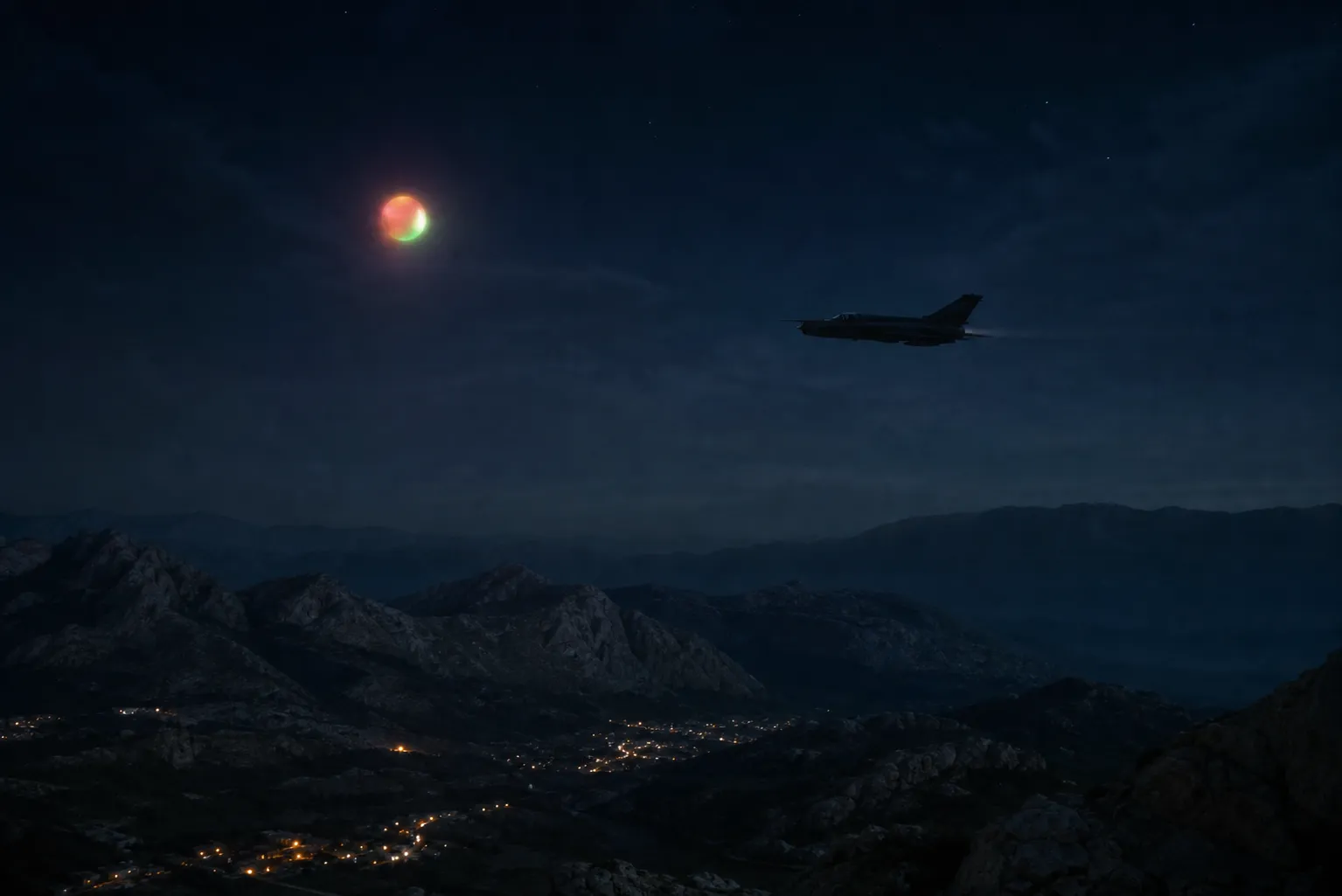
AI-rendered impression — a color-shifting luminous orb over the Lovćen massif at night, pursued by a MiG-21 silhouette — UAP Archive / openai (gpt-image-1)
Credibility Assessment
Moderate
Military WitnessMultiple WitnessesRadar CorroboratedOfficial Report
Event Description
Observed Shape
Orb
Craft morphology

Non-Human Intelligence (NHI)
Reported Entities
No NHI encounter documented for this event.
Between early January and February 12, 1975, Yugoslav Air Force pilots at the 172nd Aviation Regiment's base in Titograd (present-day Podgorica), Montenegro, repeatedly encountered a luminous, color-shifting aerial object over the Lovćen massif, the Adriatic coastline, and the historic town of Cetinje. The encounters spanned six weeks, involved at least fourteen military witnesses, resulted in multiple armed scrambles, and were ultimately classified under the code name "Vuk" — Wolf — by the Commander of the Yugoslav Air Force. The case remains one of the most operationally documented Cold War-era military UFO encounters from the Balkan region.
The primary witness was Colonel (later General) Zvonimir Jurjevic, regimental commander of the 172nd Aviation Regiment stationed at Titograd airfield. Jurjevic held a senior combat-aviation post and personally flew multiple interception sorties against the object. His superior, General Enver Ćemalović, the Commander of the Yugoslav Air Force, was briefed in real time and gave the authorisation to deploy armed MiG-21s with guided missiles. At least twelve other Yugoslav Air Force pilots and radar operators at the Prevlaka peninsula installation reported observations across the six-week period. Additionally, crew aboard the naval vessel "Galeb" — which was carrying Marshal Josip Broz Tito on an official voyage along the Adriatic coast — independently reported observing the object, a development that reportedly contributed to the decision to escalate the investigation to the highest levels of the Yugoslav military command.
The first documented encounter occurred during a night flight in early January 1975. Jurjevic recalled: "The object looked like a glowing orb, very well visible, maybe ten times lighter than the brightest star at that moment. Its color constantly changed: white, yellow, light red, orange, again white, and so on. It appeared from nowhere, unexpectedly." The object appeared to arrive on a consistent schedule — roughly 50 minutes into each mission — as though tracking the aircraft's patrol pattern rather than appearing randomly. Subsequent encounters followed a persistent geometry: the object maintained a separation distance of approximately ten kilometres regardless of the interceptors' speed or altitude adjustments. When Jurjevic accelerated, the object accelerated proportionally. When he banked toward it, the object receded at the same rate, preserving the gap. On January 25, 1975, a coordinated interception above Cetinje involved multiple aircraft attempting to converge simultaneously; the object evaded all of them. A second multi-aircraft operation involving twelve jets was ordered by General Ćemalović in late January, again without result. The object made no sound audible to pilots and produced no exhaust trail, wake, or other observable emission.
The object demonstrated sustained performance well beyond the MiG-21's operational ceiling and top speed of approximately 2,230 km/h. When Yugoslav radars recorded the object's movement during the February interceptions, the return indicated speeds in excess of 7,000 km/h — well above any manned aircraft of the era and beyond the capability of any known ballistic re-entry vehicle to sustain at such low altitudes. The object's ability to maintain a constant ten-kilometre separation from a supersonic fighter regardless of the fighter's manoeuvring — without accelerating away but also without allowing closure — suggests either extraordinary situational awareness or autonomous proximity-maintenance behavior. No sonic boom was produced despite the apparent speed differential, consistent with low_observability and the absence of a conventional propulsion wake. The object appeared and disappeared without transition — no acceleration run-up, no deceleration landing profile.
The Prevlaka peninsula radar station initially failed to detect the object; the single-regiment ground radar recorded no return during the first interceptions in January. However, when supersonic MiG-21 pairs dispatched from Belgrade arrived in the operational area, Yugoslav broader air-defence radars succeeded in recording the object, providing speed estimates. No gun-camera footage is known to have survived — the JRV (Yugoslav Air Force) command centre in Belgrade was destroyed during the 1999 NATO bombing campaign, and most operational records were lost. Only personal flight logs and the post-retirement recollections of Jurjevic and other veterans provide the documentary record.
General Enver Ćemalović, the Yugoslav Air Force Commander, assigned the code name "Vuk" (Wolf) to the object and ordered armed engagement — an extraordinary escalation that indicates senior command took the reports seriously enough to authorise the use of guided missiles. Following the final sighting on February 12, 1975, Yugoslav military specialists were tasked with analysis; they produced no specific conclusions. Jurjevic stated that following the investigation's inconclusive outcome, he ordered his regiment to cease filing encounter reports after personnel at other bases began mocking the 172nd Regiment. The incident was not publicly disclosed during the communist era; Jurjevic did not speak publicly about it until 2017, when Sputnik International published his account as a first-hand military testimony. Yugoslav state authorities never issued a public statement.
The operational secrecy of the Yugoslav military meant the case was effectively suppressed for four decades. After the conclusion of the interception campaign, personnel were informally instructed to stop reporting sightings. Jurjevic cited social ridicule within the military as a secondary suppression mechanism. The destruction of the JRV command centre in 1999 eliminated the primary archive. No evidence of coordinated disinformation exists, but the passive suppression through secrecy and the loss of the documentary record achieves a similar outcome: the case is known only through survivor testimony, not official documentation.
The "Vuk" incident is one of the most operationally intense European Cold War UAP cases in the archive. It combines: a senior regimental commander as primary witness; confirmed multi-aircraft scrambles with armed-engagement orders from a theatre-level Air Force commander; a secondary independent observation by a naval vessel carrying the head of state; and radar returns indicating performance figures no known 1975 aircraft could achieve. The destruction of JRV records limits corroboration, but General Jurjevic's 2017 disclosure — made by a man with nothing to gain and in full knowledge of his professional reputation — constitutes credible first-hand testimony that aligns structurally with better-documented Soviet and NATO military encounters of the same period. The case is archived as a strong Cold War military UAP precedent for the Western Balkans.
5 Observables Detected
Instantaneous Acceleration
Hypersonic Velocity
Low Observability
Trans-Medium Travel
Anti-Gravity Lift
Suspicious Activity
Intelligence Agency
Cover-up Actions
Men in Black
Disinformation
Witness Suppression