SightingCold War
FAC T-33 Intercept — El Dorado Airport, Bogotá, 1964
Mid-1964
El Dorado Airport, Bogotá, Colombia
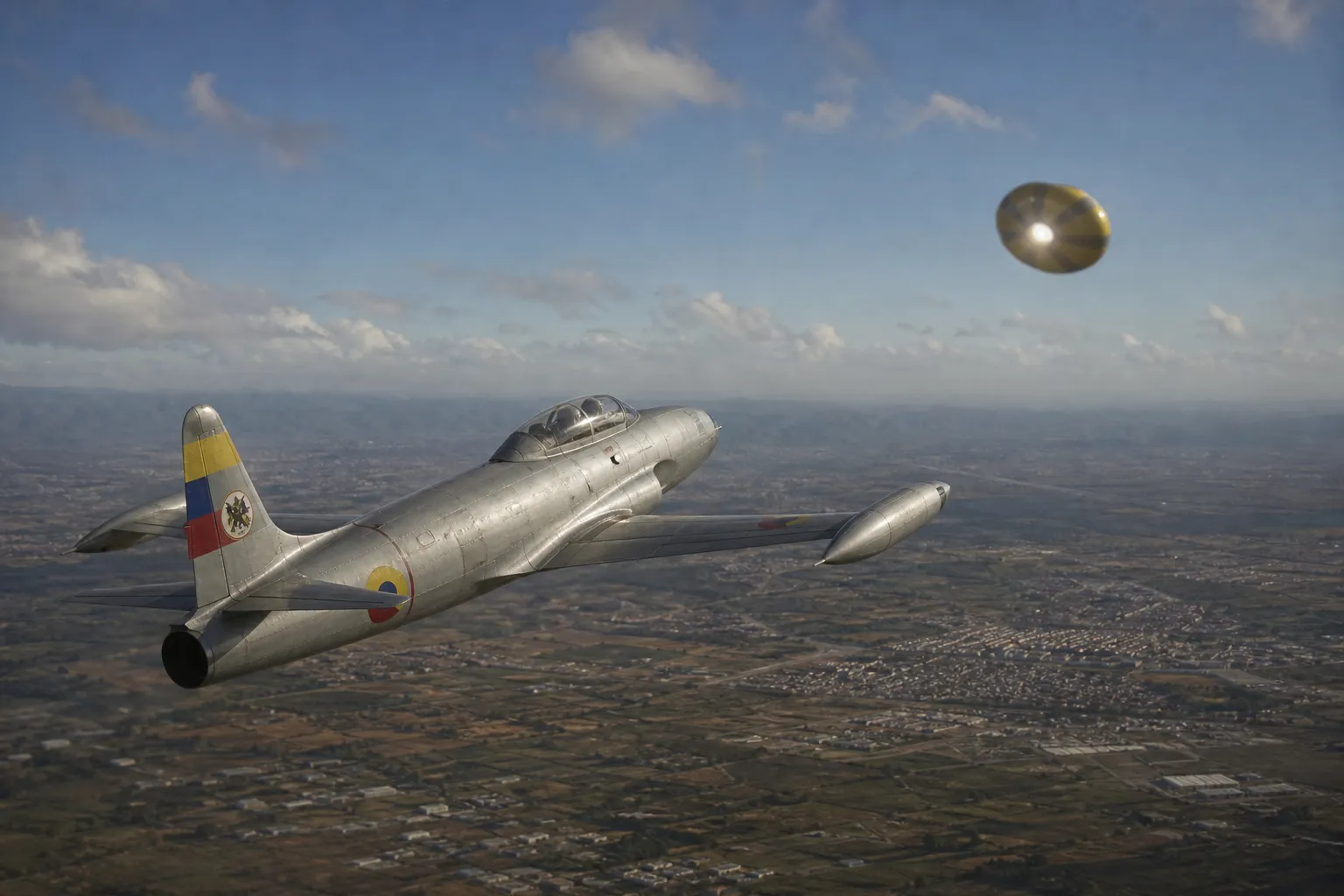
AI-rendered impression — a Lockheed T-33 jet aircraft climbing steeply toward a deep yellow disc with a sun-bright white central light, the Andes and Bogotá visible in the distance below, clear daytime sky — UAP Archive / openai (gpt-image-1)
Credibility Assessment
Moderate
Military WitnessPilot WitnessLaw EnforcementMultiple Witnesses
Event Description
Observed Shape
Disc
Craft morphology

Non-Human Intelligence (NHI)
Reported Entities
No NHI encounter documented for this event.
In mid-1964, anomalous aerial activity over El Dorado Airport in Bogotá, Colombia triggered one of the earliest documented military intercept responses in Colombian Air Force history. Colombian Air Force (Fuerza Aérea Colombiana, FAC) control tower personnel at El Dorado observed an object performing maneuvers inconsistent with known aircraft and notified military authorities. Two Lockheed T-33 Silver Star jet aircraft — FAC 2072 and FAC 2070 — were scrambled from Palanquero Air Base in Puerto Salgar, Cundinamarca, and directed toward the capital. The intercept was witnessed by multiple control tower personnel including air traffic controller Eduardo Russi and tower chief Pedro Sánchez. The encounter unfolded over approximately 31,000 feet of altitude before the object departed without explanation, and the official response was immediate institutional silence.
Eduardo Russi, the air traffic controller on duty, provided the most detailed account: he observed the object from the control tower at El Dorado Airport throughout the encounter and later described it with specific detail regarding color, shape, and the behavior of the central light. Pedro Sánchez was the control tower chief and also witnessed the event; his subsequent order of silence indicates he recognized the significance of what had been observed. Both were trained aviation professionals with responsibility for controlling military and civilian airspace. The pilot of FAC 2072 obtained visual contact with the object and pursued it to 31,000 feet — a trained military aviator reporting direct visual observation at close range, though his identity was not recorded by Russi. A second pilot in FAC 2070 was also present. The multiple-witness structure spanning control tower and airborne platforms is characteristic of the strongest documented intercept cases.
Russi described the object as "round, like a wheel" with a "deep yellow color and black sections" — a structured, solid appearance rather than a light or plasma phenomenon. The most striking feature was its central illumination: an intensely bright white light described as "brighter than the Sun" despite the clear daytime sky. This central light was distinct from the object's overall yellow coloration. The pursuing pilot in FAC 2072 climbed to approximately 31,000 feet while maintaining roughly 2,000 feet distance from the object — sufficient proximity for detailed visual identification. The object ascended vertically without producing audible sound — an anomaly for any object performing sustained high-altitude flight. It then departed on a 45-degree westward angle and disappeared. The pilot terminated pursuit due to fuel constraints and the T-33's altitude limitations; no weapons were armed.
Vertical ascent without propulsion sound is the case's central physical anomaly; no 1964-era aircraft could perform a sustained vertical climb without producing detectable noise, particularly at the altitude and in the proximity described. The object's two-part appearance — deep yellow body with black sections and a sun-bright white central light — has no counterpart in known aviation design. The T-33 Silver Star's service ceiling of approximately 47,000 feet was not reached, meaning the pilot's pursuit was terminated voluntarily by fuel limits rather than the object exceeding the aircraft's ceiling — implying the object had far greater performance reserve than was demonstrated.
No radar data is documented in the available record; neither Russi nor subsequent researchers referenced radar tracking of the object. The encounter was a visual event observed from both ground (tower) and air (cockpit) platforms. No electromagnetic effects on the T-33 aircraft are documented. The absence of radar data is a limitation of the record — in 1964, El Dorado Airport's radar capability may not have tracked the object or the data may not have been preserved or released.
The official response was swift and followed the pattern documented in contemporaneous US cases: immediate suppression of the incident. Tower chief Pedro Sánchez ordered all control tower personnel to maintain silence about what they had seen. The pilots were reportedly given similar directives upon returning to Palanquero base days later — the delay between the intercept and the pilots' return to base suggests they were debriefed elsewhere or held pending instruction. No formal written investigation report is documented in available sources, and no official FAC acknowledgment of the encounter appears in public records.
The suppression in this case followed a pattern consistent with contemporaneous Air Force practice across multiple nations during the 1960s: the tower chief's silence order and the pilots' reported directives represent the typical initial response of denying personnel the ability to discuss the event publicly. The fact that Eduardo Russi later described the event in detail — including his regret at not having recorded the pilots' names — suggests the suppression was not indefinitive but that institutional pressure had deterred immediate reporting. Researcher Esteban Cruz documented the case in his Spanish-language study of Colombian Air Force UAP encounters, which brought the 1964 event into the formal historical record. Project Blue Book files may contain additional documentation; Colombian sightings from the same period were reportedly included in Blue Book investigations.
The 1964 Bogotá T-33 intercept is historically important as one of the earliest documented Colombian Air Force UAP engagement cases in the accessible record. It demonstrates that the FAC treated anomalous aerial phenomena seriously enough to scramble jet aircraft over the capital city — an operationally significant response — while simultaneously suppressing the event through personnel directives. The involvement of trained air traffic controllers, a control tower chief, and at least one military pilot who obtained sustained visual contact at altitude creates a multi-platform corroboration chain comparable to US and UK intercept cases of the same era. The case also fits the documented pattern of 1960s-era institutional UAP suppression across multiple air forces: observe, investigate operationally, then silence witnesses. Colombia's participation in that pattern — largely undocumented in English-language sources — confirms that the phenomenon was being taken seriously across the hemisphere by military aviation authorities regardless of public posture.
5 Observables Detected
Instantaneous Acceleration
Hypersonic Velocity
Low Observability
Trans-Medium Travel
Anti-Gravity Lift
Suspicious Activity
Intelligence Agency
Cover-up Actions
Men in Black
Disinformation
Witness Suppression