SightingCold War
Lago Cote Aerial Survey Photo — Costa Rica, September 1971
September 4, 1971
Lago de Cote, Guanacaste Province, Costa Rica
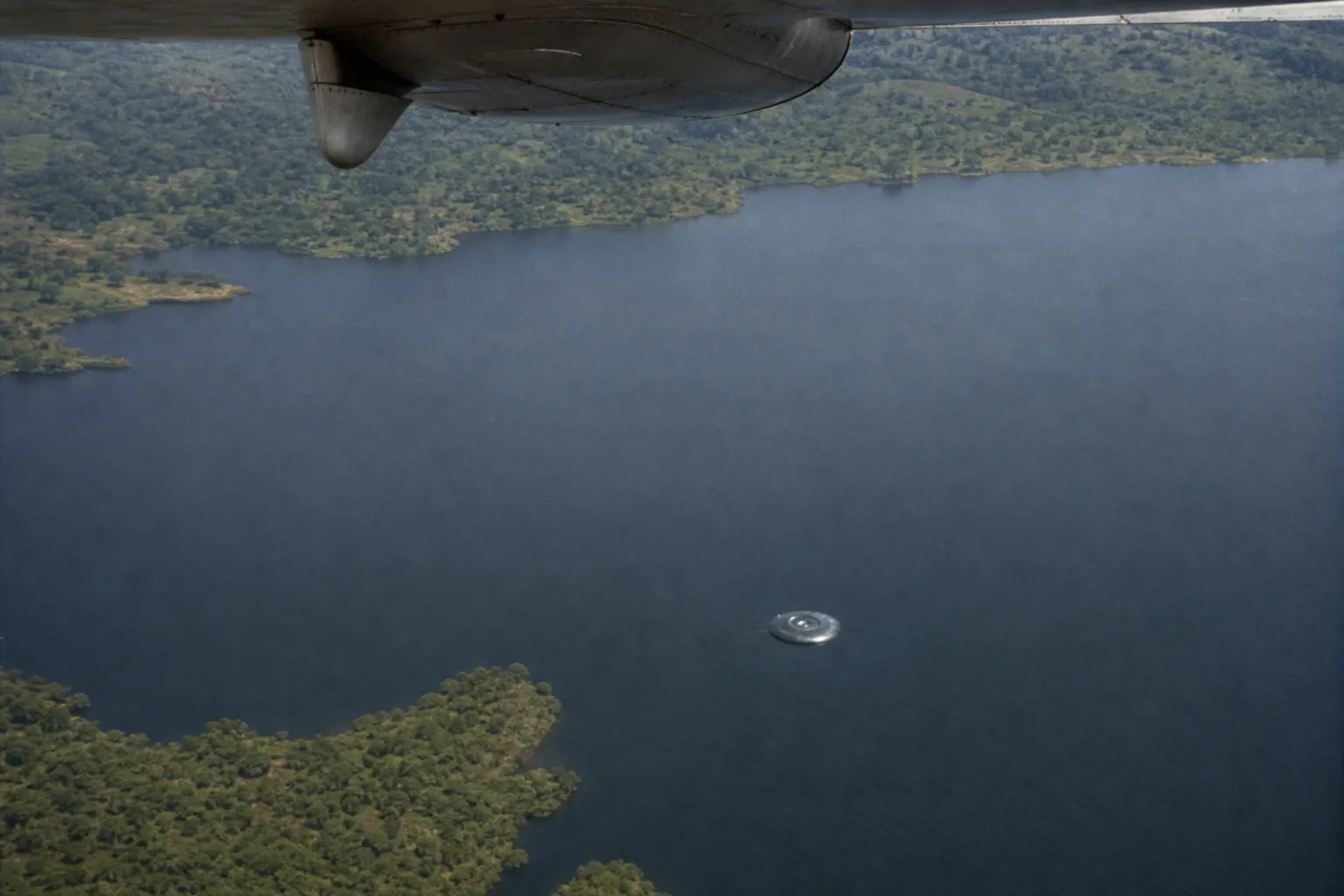
AI-rendered impression — a sharp-edged metallic disc photographed from above during a government aerial survey, suspended over the dark surface of Lago de Cote in Costa Rica, Guanacaste forest visible at the lake margins — UAP Archive / openai (gpt-image-1)
Credibility Assessment
Moderate
Photo EvidenceOfficial ReportHistorical DocumentExpert WitnessMultiple Witnesses
Event Description
Observed Shape
Disc
Craft morphology

Non-Human Intelligence (NHI)
Reported Entities
No NHI encounter documented for this event.
On the morning of September 4, 1971, a three-person crew flying for Costa Rica's Instituto Geográfico Nacional (IGN) was conducting a precision aerial photographic survey for the Instituto Costarricense de Electricidad — Costa Rica's national electricity authority — to map water sources for a planned hydroelectric project near Lago de Cote in Guanacaste Province. The aircraft was an Aero Commander F680, flying at 10,000 feet altitude. Aboard was aerial photographer Sergio Loaiza operating a 100-pound NRK 15-23 German precision mapping camera, along with pilot Omar Arias and navigator Francisco Reyes. The camera fired automatically at precisely timed 13-second intervals, producing a continuous sequence of high-resolution black-and-white frames of the terrain below. The crew completed their mission and returned to base. Months later, while IGN employees were reviewing the photograph sequences to map the Lago de Cote area for the hydroelectric study, they discovered something: in a single frame, a sharp-edged metallic disc-shaped object was visible against the dark surface of the lake.
Sergio Loaiza was a professional aerial photographer employed by an official government institution, operating precision equipment in an official scientific survey context. Pilot Omar Arias and navigator Francisco Reyes were professional aviation crew. None of the three observed the object visually during the flight — it was captured by the automatic camera system without their awareness. This circumstance is, if anything, a point in favor of the image's evidentiary value: no deliberate or unconscious human framing shaped the photograph. The discovery was made during routine institutional photo analysis. Loaiza later disclosed that he and both crewmates were explicitly ordered not to discuss the photo after its discovery — a suppression directive that, paradoxically, confirms the photograph's provenance as a government document that the institution itself took seriously enough to attempt to manage.
The object appears as a sharp-edged, disc-shaped form with a smooth metallic-appearing surface, darker on its underside, with no visible windows, ports, or appendages. It appears in a single frame of the survey sequence and is absent from both the preceding and subsequent frames — meaning whatever it was, it transited the camera's field of view within a 13-second interval. Given the aircraft's altitude of 10,000 feet and the camera's field of view, analysts estimated the object was at an altitude considerably lower than the survey aircraft — ruling out it being a high-altitude craft that might have been too distant to be seen by the crew. The object's sharpness in the image (no motion blur consistent with the camera's exposure timing) and its apparent three-dimensional shape distinguish it from lens artifacts, which would typically show as consistent radial distortions or reflections across multiple frames.
The object's appearance in one frame and absence from adjacent frames means either it was present for less than 13 seconds or it was moving at a speed that took it outside the frame within that interval — both of which are consistent with non-conventional performance if the object was of significant size. The image's sharpness and apparent shadow suggest a solid physical object rather than a reflection or artifact. Ground Saucer Watch, using computer-enhancement techniques advanced for their era, found "no evidence of optical defects, deliberate hoax, or support for other prosaic explanations" in their 1989 analysis. A subsequent French analysis reached the same conclusion. A Journal of Scientific Exploration review described it as a "photo montage" — the main dissenting analysis — but critics have noted that the precision cartographic camera and the film's handling chain through an official government institution make photographic montage far more difficult to execute than in a civilian context.
The primary evidence is the photographic image itself — a single frame from a precision cartographic camera operated by a government institution for a documented official purpose. The original negative is held by the Instituto Geográfico Nacional, providing an unbroken chain of custody unlike the vast majority of historical UFO photographs. Multiple independent analyses were conducted: Ground Saucer Watch (1989), French researchers, US researchers, and others all examined either prints or copies of the negative. The majority concluded the image was authentic. A high-resolution rescan of the original negative was conducted and published in 2022, enabling a new generation of image analysts to examine the photograph at full resolution for the first time since its original development.
The immediate institutional response was suppression: upon discovery of the anomalous frame, Sergio Loaiza and both crewmates were told not to discuss the photograph publicly. The photo remained internal to the IGN for approximately eight years. In 1979 the image was sent to Ground Saucer Watch, the US-based photographic analysis organization, which published its findings confirming authenticity. The photograph subsequently received coverage in Costa Rican media. The IGN has never officially commented on or released an analysis of the image, though the negative has remained in the institution's custody. There is no documented investigation by the Costa Rican Air Force or civil aviation authority; the country had no equivalent of CRIDOVNI or COMETA.
The explicit prohibition on discussing the photograph — described by Loaiza himself — represents an institutional attempt to prevent the image from becoming public, consistent with the pattern at many government agencies globally when anomalous data is captured through official instrumentation. The suppression period of approximately eight years (1971–1979) allowed for internal institutional handling before outside researchers obtained access. The ultimate release came through individual disclosure rather than institutional transparency. The Journal of Scientific Exploration's "photo montage" conclusion has been cited by skeptics but has not been substantiated with specific identification of the montage technique, source image, or opportunity — unusual for a peer-reviewed rejection of photographic authenticity.
The Lago Cote photograph is considered by multiple serious researchers to be among the highest-quality UAP photographs ever produced, for reasons that trace directly to its institutional context. It was taken by a calibrated precision instrument — not a tourist camera or cellphone — as part of a documented official government survey. The original negative has a verified chain of custody. Three professional crew members were aboard; none had reason to construct a hoax or benefit from doing so. The crew's lack of visual awareness of the object at the time of capture eliminates the possibility of deliberate staging during the flight. The institutional suppression response — silencing the crew — inadvertently corroborates that the image captured something real enough to be treated as sensitive by a government agency. Investigative journalist Leslie Kean, whose work on UAP has been cited by congressional testimony, has described this as the best UAP photograph ever taken. That assessment reflects not just image quality but the evidentiary framework — official camera, official mission, official institution, official negative — that surrounds it.
5 Observables Detected
Instantaneous Acceleration
Hypersonic Velocity
Low Observability
Trans-Medium Travel
Anti-Gravity Lift
Suspicious Activity
Intelligence Agency
Cover-up Actions
Men in Black
Disinformation
Witness Suppression
Sources
mediaThe Tico Times — 'Costa Rica's Mysterious Lago Cote and Its UFO Sighting History'mediaIFLScience — '"Best UFO Photo Ever" Gets A High-Resolution Makeover'mediaQ Costa Rica — '45 Years Ago, a UFO Sighting In Costa Rica Impressed The World'
academicJournal of Scientific Exploration — analysis of Lago Cote photograph (Vol. 3, 1989)