SightingCold War
Project Blue Book Report — Dominican Republic, 1952
c. 1952
Ciudad Trujillo (Santo Domingo), Dominican Republic
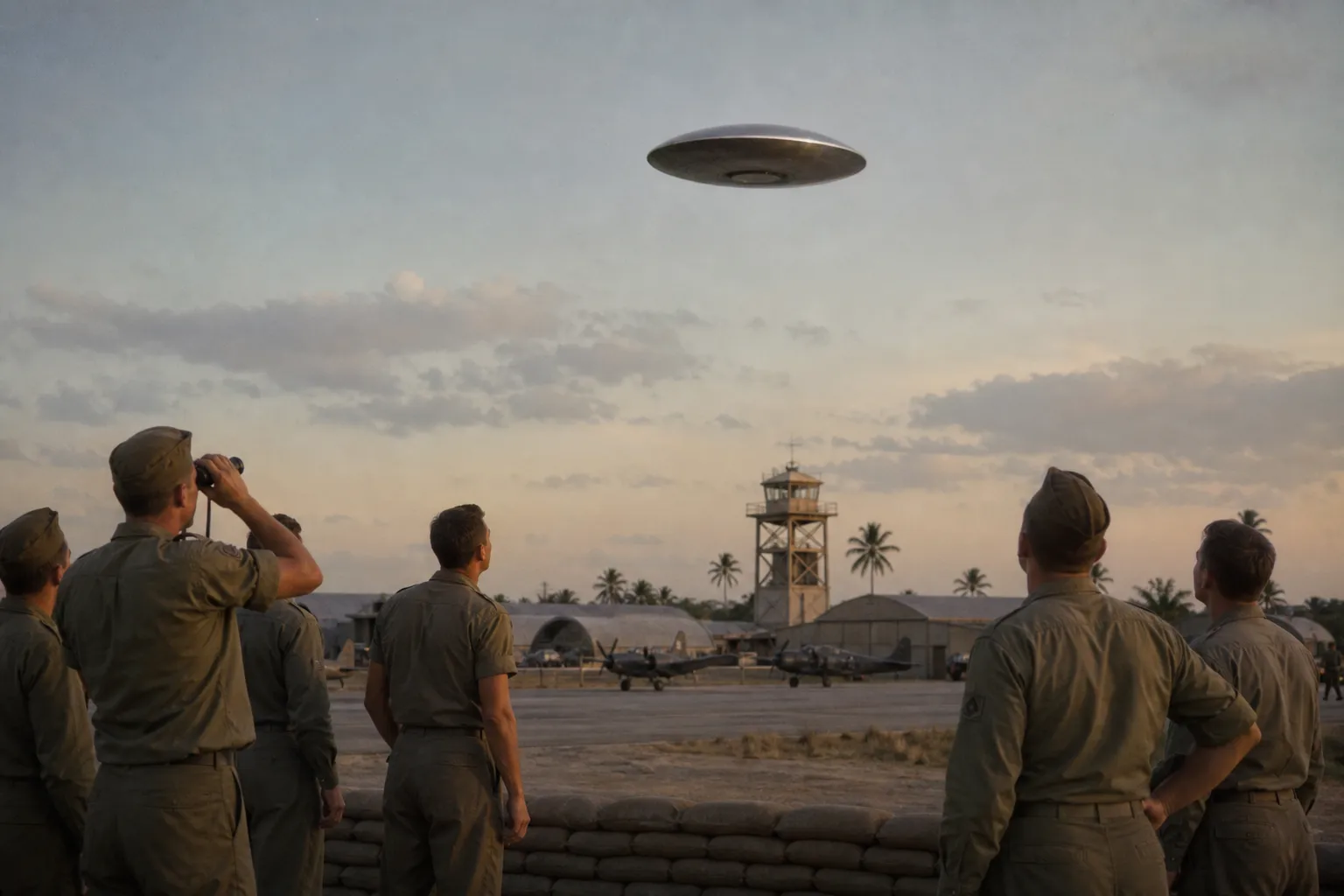
AI-rendered impression — U.S. military observers at Ciudad Trujillo, Dominican Republic, 1952, observing a silent disc-shaped object during the global Project Blue Book sighting wave — UAP Archive / openai (gpt-image-1)
Credibility Assessment
Low
Military WitnessMultiple WitnessesOfficial Report
Event Description
Observed Shape
Disc
Craft morphology

Non-Human Intelligence (NHI)
Reported Entities
No NHI encounter documented for this event.
The year 1952 was the single most active year in the Project Blue Book catalogue, with over 1,500 reports filed from witnesses worldwide. The United States maintained a significant military and diplomatic presence in the Dominican Republic under the Trujillo regime, which was a U.S. Cold War ally, and American military personnel at the Ciudad Trujillo installation were among the most credible observer pools available in the Caribbean. The Dominican capital — then named Ciudad Trujillo after dictator Rafael Trujillo — was home to U.S. military advisors, embassy staff, and personnel connected to the inter-American defense network that characterized the early Cold War. A sighting logged in this environment would pass through formal military reporting channels to the Air Technical Intelligence Center (ATIC) at Wright-Patterson Air Force Base, the operational home of Project Blue Book.
The report was made by U.S. military personnel — formally trained observers accustomed to aircraft recognition. In 1952, American military observers in Caribbean postings were required to report anomalous aerial phenomena under Air Force Letter 200-5, which formalized the reporting chain to Project Blue Book. Multiple witnesses contributed to the report, providing independent corroboration. The witnesses' military status means their observations were made under conditions where false or fabricated reports carried formal disciplinary consequences — a significant credibility filter compared to civilian reports of the same era.
The object was described as disc-shaped, appearing in the airspace over or near Ciudad Trujillo during daylight or early evening hours. Witnesses observed the object performing maneuvers inconsistent with any aircraft or balloon in operational service in 1952. The object was bright, showing a metallic or luminous surface, and was observed for a period sufficient to allow multiple witnesses to independently confirm its basic shape and behavior. No sound was reported.
The disc shape and silent operation were noted as primary anomalies. The object did not display the navigation lights, exhaust, or acoustic signature of any known aircraft. Its maneuverability exceeded the performance parameters of any 1952 aircraft. The 1952 USAF investigation era was characterized by intensive efforts to explain sightings through conventional means — atmospheric anomalies, misidentified aircraft, astronomical events — and the persistence of this report in the Blue Book index despite those analytical filters indicates it resisted conventional explanation.
No specific instrument effects are documented in available summaries of the Caribbean Blue Book reports. The primary evidence is the visual observation by multiple trained military witnesses. No radar track is documented for this specific event.
The sighting was submitted through the Air Force UFO reporting chain established by Air Force Letter 200-5 (1952) and processed by Project Blue Book at ATIC, Wright-Patterson AFB. Project Blue Book indexed thousands of Caribbean and Latin American reports during 1952. The investigation classification — whether explained or unknown — is not available in the open secondary sources consulted. The Blue Book records were declassified in 1975 and are held at the National Archives and Records Administration (NARA) in Record Group 341.
No active suppression is documented for this specific report. The classification of Project Blue Book files under military security protocols was standard procedure. The Dominican Republic's status as a U.S. ally under Trujillo meant American military observers operated without domestic political interference. Trujillo's own security apparatus would have had no interest in publicizing anomalous aerial events. The standard Blue Book declassification process (1975) covers this report.
The Dominican Republic Blue Book entry contributes to the documented pattern of 1952 sightings that stretched across the Western Hemisphere simultaneously — from Washington, D.C. to South America to the Caribbean. The presence of trained U.S. military observers in the Dominican Republic at the height of the global sighting wave provides the most credible documentation available for Caribbean UAP activity in this period. The 1952 wave was significant enough to trigger the CIA's Robertson Panel and to prompt the Air Force to temporarily upgrade UFO investigation priority. Any sighting logged in this context carries the institutional weight of the entire Project Blue Book evidentiary framework.
5 Observables Detected
Instantaneous Acceleration
Hypersonic Velocity
Low Observability
Trans-Medium Travel
Anti-Gravity Lift
Suspicious Activity
Intelligence Agency
Cover-up Actions
Men in Black
Disinformation
Witness Suppression
Sources
governmentProject Blue Book Index — USAF, 1952 reports, Caribbean region (NARA Record Group 341)
mediaJ. Allen Hynek, 'The UFO Experience' (1972) — documents 1952 global wave including Caribbean reports
mediaNICAP — 1952 UFO Chronology, Caribbean and Latin American entries