SightingModern Era
FAE Pilot Encounter over Crucita — Manabí, Ecuador, 1998
1998 (exact date withheld)
Crucita, Manabí, Ecuador
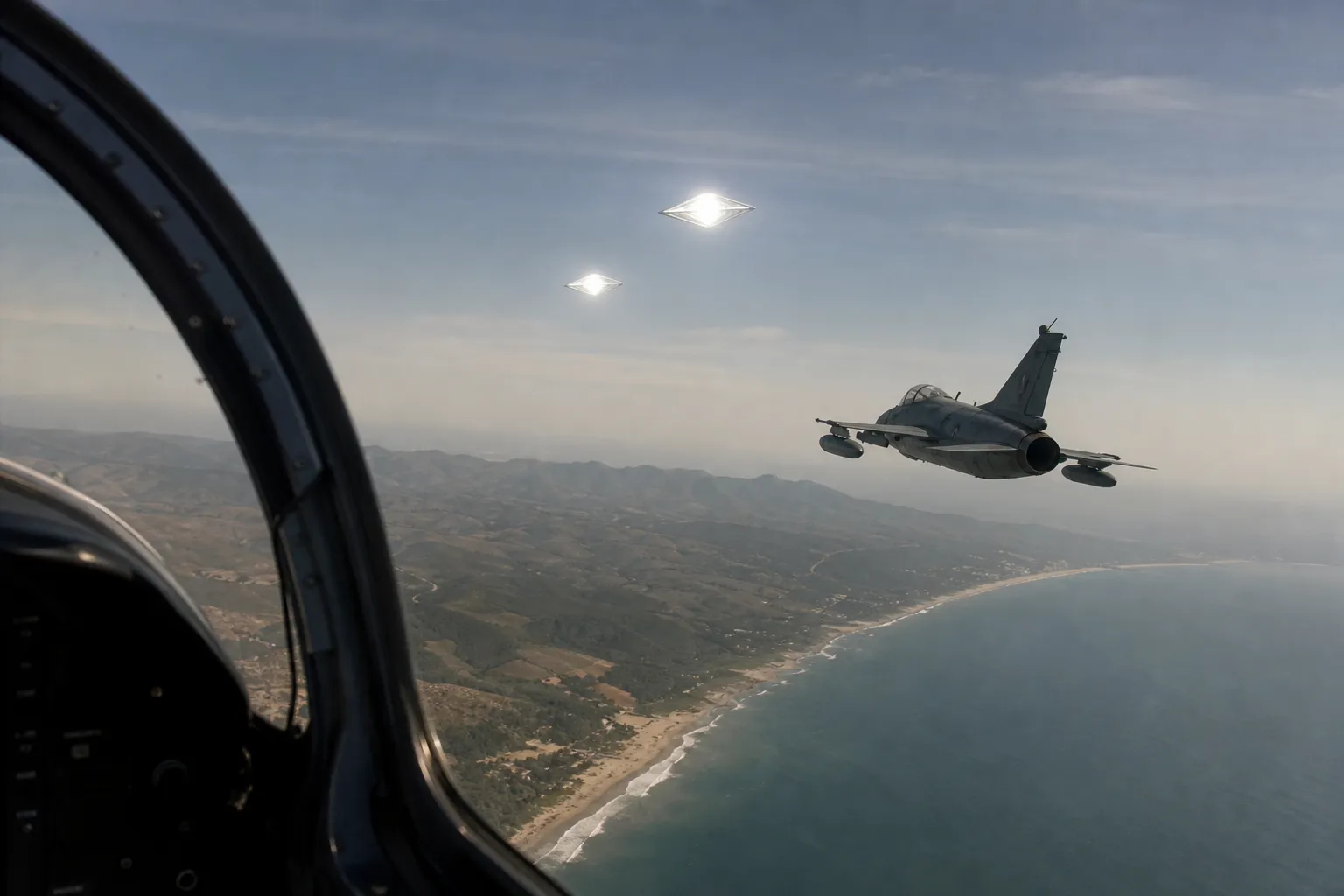
AI-rendered impression — two rhomboidal luminous objects approaching a military aircraft at 5,000 feet over the Pacific coastal zone near Crucita, Manabí, Ecuador — UAP Archive / openai (gpt-image-1)
Credibility Assessment
Moderate
Pilot WitnessMilitary WitnessGovt. AcknowledgmentOfficial Report
Event Description
Observed Shape
Craft morphology

Non-Human Intelligence (NHI)
Reported Entities
No NHI encounter documented for this event.
In 1998, a serving officer of the Fuerza Aérea Ecuatoriana (FAE), Major Leonidas Enríquez, was conducting routine flight operations over Ecuador's Pacific coast when he encountered two unidentified objects at cruise altitude. The encounter took place above the Crucita coastal zone in Manabí province — a stretch of Pacific coastline approximately 30 kilometers southwest of the city of Portoviejo. Crucita's coastal geography, with the Pacific Ocean to the west and the Manabí cordillera to the east, would figure prominently in the objects' apparent exit trajectory. The incident became one of the core military witness accounts formally compiled by Ecuador's government UAP investigation body and was declassified as part of a 44-record tranche authorized by the Ecuadorian executive branch in 2007.
Major Leonidas Enríquez was a qualified military pilot in active service with the Ecuadorian Air Force at the time of the incident. His credentials as a trained aviator — with the aeronautical observational training that entails — place his account in the category of expert witness. Military pilots are specifically trained to identify and distinguish known aircraft types; their failure to identify an object as a known aircraft carries greater epistemic weight than equivalent civilian testimony. The incident occurred during a flight mission, meaning Enríquez was operating as part of an active sortie with communications to a control tower, providing a contemporaneous institutional record. The control tower's real-time confirmation that no aircraft were authorized in the airspace adds an independent corroborating element.
At approximately 5,000 feet of altitude over the Crucita coastal zone, Major Enríquez observed two objects approaching his aircraft. The objects were described as rhomboidal — a diamond or lozenge shape — and brilliantly luminous. They closed on his aircraft, maneuvering in a manner that was erratic rather than following a constant heading or velocity. After executing what witnesses described as unpredictable movements in the vicinity of the aircraft, the objects departed at speed toward the Crucita mountain range to the east and disappeared from view behind its ridgeline. The observation lasted long enough for the pilot to take in the objects' shape, luminosity, and behavior. Real-time communication with the Crucita/Manabí area control tower during or immediately after the encounter confirmed that no civil, commercial, or military aircraft were operating in the airspace — eliminating the possibility of misidentified known aircraft.
The principal anomalies are the shape and performance characteristics. Rhomboidal luminous objects with no visible propulsion system, capable of maneuvering erratically at altitude, do not correspond to any Ecuadorian Air Force or civil aviation asset operating in that era. The objects' ability to approach and then rapidly exit toward a mountain ridgeline without following conventional flight paths is inconsistent with fixed-wing aircraft. The dual-object formation showing coordinated yet erratic movement adds a second layer: two objects acting in proximity suggests controlled behavior rather than natural phenomena such as ball lightning or atmospheric optics. The radar null — or at minimum the absence of ATC-recognized flight plans — eliminates the most straightforward conventional explanations.
Major Enríquez's account does not detail instrument anomalies aboard his aircraft during the encounter in the available documented record. The significant technical datum is the control tower's real-time confirmation of no authorized air traffic in the area, which functions as both a negative radar corroboration and an administrative record of the airspace status at the time. The 1998 incident is one of 44 cases in Ecuador's Defense Ministry archive for which photographic or video evidence was documented; however, whether Enríquez's specific encounter produced recorded sensor data beyond the pilot's verbal account has not been confirmed in open-source reporting.
The incident was documented within Ecuador's Defense Ministry files. Between 2005 and 2007, the Ecuadorian government operated CEIFO (Comisión Ecuatoriana para la Investigación del Fenómeno Ovni), formally authorized first under President Lucio Gutiérrez in 2005. CEIFO, led by ufologist Jaime Rodríguez, was granted access to classified Defense Ministry records and compiled testimony from both military personnel and civilians. On June 25, 2007, President Rafael Correa authorized the declassification of 44 cases from the 412 photographic and video evidence items held by the Armed Forces. Major Enríquez was among the military witnesses whose accounts were formally reviewed and declassified through this process. Ecuador thus became one of the few Latin American nations to formally declassify military UAP records through an executive-authorized commission.
Prior to CEIFO's establishment, military UAP accounts in Ecuador — including Enríquez's — were held in classified Defense Ministry files and not publicly accessible. The commission's director, Jaime Rodríguez, alleged that CIA-affiliated personnel had embedded themselves within the commission's investigative team and contributed to its premature closure in 2007 before the full 412-item evidence archive could be analyzed. The circumstances of CEIFO's disbanding before completing its work mean that the majority of Ecuador's military UAP documentation — 368 of the 412 items — remains unanalyzed or inaccessible to independent researchers. Only 44 cases were formally reviewed and declassified.
The Crucita encounter exemplifies the class of credible military pilot UAP reports from Latin America that received formal government acknowledgment. Ecuador's CEIFO process represents one of the region's most institutionally robust UAP disclosure efforts: it was executive-authorized, involved serving military officers as witnesses, produced a formal declassification action, and was publicly announced by the Ecuadorian government. The Enríquez case specifically satisfies the standard criteria for high-quality UAP reporting: trained expert witness, active-duty military, real-time ATC corroboration of anomalous airspace status, unusual object morphology, and erratic performance beyond known aircraft. Its place in a formally declassified government corpus distinguishes it from the broader category of anecdotal military pilot accounts that lack any institutional documentation.
5 Observables Detected
Instantaneous Acceleration
Hypersonic Velocity
Low Observability
Trans-Medium Travel
Anti-Gravity Lift
Suspicious Activity
Intelligence Agency
Cover-up Actions
Men in Black
Disinformation
Witness Suppression