USOCold War
Gdynia Harbor UAP Crash — Poland's Roswell
January 21, 1959
Gdynia, Poland
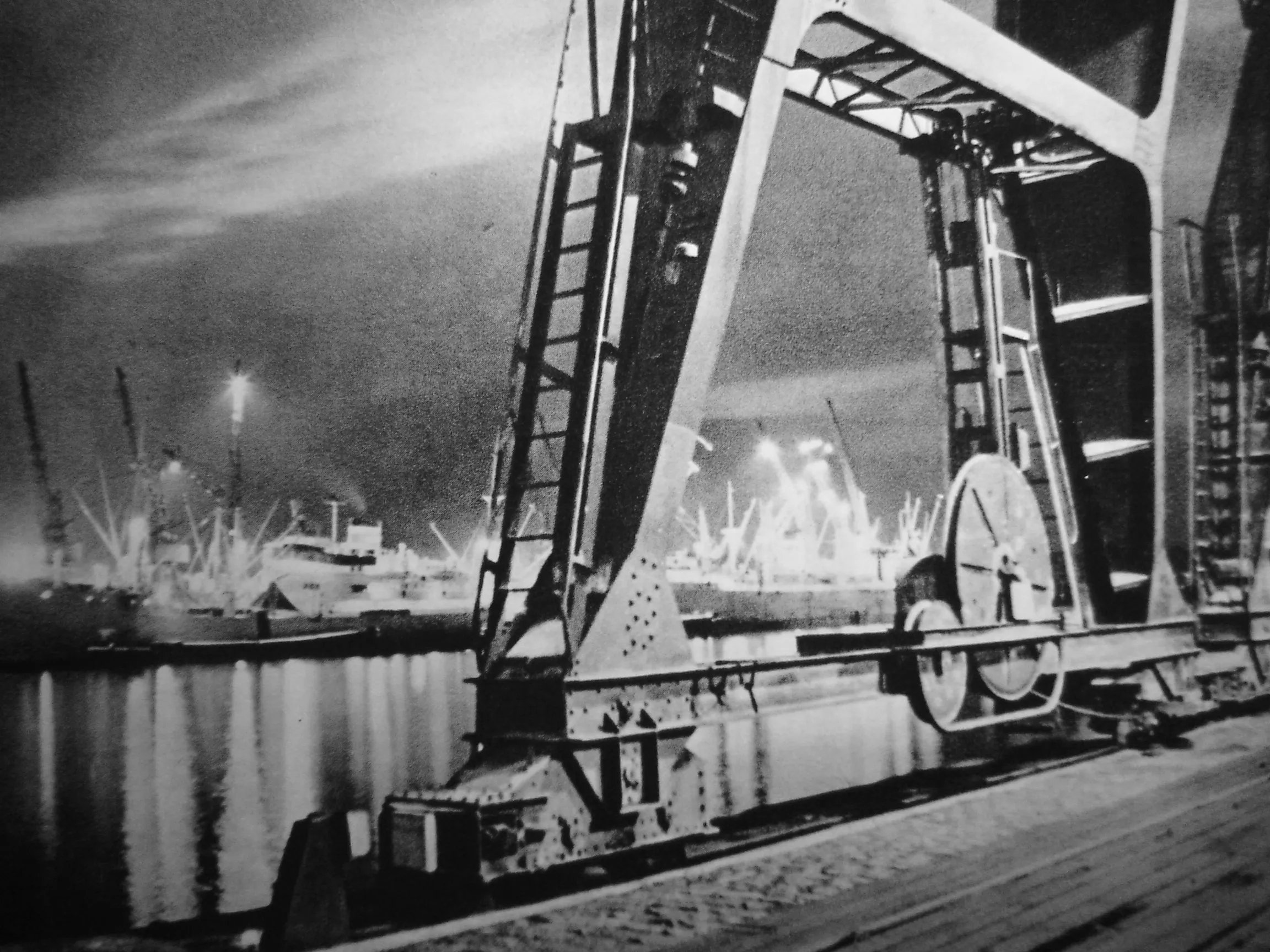
The port of Gdynia as it appeared in 1964, five years after the January 1959 incident in which a glowing red object struck one of the harbor basins — Anonymous / Twenty Years of the People's Republic of Poland (Public Domain)
Credibility Assessment
Low
Multiple WitnessesHistorical DocumentOfficial Report
Event Description
Observed Shape
Sphere
Craft morphology

Non-Human Intelligence (NHI)
Reported Entities
No NHI encounter documented for this event.
Shortly before 5:00 a.m. on January 21, 1959, the pre-dawn darkness over Gdynia's busy commercial harbor was split by an anomalous light. Workers on the night shift at Poland's premier Baltic Sea port — longshoremen, crane operators, and sailors — reported a glowing pink-red object approaching rapidly from the direction of the city. Within seconds it was close enough to make out a distinct oblong shape. Then it struck the water.
Crane operator Władysław Kuczyński was sitting in the cab of a harbor crane when the object flew past at close range. He later told the local newspaper Wieczór Wybrzeża that the object was approximately four meters long and 1.5 meters in diameter, with an initially pale-pink glow that deepened to a vivid red as it descended. Longshoreman Jan Blok, working a night shift aboard the Polish merchant vessel Jarosław Dąbrowski, said he instinctively ducked, convinced the object was going to strike the ship directly. Stanisław Kołodziejski, another dock worker, described it as the size of a 200-liter barrel tumbling through the air. Warehouse employees Jadwiga and Włodzimierz Płonczkier, who contacted the newspaper themselves, reported it as a disc-shaped orange object with pink edges that executed a sharp maneuver as if to avoid hitting the quayside, then dropped almost vertically into the harbor basin. Multiple witnesses described a metallic scraping or grinding sound — metal on metal — immediately before impact. A column of water rose roughly 1.5 meters and the surface steamed for several minutes afterward.
What made the object anomalous, beyond its luminous appearance, was the maneuvering behavior reported by several witnesses. Płonczkier's account specifically describes a course correction just before impact, suggesting some form of controlled descent or aerodynamic response rather than a simple ballistic fall. The object had also reportedly hovered briefly above Plac Kaszubski — a square near the port — before moving toward the basin, though this detail appears in fewer witness accounts and may reflect the fog of a chaotic pre-dawn sighting. No detonation, explosion, or impact crater on the quay was observed; the object entered the water cleanly.
Gdynia's strategic importance in the Cold War context cannot be overstated. As Poland's principal commercial and naval port, the harbor was a significant industrial and military node in the Eastern Bloc's Baltic infrastructure. The port handled Soviet-aligned trade and was in close proximity to Polish Navy installations. Within hours of the impact, the harbor basin was searched by Polish Navy divers, and Urząd Bezpieczeństwa (UB) security service officers reportedly appeared on-scene and took control of any recovered material. Michał Miegoń of the Museum of the City of Gdynia, who investigated the case, confirmed that the military and security services were interested in the incident even while the communist censor allowed initial press coverage — an unusual combination that he acknowledged he could not fully explain. A reward of 1,000 złoty was later offered by the Polish Academy of Sciences (PAN) for anyone who could deliver physical fragments — officially framing the object as a meteorite.
Polish Academy of Sciences researchers, led by meteorite specialist Jerzy Pokrzywnicki, mounted a formal investigation and concluded that the physical and optical characteristics were consistent with a large iron meteorite. Pokrzywnicki argued that the light phenomena, the metallic sound, and the plunge into water were all "fairly typical" of meteorite falls, and he organized a dredging operation in July 1960 that turned up nothing. Other researchers strongly disagreed. The most compelling alternative hypothesis — advanced by Michał Miegoń and others — links the object to the American satellite SCORE (Signal Communications by Orbiting Relay Equipment), which re-entered the atmosphere on exactly January 21, 1959, after completing its mission of broadcasting a recorded message from President Eisenhower. The satellite's re-entry track and the date align precisely, and its recovery by Soviet or Polish authorities would have prompted exactly the kind of sudden security clampdown reported by witnesses. SCORE was a classified project at the time; its debris falling into the hands of Soviet-bloc intelligence services at Gdynia would have been a significant Cold War intelligence event requiring suppression from all sides.
Ufological accounts of the incident add further layers that remain unverified. According to claims published in a Western UFO book and later circulated by Polish researcher Bronisław Rzepecki, harbor guards found a humanoid figure on the city beach in the days following the crash — described as wearing an unusual suit, bearing six fingers on hands and feet, and suffering severe burns. The figure was allegedly transported to a military hospital at Redłowo, where it died when medical staff removed a bracelet from its wrist. A post-mortem examination allegedly revealed atypical internal organ arrangement and an unusual circulatory system. The remains were then said to have been transported to the Soviet Union. Rzepecki claimed he later identified the name of a physician present at the examination, and that the doctor's widow confirmed involvement — but the original source is an unattributed account in a foreign UFO publication, and no primary documentation has surfaced. Polish ufologists, including Rzepecki himself, acknowledge the chain of provenance is too weak to assert the humanoid account as fact. It is treated here as part of the documented folklore around the case, not as verified testimony.
The Gdynia incident was first reported on January 23, 1959, two days after the event, in Wieczór Wybrzeża. The newspaper published multiple follow-up pieces drawing on a range of witness accounts. That press coverage was permitted at all — given that the UB was simultaneously treating the site as a security matter — remains a puzzle to researchers. One interpretation is that allowing a UFO or meteorite narrative to circulate publicly served to deflect attention from a more sensitive explanation, whether a classified satellite recovery or some other Cold War intelligence event. Foreign interest was substantial: Japanese and American television crews later visited Gdynia seeking information. No authoritative official explanation has ever been issued by the Polish government. The case remains open and is considered Poland's most significant UAP incident of the Cold War era, sometimes called the "Polish Roswell."
5 Observables Detected
Instantaneous Acceleration
Hypersonic Velocity
Low Observability
Trans-Medium Travel
Anti-Gravity Lift
Suspicious Activity
Intelligence Agency
Cover-up Actions
Men in Black
Disinformation
Witness Suppression
Sources
mediaWieczór Wybrzeża — first press report on Gdynia UAP incident, January 23, 1959
mediaOnet Podróże — Łukasz Zalesiński, 'Tajemniczy incydent w Gdyni z roku 1959. UFO czy amerykański satelita?' (January 2023)mediaOnet Facet — Piotr Cielebiaś, 'Gdyńska katastrofa UFO z 1959 roku. Świadkowie opowiadają o czerwonym obiekcie' (December 2010)mediaInteria Historia — '21 stycznia 1959 r. UFO nad Gdynią?' (January 2016)mediaPlaneta Trójmiasto — 'Gdyńskie UFO z 1959 roku — legenda, która nie daje spać — wraca!' (January 2026)academicJerzy Pokrzywnicki (PAN) — meteorite analysis cited in Polish Academy of Sciences publication, c. 1960