SightingCold War
Project Hessdalen — Hessdalen Valley, Norway, 1984
January–February 1984
Hessdalen Valley, Norway
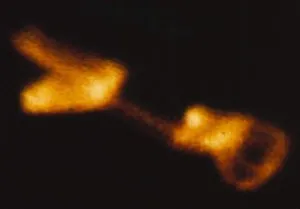
Hessdalen light photographed by Kurt Andressen, winter 1982–83, during the peak activity period that prompted the 1984 scientific expedition — Kurt Andressen / Project Hessdalen (reproduced via Life in Norway)
Credibility Assessment
Moderate
Multiple WitnessesRadar CorroboratedExpert WitnessOfficial Report
Event Description
Observed Shape
Orb
Craft morphology

Non-Human Intelligence (NHI)
Reported Entities
No NHI encounter documented for this event.
Since at least the 1930s, and with particular intensity beginning in December 1981, the 12-kilometer Hessdalen valley in rural central Norway — about 120 kilometers south-southeast of Trondheim — has produced persistent reports of unexplained luminous phenomena. At peak activity between December 1981 and mid-1984, lights were observed 15 to 20 times per week by local residents and visiting researchers. The phenomenon attracted sufficient attention that the Norwegian Army dispatched two officers to investigate, and a formal international scientific expedition, Project Hessdalen, conducted a six-week instrumented field study in January–February 1984. That study established the phenomenon as physically measurable and unidentified by known natural processes, making Hessdalen the most rigorously documented recurring UAP site in the world.
Local residents had been reporting lights for decades before scientific attention arrived. In 1981–1984, hundreds of witnesses filed reports with the Norwegian UFO organizations UFO-Norge and UFO-Sverige, which together initiated Project Hessdalen. The 1984 expedition team included engineers and physicists from Norwegian universities, led by researcher Erling Strand of Østfold University College. J. Allen Hynek, the astronomer who served as scientific consultant to the U.S. Air Force's Project Blue Book and later founded the Center for UFO Studies, visited Hessdalen and stated: "Hessdalen is really a UFO-laboratory." Subsequent research under the EMBLA program was conducted in collaboration with the Italian National Research Council (CNR). Two Norwegian Army officers were officially dispatched to investigate during the peak activity period.
The Hessdalen lights present in multiple forms: a white or yellow-white floating orb that may remain stationary for up to two hours; fast-moving lights traversing the valley at extreme speeds; lights that separate into multiple components and reform; blue and white flashes of short duration; and daytime sightings of metallic-appearing objects. The most common observation is a bright stationary orb positioned along the valley floor, sometimes appearing below the horizon when seen from higher ground. Color transitions from white to yellow-orange to red have been documented. Size estimates based on radar range and angular measurements suggest phenomena ranging from one to several meters across. Temperature estimates based on spectral analysis place the luminous surface at approximately 5,000 Kelvin.
Radar tracking during the 1984 study recorded objects moving at speeds up to 30,000 km/h — far beyond any known aircraft. On January 27, 1984, the lights were simultaneously observed visually and tracked by radar: an oblong-shaped white-and-red blinking light was tracked moving over the mountains. Separate radar contacts detected objects that were not visible to the eye, demonstrating the phenomenon is detectable beyond the optical spectrum. Most significantly, a documented laser interaction protocol produced a repeatable apparent response: in eight of nine trials, pointing a laser beam at an active light caused it to immediately double its blinking frequency, then revert to the original rhythm when the laser was withdrawn. This behavior — a consistent response to directed stimuli — cannot be explained by any known natural phenomenon.
The 1984 expedition instrumented the valley with radar (Atlas 2000), cameras with optical gratings for spectral analysis, infrared viewers, spectrum analyzers, magnetometers, seismographs, and Geiger counters. Fifty-three separate phenomena were documented over the six-week study. Radar confirmed objects with no corresponding visual signature and tracked speeds unattainable by known craft. Physicist Massimo Teodorani documented elevated radioactivity on rocks near a location where a large light ball had been observed during a 2004 field study. Spectroscopic analysis identified hydrogen and oxygen as components of the luminous phenomena, with titanium also identified in some spectra. Measurements placed the phenomenon's temperature near 5,000 Kelvin — consistent with a plasma state but inconsistent with any known natural plasma-generating mechanism in a valley environment.
The Norwegian Army sent two officers to investigate the initial outbreak of activity; their findings were not made public. UFO-Norge and UFO-Sverige officially organized and funded the 1984 expedition, which operated with the knowledge and passive cooperation of Norwegian authorities. No formal government investigation was initiated. In 1994, the first international scientific conference on the Hessdalen phenomenon was convened. In 1998, a permanent Hessdalen Automatic Measurement Station (AMS) was installed by Østfold University College to register lights automatically. In 2018, a formal Hessdalen Observatory was established on a mountain at approximately 1,000 meters elevation. Peer-reviewed papers on the phenomenon have appeared in Acta Astronautica, the Journal of Scientific Exploration, and other publications, representing one of the only UAP cases with a body of mainstream academic literature.
None documented. Norway has not classified or suppressed research findings from Hessdalen. The absence of government engagement — rather than active suppression — has been the primary institutional response. Researchers have noted that mainstream funding agencies have been reluctant to support investigation of a phenomenon labeled anomalous, but this represents institutional inertia rather than deliberate suppression.
Hessdalen represents a unique case in UAP research: a recurring, geographically fixed phenomenon that has been observed continuously for decades, instrumentally measured during multiple scientific expeditions, documented in peer-reviewed literature, and studied using laser interaction protocols that produced apparently responsive behavior. The case cannot be dismissed as misidentification of conventional phenomena given the radar tracks, radioactivity measurements, and spectral data. Proposed natural explanations — piezoelectric plasma from quartz-bearing geology, radon decay products, a natural battery mechanism from the valley's mineral deposits — remain hypothetical and have not been experimentally reproduced. Whatever the Hessdalen lights represent, they constitute the most scientifically documented unresolved aerial phenomenon in the world.
5 Observables Detected
Instantaneous Acceleration
Hypersonic Velocity
Low Observability
Trans-Medium Travel
Anti-Gravity Lift
Suspicious Activity
Intelligence Agency
Cover-up Actions
Men in Black
Disinformation
Witness Suppression