Close EncounterCold War
DMZ UAP Wave — HMAS Hobart Struck, USAF Chief of Staff Admits Cover
June 15–17, 1968
Demilitarized Zone / Tiger Island, South China Sea
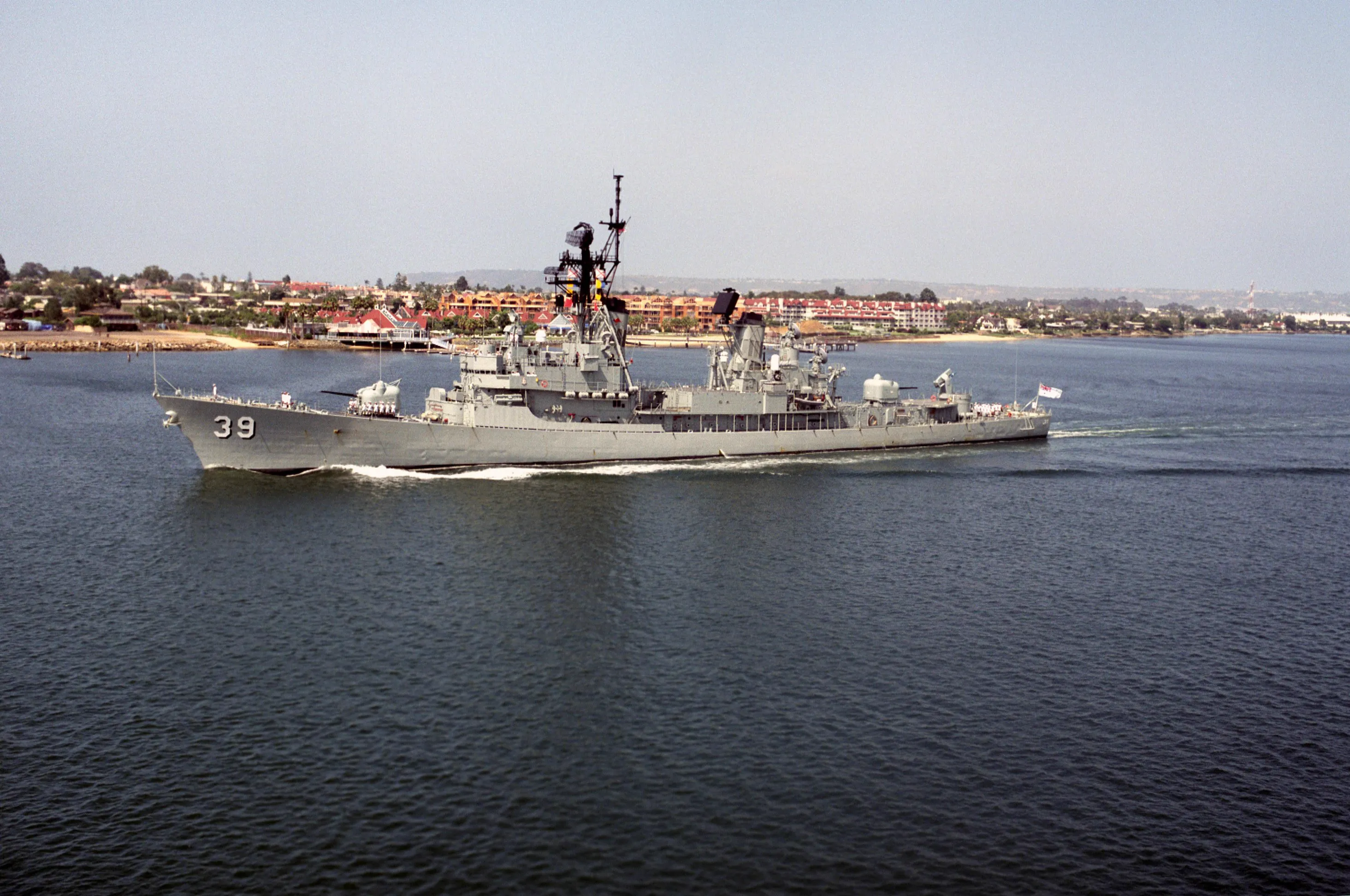
HMAS Hobart (D39), the Royal Australian Navy destroyer struck by three US Sparrow air-to-air missiles on June 17, 1968 during the DMZ UAP wave. Two Australian sailors were killed. — Royal Australian Navy / Wikimedia Commons (public domain)
Credibility Assessment
Exceptional
Military WitnessMultiple WitnessesOfficial ReportGovt. AcknowledgmentPhysical EvidencePilot Witness
Event Description
In the early summer of 1968, Allied forces along the Demilitarized Zone (DMZ) separating North and South Vietnam began reporting repeated sightings of unidentified slow-moving aerial objects at night. Military commanders, under pressure to provide an actionable classification, designated the objects as "enemy helicopters" — a decision later explicitly confirmed and publicly repudiated by one of the most senior military officers in the United States Air Force.
On the night of June 15, approximately 30 slow-moving yellowish-white lights were observed by Allied spotters along the eastern DMZ near the Ben Hai River. F-4 Phantom fighters were scrambled on multiple occasions. The objects moved too slowly for jets, hovered in ways inconsistent with any known rotor aircraft, and showed no IFF (Identification Friend or Foe) transponder responses expected of either allied or enemy aircraft.
In the early hours of June 16–17, US Navy Swift Boat PCF-19 was struck by three air-to-air missiles and sunk, killing five of her seven crew. Jim Steffes, a crew member aboard the companion Swift Boat PCF-12, reported two aircraft hovering approximately 300 yards away at 100 feet altitude — one with a "rounded front like an observation helicopter" with what appeared to be crew visible through a windshield — before the attack. The attacking projectiles were consistent with US Air Force Sparrow air-to-air missiles.
On June 17, HMAS Hobart — the Royal Australian Navy destroyer operating in the same coastal patrol zone — was struck by three Sparrow missiles fired by a US Air Force F-4 Phantom. Two Australian sailors were killed: Ordinary Seaman R.J. Butterworth and Chief Electrician Hunt. Seven more were wounded. The Australian ship's IFF system had registered the incoming aircraft as "friendly," meaning the Phantom's crew had deliberately engaged an identified allied vessel.
The Royal Australian Navy's subsequent inquiry found no evidence that enemy helicopters had been present in the operational area at any point during the engagement period. A US Board of Inquiry attributed the incidents to radar system shortcomings but could not account for why Hobart's IFF had registered a friendly signal moments before impact. No wreckage of any enemy helicopter was found despite intensive sea searches. Captain Ken Shands of HMAS Hobart stated in a 1996 interview: "Neither before nor after the incident…was there any report by any of the ships of a helicopter being there."
On October 16, 1973 — at a press conference in Chicago — USAF Chief of Staff General George S. Brown, speaking from his personal experience as 7th Air Force commander in Vietnam, made one of the most remarkable public admissions by any senior military officer regarding UAPs: "They weren't called UFOs, they were called enemy helicopters, and they were only seen at night and they were only seen in certain places. They were seen up around the DMZ in the early summer of '68, and this resulted in quite a battle. And in the course of this, an Australian destroyer took a hit…there was no enemy at all involved but we always reacted."
Brown's statement — made voluntarily, without prompting, by a four-star general and serving USAF Chief of Staff — is among the most credible government-level admissions in UAP history. It directly confirms that unidentified aerial objects were present, that Allied forces engaged them believing them to be enemy craft, that sailors died as a direct consequence, and that the objects were never identified. The use of a bureaucratic misclassification ("enemy helicopters") to avoid triggering formal UAP reporting protocols is explicitly acknowledged.
5 Observables Detected
Instantaneous Acceleration
Hypersonic Velocity
Low Observability
Trans-Medium Travel
Anti-Gravity Lift
Suspicious Activity
Intelligence Agency
Cover-up Actions
Men in Black
Disinformation
Witness Suppression