SightingCold War
Hoia-Baciu Forest UFO Photographs — Emil Barnea, Romania, 1968
August 18, 1968
Hoia-Baciu Forest, Cluj-Napoca, Romania
One of the Emil Barnea photographs taken on August 18, 1968, showing the silvery disc-shaped object above the Hoia-Baciu Forest clearing, Cluj-Napoca, Romania. — Emil Barnea / ufologie.patrickgross.org — published via Agerpres (Romanian state news agency), September 18, 1968
Credibility Assessment
Moderate
Photo EvidenceMultiple WitnessesExpert WitnessGovt. AcknowledgmentOfficial Report
Event Description
Observed Shape
Disc
Craft morphology

Non-Human Intelligence (NHI)
Reported Entities
No NHI encounter documented for this event.
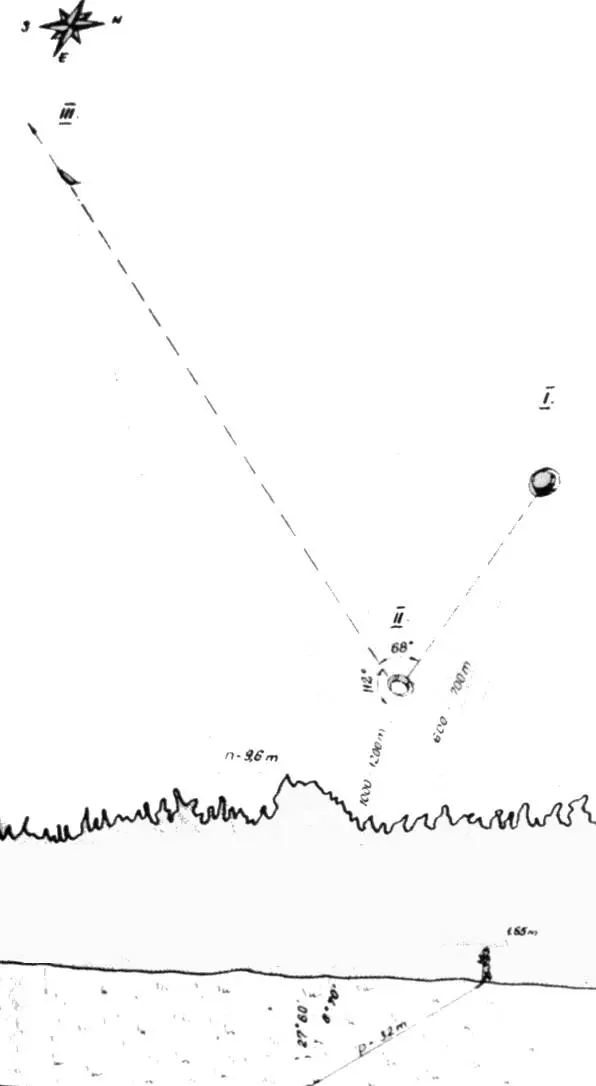
On the afternoon of August 18, 1968, at approximately 13:23 local time, Emil Barnea — a 45-year-old construction technician and former Romanian army officer — was relaxing in a sun-lit clearing of the Hoia-Baciu Forest on the western outskirts of Cluj-Napoca with three companions, including his girlfriend Zamfira Mattea. The forest, also called Baciu Forest, occupies roughly 295 hectares of beech woodland and had already accumulated a local reputation for unusual phenomena dating to researcher Alexandru Sift's investigations earlier in the decade. The group had stopped for lunch near the road connecting Cluj to Bucharest when one of the companions called out that something strange was visible in the sky.
When Barnea looked up, he observed a large, round, flattened object of metallic appearance hovering above the tree line. Witnesses described it as resembling an inverted plate with a pronounced dome on its upper surface and a distinct brim or rim running its circumference. The brim was described as self-luminous — brighter than direct sunlight — while the dome surface remained dark by contrast, a combination of light behavior that analysts would later find scientifically anomalous. The object drifted slowly toward the southwest for a period, then without any apparent transition, accelerated diagonally upward and vanished. Barnea, who had a FED-2 camera loaded with standard ORWO DIN 17 film, managed to capture five photographs of the object during its transit.
One month after the incident, on September 18, 1968, the Romanian state news agency Agerpres published one of the five photographs, accompanied by a written account by Barnea. The image was also broadcast by Romanian national television, making it an unusually public disclosure for a communist-bloc country where official attitudes toward paranormal claims were hostile. Romanian ufologist Ion Hobana conducted his own investigation, meeting Barnea in 1968 and again in 1970, and submitted the photographs for expert analysis. Specialists from the Faculty of Architecture in Cluj-Napoca conducted geometric modeling of the light source, concluding that the brim's luminosity exceeded solar illumination levels and that the shadow geometry on the object was inconsistent with any single external light source — including the sun.
The photographs were subsequently submitted to the Belgian LAET (Laboratoire d'Analyse des Emissions de Terre) laboratory in Brussels by the French specialized journal Lumières dans la Nuit. The LAET analysis declared that the images presented "major elements of authenticity" and found an "absence of detectable evidence of a possible fake." Belgian and French analysts independently examined the shadow angles across the photographs and confirmed that the illumination pattern could not be produced by a simple artificial light source superimposed on a fabricated object. No mechanism of fakery was identified in any of the examinations. As of the time of writing, no subsequent analysis has succeeded in demonstrating how the photographs could have been forged.
Barnea's public disclosure carried a severe personal cost under Romania's communist government, which operated under Nicolae Ceaușescu's rule from 1965 onward. State ideology treated belief in paranormal phenomena as ideologically unsound — a form of bourgeois mysticism inconsistent with Marxist-Leninist materialism — and official reports of UFOs risked being interpreted as deliberate sabotage of public confidence in the state. Barnea lost his job following his report. His three companions, who could have provided independent corroboration, declined to be publicly identified and requested their anonymity be preserved, reportedly out of fear of similar professional or social consequences. The context of that suppression itself became a secondary datum for researchers: in a society where reporting cost you your livelihood, the incentive to fabricate was near zero.
The case achieved international recognition at the 1977 International UFO Congress held in Acapulco, Mexico, where the Barnea photographs were among the European cases presented to the assembled researchers. The images became — and remain — the most frequently cited and analyzed UAP photographs from Eastern Europe. Within the community of European UFO researchers, the case is grouped alongside the 1950 McMinnville photographs and the 1958 Trindade Island photographs as among the small number of historical UAP images that have survived repeated expert scrutiny without a definitive debunking.
The Hoia-Baciu sighting did not occur in isolation. The day prior, on August 17, 1968, the crew of a TAROM (Transporturile Aeriene Române) airliner reported a UAP observation near Oradea, approximately 150 kilometers west of Cluj. The proximity in both time and geography of a commercial aviation crew sighting and Barnea's ground-level photographs — occurring on consecutive days in the same region — was noted by Romanian investigators, though no formal connection has been established. The TAROM case added a layer of pilot-witness corroboration to the regional event cluster.
What distinguishes the Hoia-Baciu incident in the broader UAP evidence record is the convergence of several independently verifiable factors: a witness with military background and no evident financial motive; five photographs taken with a period-appropriate film camera; laboratory authentication by two independent institutions in different countries; anomalous light behavior that specialists could not explain by any conventional optical model; and the confirming pressure of state reprisal, which speaks indirectly to the witness's conviction. The case represents one of the most rigorously analyzed UAP photograph events in European Cold War–era history.
5 Observables Detected
Instantaneous Acceleration
Hypersonic Velocity
Low Observability
Trans-Medium Travel
Anti-Gravity Lift
Suspicious Activity
Intelligence Agency
Cover-up Actions
Men in Black
Disinformation
Witness Suppression