SightingCold War
Nakhon Phanom Radar Track — Laos Border, 1968
November 28, 1968
Laos–Thailand Border, Nakhon Phanom Province
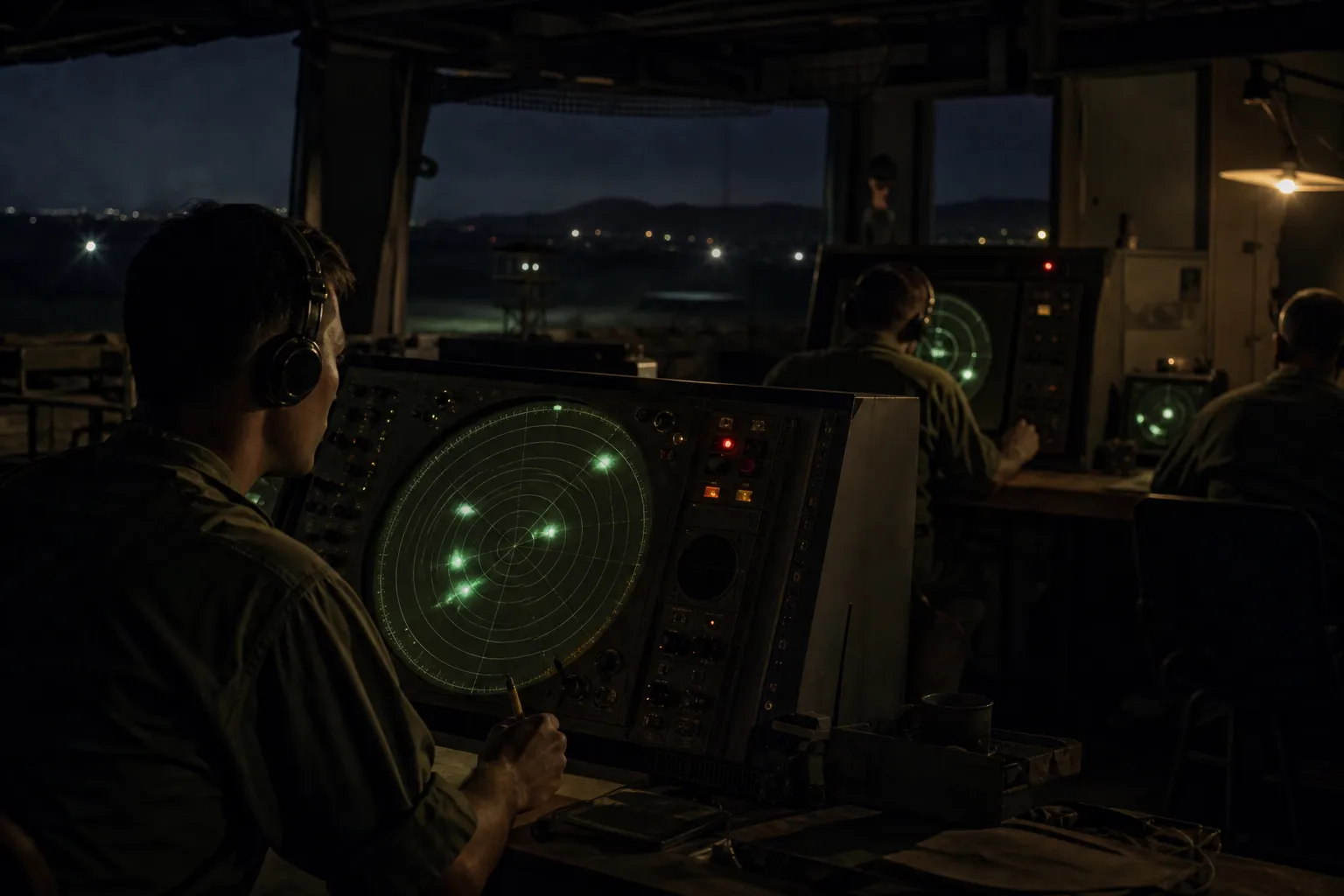
AI-rendered impression — a radar scope showing anomalous returns over the Laos–Thailand border zone at night, 1968 — UAP Archive / openai (gpt-image-1)
Credibility Assessment
Moderate
Military WitnessRadar CorroboratedOfficial Report
Event Description
During the Vietnam War, the airspace over Laos — known to US forces as the "Secret War" theater — was among the most intensively monitored in Southeast Asia. US and allied radar installations tracked an enormous volume of aerial traffic, including hostile aircraft, supply convoys, and covert operations. Against this background of heightened surveillance, a formal US military intelligence report dated December 26, 1968 documented radar contacts with unidentified targets in the Laos–Thailand border area that defied explanation. The document, a Defense Intelligence Agency (DIA) Intelligence Information Report written by USAF Major Dale Fulton, Air Attaché at the US Embassy in Vientiane, constitutes an official US government record of an unidentified aerial phenomenon over Laotian territory — unique in the documentary record of the Southeast Asian conflict.
The primary author and senior witness was USAF Major Dale Fulton, serving as Air Attaché at the US Embassy, Vientiane, Laos — a senior aviation-specialist diplomatic post requiring a serving US Air Force officer with operational and intelligence credentials. The report was filed through Defense Intelligence Agency channels, meaning it passed through a formal military intelligence review process before archiving. Radar operators at the Nakhon Phanom RTAFB (Royal Thai Air Force Base) Command Post — Thai military air traffic controllers with professional training — first detected the targets and notified the command post. The operators evaluated and dismissed atmospheric anomaly as a cause ("not ghosts") before escalating. Knife-27, the helicopter crew dispatched to investigate, constitutes additional military personnel who searched the area, though they made no visual contact.
On the night of November 28, 1968, in the early morning hours, radar operators at Nakhon Phanom RTAFB Command Post detected multiple unidentified targets moving through the Laos–Thailand border zone. The targets demonstrated anomalous features — behavior inconsistent with known aircraft traffic in the area and inconsistent with the atmospheric clutter patterns the operators were trained to recognize. The operators informed the command post that the returns "definitely were not ghosts," the professional terminology for radar artifacts. A helicopter crew (designated Knife-27) was scrambled and dispatched to the area but returned without visual contact. Major Fulton's December 26 report compiled the radar data, the helicopter crew's negative visual search, and the operators' assessment into a formal DIA intelligence document.
The anomalous characteristics of the radar returns are described in terms of behavior inconsistent with known traffic and inconsistent with atmospheric propagation artifacts. In a theater where US forces maintained continuous radar surveillance specifically to track every aerial movement, contacts that both experienced radar operators and a trained Air Attaché could not attribute to known aircraft, weather, or equipment artifact represent a genuine unresolved phenomenon. A second related DIA report, dated September 6, 1969, from analyst Robert Kaehler (OSI), explicitly stated that radar and visual sightings of UFOs were "not a new phenomenon, particularly at night" in the Thailand–Laotian border zone — indicating this was a recurrent pattern rather than an isolated anomaly.
The evidence in this case is exclusively radar-instrument data, documented in formal DIA reporting. No visual contact was made by Knife-27. The radar returns met the professional threshold for anomalous classification by trained military operators who had extensive experience with the specific atmospheric and traffic conditions of the area. The DIA archive preserving the Fulton report constitutes the physical record; the document was declassified and referenced in later UFO research.
The sighting generated a formal Defense Intelligence Agency Intelligence Information Report — a classified government document within the US military intelligence system. The helicopter scramble (Knife-27) represents a direct tactical military response. A follow-up DIA report from September 1969 confirmed the pattern was recurrent. However, as with most Vietnam War-era military UAP reports, no formal investigation beyond the initial reporting was conducted, and the primary US focus was on determining whether the objects were hostile enemy craft (a determination that was not made).
The document was classified on filing but has since been declassified and accessed by UFO researchers through FOIA processes. The wartime classification served national security purposes unrelated to UAP concealment. The secondary 1969 DIA report explicitly acknowledging recurrent radar-and-visual UFO phenomena in the border zone suggests that within the intelligence community, the phenomenon was considered a known operational factor rather than something requiring active suppression.
The Fulton DIA report is the only officially filed US government UAP intelligence document originating from Laotian territory. Its significance lies in its provenance: written by a serving USAF officer of Air Attaché rank, filed through Defense Intelligence Agency channels, and reflecting professional radar operators' assessed rejection of all conventional explanations. The secondary 1969 Kaehler report contextualizes it within a pattern of recurrent UAP activity in the Thailand–Laos border zone during the peak of US combat operations. Both documents are part of the Vietnam War-era UAP record that has been studied by researchers including Peter Davenport (NUFORC) and academics examining UAP reports in wartime contexts.
5 Observables Detected
Instantaneous Acceleration
Hypersonic Velocity
Low Observability
Trans-Medium Travel
Anti-Gravity Lift
Suspicious Activity
Intelligence Agency
Cover-up Actions
Men in Black
Disinformation
Witness Suppression
Sources
governmentUSAF Major Dale Fulton — Defense Intelligence Agency Intelligence Information Report, December 26, 1968 (declassified)
governmentRobert Kaehler (OSI) — DIA report 'Unknown Entity — Unidentified Object Thought to be Helicopter Observed Near Nakhon Phanom RTAFB', September 6, 1969
mediaOpenMinds.tv — 'UFOs During the Vietnam War' (synthesizes declassified DIA documents)mediaListverse — '10 UFO Stories From The Vietnam War Era'