SightingModern Era
Male Formation — Maldives, 2008
November 5, 2008
Malé, Maldives
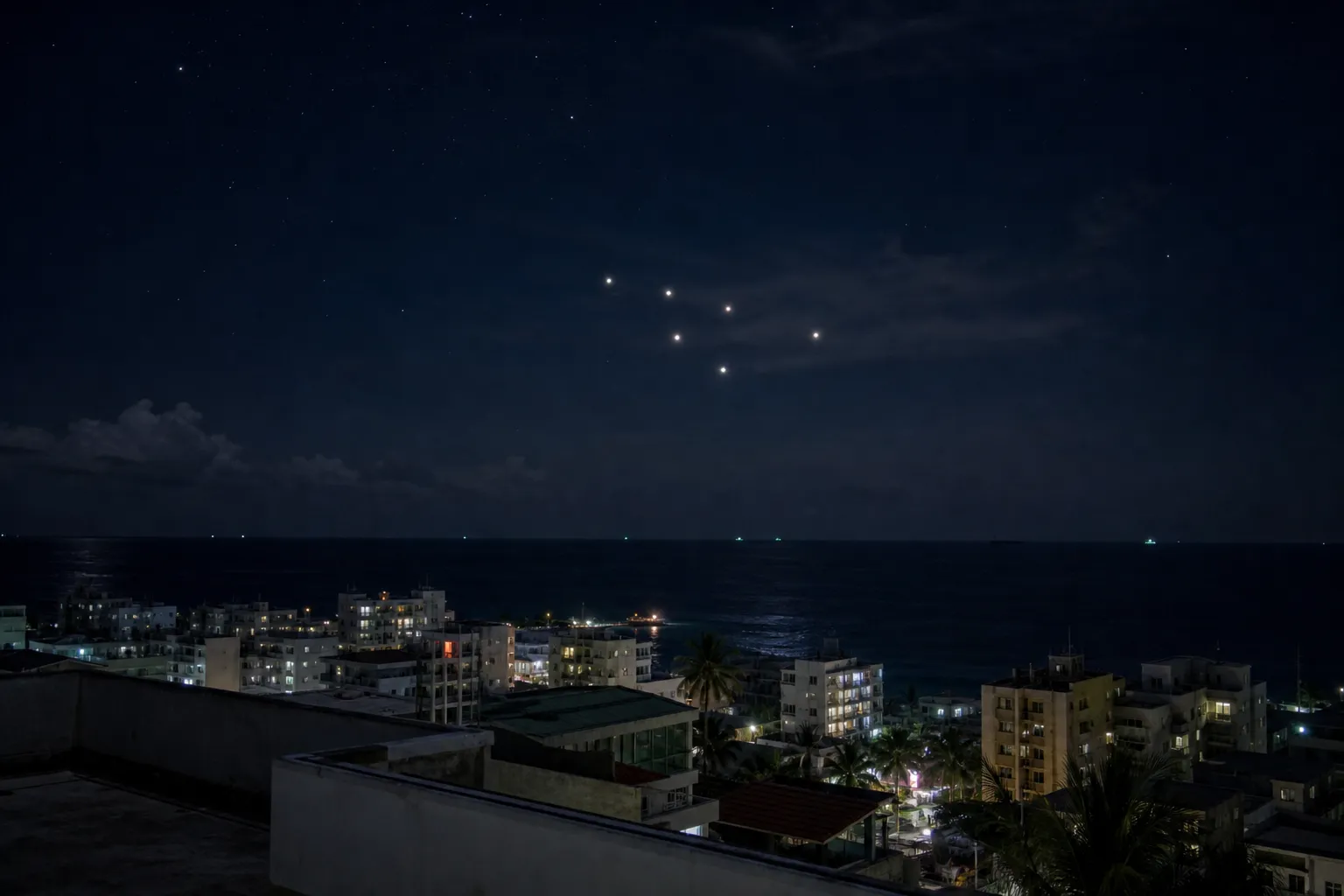
AI-rendered impression — a changing formation of white lights over the Indian Ocean night sky viewed from a Malé rooftop, November 2008 — UAP Archive / openai (gpt-image-1)
Credibility Assessment
Low
Multiple Witnesses
Event Description
Malé, the capital of the Maldives and one of the most densely populated cities on Earth by area, sits at sea level barely a meter above the Indian Ocean, surrounded by nothing but open water and the vast arch of equatorial sky. On the evening of November 5, 2008, two observers dining at an outdoor rooftop restaurant in Malé had an unobstructed view of the night sky and the distant horizon when they noticed a formation of unusual lights moving in a coordinated, slow pattern through the sky to the south. The sighting lasted 30 minutes — long enough for the witnesses to rule out conventional aircraft and observe the formation change shape, direction, and luminosity multiple times. The report was filed with NUFORC the same evening, providing contemporaneous documentation with minimal memory distortion.
Two witnesses observed the phenomenon from a rooftop restaurant, providing mutual corroboration. The contemporaneous same-evening filing with NUFORC (at 8:46 AM Pacific — accounting for time zone difference) demonstrates the witnesses acted immediately to document their observation, indicating they treated it as a significant and anomalous event. The rooftop restaurant context — open-air, elevated, with clear sky access — provided optimal viewing conditions. No professional credentials are specified, but the precise, analytical nature of the report (ruling out airport traffic by comparing known aircraft appearance, estimating formation size by angular width at estimated distance) indicates methodical observers.
At 7:30 p.m. local time, the witnesses observed a formation of initially 5–7 white lights moving slowly from left to right. The formation then changed direction, moving right to left. The lights shifted in color and changed in number — sometimes appearing as 5–7 individual lights, at other times coalescing into a triangular arrangement of 3 with a single trailing light. The formation moved too slowly and lacked sufficient brightness to be consistent with commercial aircraft traffic departing Malé's Ibrahim Nasir International Airport, which the witnesses explicitly ruled out. The total duration of observation was approximately 30 minutes. At the estimated distance of 10–50 miles, the formation would have been 1–2 miles in total width — suggesting a large structure or a coordinated group of large objects.
A multi-light formation that reverses direction twice over a 30-minute period, changes configuration between 3-triangle and 7-scattered arrangements, and operates at a scale of 1–2 miles is inconsistent with any known conventional aircraft, satellite, or natural phenomenon. Satellites do not reverse direction. Aircraft do not form shape-shifting formations. Weather phenomena do not produce discrete luminous formations of this character. The witnesses' explicit elimination of airport traffic — based on the lights' insufficient brightness, unusual speed, and atypical behavior for Malé's well-known approach corridors — is a methodical observational argument rather than speculation.
No physical trace evidence or instrument corroboration documented. The case rests on two-witness testimony filed same-day with NUFORC. Malé's equatorial night sky location — far from major continental light pollution — provides optimal naked-eye observation conditions, making the 30-minute sustained observation reliable.
No Maldivian government or military response was documented. The Maldives National Defence Force (MNDF) maintains responsibility for air and maritime surveillance, but no MNDF statement regarding this observation was made publicly. The case was documented entirely through NUFORC.
No evidence of suppression. The Maldives has no institutional UAP investigation infrastructure. The contemporaneous NUFORC filing provides the sole formal record.
The Malé 2008 sighting is the most credibly documented UAP case from the Maldives in the NUFORC indexed record. Its significance lies in the 30-minute duration, the two-witness structure, the same-evening documentation, and the witnesses' methodical elimination of conventional explanations. The Maldives' geographic position — astride Indian Ocean shipping and aviation corridors, and close to the US Navy's Diego Garcia base — makes UAP documentation from this region of operational interest. The case establishes the Maldives' first entry in the archive.
5 Observables Detected
Instantaneous Acceleration
Hypersonic Velocity
Low Observability
Trans-Medium Travel
Anti-Gravity Lift
Suspicious Activity
Intelligence Agency
Cover-up Actions
Men in Black
Disinformation
Witness Suppression