Close EncounterCold War
Manises UFO Incident
November 11, 1979
Valencia, Spain
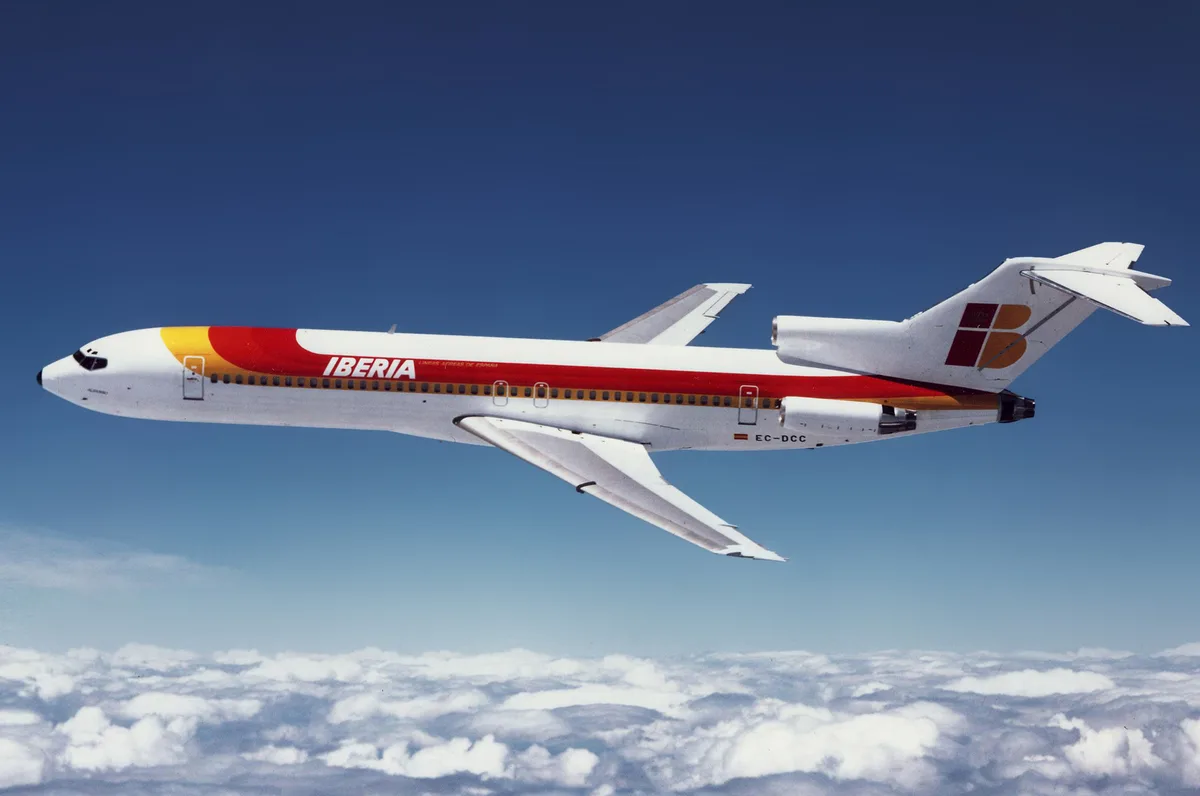
Iberia Airlines Boeing 727 — the aircraft type Captain Lerdo de Tejada was flying when he diverted to Valencia after an unidentified object approached Flight IB-297 on November 11, 1979 — Wikimedia Commons / CC BY-SA
Credibility Assessment
Exceptional
Pilot WitnessMilitary WitnessRadar CorroboratedOfficial ReportMultiple Witnesses
Event Description
Observed Shape
Orb
Craft morphology

Non-Human Intelligence (NHI)
Reported Entities
No NHI encounter documented for this event.
On the night of November 11, 1979, Iberia Airlines Flight IB-297 was en route from Salzburg to Las Palmas, Gran Canaria, carrying 109 passengers over the Mediterranean, when Captain Javier Lerdo de Tejada observed unidentified red lights approaching his Boeing 727 from the northeast at high speed. The objects closed to within ten kilometers of the aircraft before maneuvering alongside it. Captain Lerdo de Tejada, assessing the proximity as a genuine collision risk, made the decision to divert the flight to Valencia's Manises Airport — an emergency landing that represented an extraordinary deviation from normal commercial operations.
After passengers disembarked, the unidentified objects continued to operate in the vicinity of the airport. The Spanish Air Force, tracking the objects on radar, scrambled two McDonnell Douglas F-1 Mirage jets. Pilot Lieutenant Arturo Sánchez-Vallejo, callsign Alfa 7, achieved visual contact at 20,000 feet and described an object with blinking lights performing maneuvers impossible for any aircraft in the USAF or NATO inventory. When Sánchez-Vallejo attempted to close distance and achieve a targeting solution, the object accelerated away and he was unable to maintain pursuit. A second scramble was ordered; the result was the same. Spanish Air Force ground radar tracked the objects throughout the entire event from the initial civilian airliner diversion through the military intercept attempts.
Captain Lerdo de Tejada subsequently filed a formal report through Iberia's command structure and with Spanish aviation authorities. The Spanish Air Force conducted one of the most thorough official UAP investigations in European history — remarkable among NATO air forces for its relative openness. The official finding stated that no satisfactory conventional explanation had been established for the events of November 11, 1979. The Air Force's formal report identified the objects as genuinely unidentified.
The Manises incident became a landmark case in European UAP history for multiple reasons: it involved a commercial airline diversion based on a UAP proximity judgment by a senior captain, a multi-phase military intercept operation, radar tracking from the ground, and a formal Air Force investigation that reached an explicitly inconclusive finding. It was directly cited as a factor in Spain's decision to begin declassifying its UAP investigation files in 1992 — one of the first NATO nations to do so.
5 Observables Detected
Instantaneous Acceleration
Hypersonic Velocity
Low Observability
Trans-Medium Travel
Anti-Gravity Lift
Suspicious Activity
Intelligence Agency
Cover-up Actions
Men in Black
Disinformation
Witness Suppression
Sources
governmentSpanish Air Force declassified files, 1993
witnessCapt. Francisco Javier Lerdo de Tejada, Iberia Airlines