SightingCold War
Nicaraguan Air Force Pilot UAP Intercept — Managua, 1978
c. 1978
Managua, Nicaragua
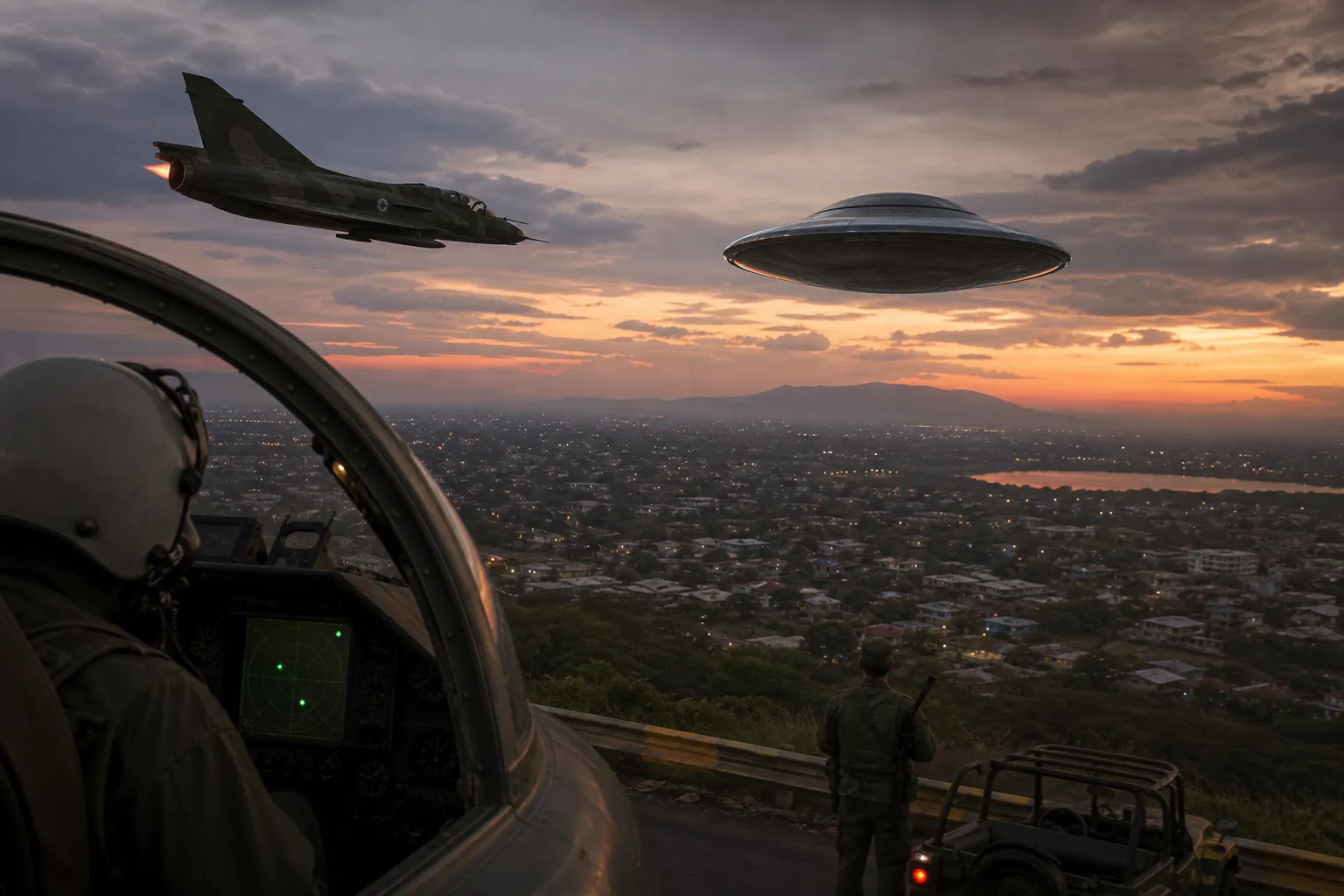
AI-rendered impression — A Nicaraguan Air Force pilot closing on a large metallic disc over Managua while ATC radar tracks the contact and a National Guard sergeant observes from the highway below, 1978 — UAP Archive / openai (gpt-image-1)
Credibility Assessment
Low
Military WitnessMultiple WitnessesRadar CorroboratedLaw EnforcementPilot WitnessOfficial Report
Event Description
Observed Shape
Disc
Craft morphology

Non-Human Intelligence (NHI)
Reported Entities
No NHI encounter documented for this event.
Nicaragua in 1978 was in the final throes of the Somoza dynasty — the Sandinista insurrection was reaching its peak and would overthrow Anastasio Somoza in 1979. The Fuerza Aérea de Nicaragua (FAN), equipped with T-28 trainers, T-33 jets, and a small number of combat aircraft, was on active operational alert due to the guerrilla war. Las Mercedes Airport (today Augusto C. Sandino International Airport) served as the FAN's primary base. National Guard checkpoints throughout the country were on high alert, making military and security personnel — motivated to identify any unknown aircraft that might be ferrying supplies or personnel to the Sandinistas — among the most attentive and motivated observers available.
A National Guard checkpoint sergeant — a law enforcement officer with formal observation training — first reported the object from his position northwest of Managua. The FAN duty officer scrambled a pilot, who made visual contact and narrated his observation by radio before losing the object. Air traffic control at Las Mercedes confirmed an unidentified radar return at the reported position. The three witness categories — National Guard (law enforcement), FAN pilot (military aviation professional), and ATC radar operator (trained technical observer) — provide independent multi-source corroboration from ground, air, and radar perspectives simultaneously.
The National Guard sergeant described a large, bright disc moving slowly at low altitude, silent, with a metallic sheen. The FAN pilot, approaching for identification, confirmed the disc shape and estimated it as substantially larger than any aircraft in the FAN's inventory. The object was stationary or near-stationary when first spotted, then executed a series of tight-radius turns before the pilot attempted to follow, at which point it accelerated to a speed the pilot described as beyond any jet aircraft he knew. Las Mercedes ATC confirmed the radar return and its rapid departure.
The radar-visual combination — ATC radar contact plus airborne and ground visual confirmation — is the primary evidentiary strength. The disc shape, metallic surface, silent operation, hovering capability, tight-radius turns, and terminal acceleration were all inconsistent with any known 1978 aircraft. In a country at war, identifying unknown aircraft was operationally critical, giving military and security observers strong motivation to make accurate identifications.
Las Mercedes ATC radar contact is documented. The return was tracked by the duty radar operator before and during the FAN pilot's intercept attempt. No communications interference or physical trace is recorded.
The incident was entered in the FAN's operational log. NICAP's Latin American correspondent documented the case from Nicaraguan military contacts. The political chaos of 1978 meant that no formal investigation was conducted; the Somoza regime had more pressing security concerns.
Nicaragua's 1978 political crisis effectively subsumed any other form of official attention. No active suppression of this specific report is documented. Military classification of the operational log provided the default non-disclosure.
The Nicaragua 1978 case provides the radar-visual combination that is among the strongest evidence categories in UAP research, combined with three independent witness categories from different vantage points. The operational context — a military force actively hunting Sandinista supply routes — means these were among the most motivated identifiers possible. The case contributes to the documented pattern of radar-visual UAP encounters across Central America during the late 1970s.
5 Observables Detected
Instantaneous Acceleration
Hypersonic Velocity
Low Observability
Trans-Medium Travel
Anti-Gravity Lift
Suspicious Activity
Intelligence Agency
Cover-up Actions
Men in Black
Disinformation
Witness Suppression
Sources
mediaNICAP Latin American network — Nicaragua FAN case files, 1978
mediaAPRO Bulletin — Central American military reports, 1978 series
mediaLa Prensa (Managua) — National Guard UAP report, 1978 (contemporaneous press coverage)