SightingMedieval
Celestial Phenomenon Over Nuremberg
Apr 14, 1561
Nuremberg, Holy Roman Empire (Germany)
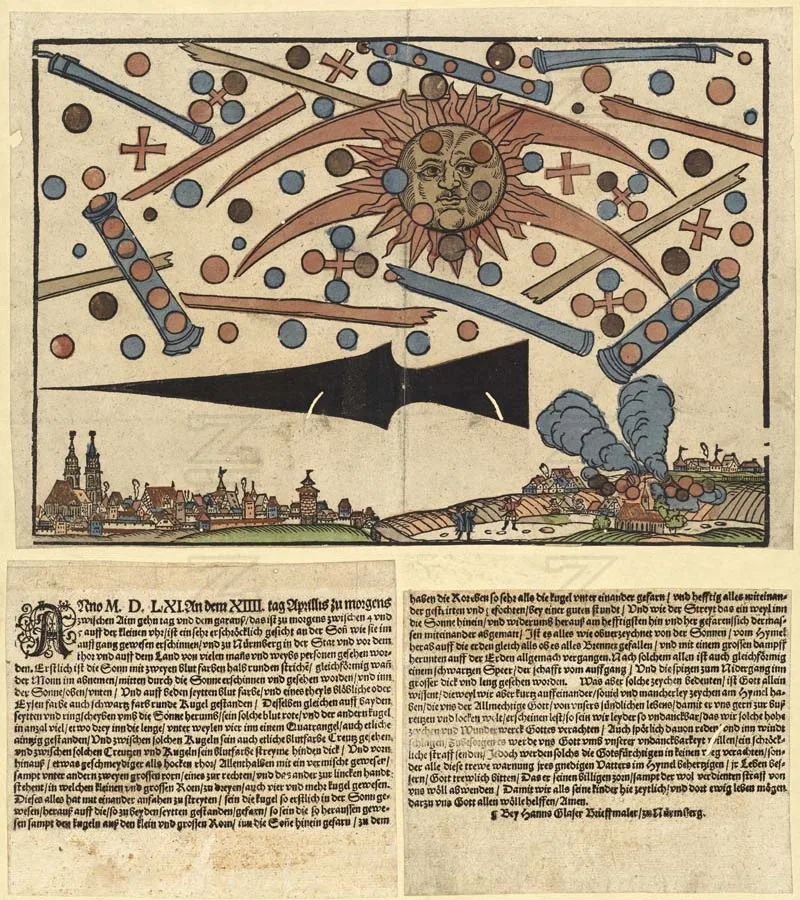
Hans Glaser's 1561 broadsheet woodcut depicting the 'celestial phenomenon over Nuremberg' on April 14, 1561 — Hans Glaser / Zentralbibliothek Zürich / Public Domain
Credibility Assessment
Moderate
Multiple WitnessesHistorical Document
Event Description
Observed Shape
Sphere
Craft morphology

Non-Human Intelligence (NHI)
Reported Entities
No NHI encounter documented for this event.
On the morning of April 14, 1561, the sky above Nuremberg erupted into what witnesses described as a violent aerial spectacle. Citizens watched as hundreds of spherical objects — described as blood-red, blue-black, and leaden in color — emerged from two large cylinders hovering over the city. The objects moved at tremendous speed, maneuvering against one another before many appeared to fall to earth and burn in a cloud of steam. The phenomenon lasted approximately one hour beginning at sunrise and was observed from multiple vantage points across the city.
Hans Glaser, a printer in Nuremberg, published a broadsheet recording the event in detail with a woodcut illustration — now one of the most iconic documents in the history of recorded aerial phenomena. His woodcut depicts globes, cylinders, crosses, and a dark lance-like object among the forms in the sky. The forms are depicted with remarkable variety: some spherical, some cylindrical, some cross-shaped. Glaser described the event as a 'very frightful spectacle' and noted that many objects crashed to earth and 'wasted away on the earth with immense smoke.' The broadsheet functioned as the news media of its time and circulated widely across German-speaking Europe.
The original broadsheet is held at the Zentralbibliothek Zürich, where historian Ilse von zur Mühlen has authenticated the document and confirmed its period accuracy. The Nuremberg broadsheet is not unique: a similar but distinct celestial phenomenon over Basel, Switzerland in 1566 produced another broadsheet describing black spheres maneuvering in large numbers against the morning sun, with objects appearing to battle each other and some falling to earth. Both documents describe structured forms in large numbers conducting what witnesses interpreted as combat.
Modern researchers note the structural similarity between Glaser's described forms — particularly the cylinders releasing spheres — and patterns in contemporary UAP reports. Whether the 1561 event reflects genuine anomalous phenomena, mass misinterpretation of a natural event such as a meteor shower or atmospheric optical effect, or early modern storytelling conventions for the extraordinary, the Nuremberg broadsheet represents the most detailed and visually documented pre-industrial aerial phenomenon account in European historical records.
5 Observables Detected
Instantaneous Acceleration
Hypersonic Velocity
Low Observability
Trans-Medium Travel
Anti-Gravity Lift
Suspicious Activity
Intelligence Agency
Cover-up Actions
Men in Black
Disinformation
Witness Suppression