SightingCold War
USAF Weather Observer Reports Red Rotating Triangle — Simiutak, Greenland, 1953
June 24, 1953
Simiutak Island, Southwest Greenland
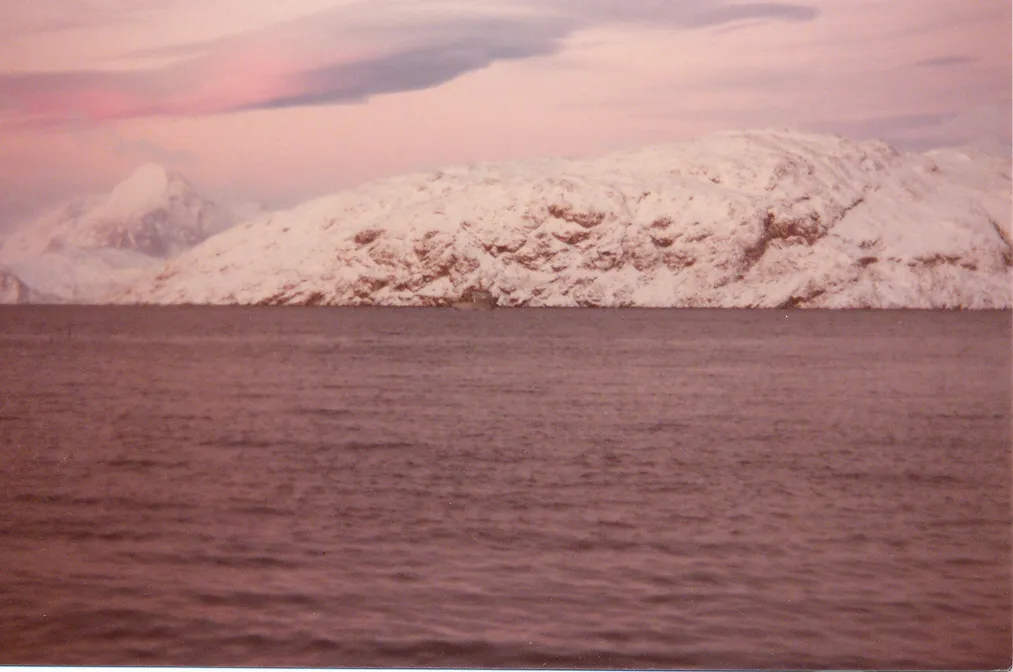
Arsuk Fjord, southwest Greenland — the rugged coastal landscape of the region where USAF weather observer R.A. Hill reported a red rotating triangle at Simiutak Island on June 24, 1953 — Wikimedia Commons / public domain
Credibility Assessment
Low
Military WitnessExpert Witness
Event Description
Observed Shape
Triangle
Craft morphology

Non-Human Intelligence (NHI)
Reported Entities
No NHI encounter documented for this event.
Shortly before noon on June 24, 1953, Airman Second Class R.A. Hill was on duty at the United States Air Force meteorological station on Simiutak Island in southwest Greenland — the remote site that had served the United States as Bluie West Three, a radio direction-finding and weather station operated by the U.S. Coast Guard and Navy beginning in World War II. At 11:30 local time, Hill observed a red, triangular object that hovered and rotated before climbing away on a sustained vertical trajectory lasting five full minutes. The conditions — mid-summer in southwest Greenland — provided extended daylight and clear visibility, and Hill was at his post in his professional capacity, conducting meteorological observations that specifically require precise discrimination between atmospheric phenomena, instruments, and anomalous aerial contacts.
The Simiutak 1953 case occupies a quiet but important position in the early Cold War UAP record. It does not carry the institutional weight of a Project Blue Book UNKNOWN designation in the available sources, and it has a single military witness rather than multiple. But the quality of that single witness — a working weather observer whose entire professional function involves identifying and tracking aerial and atmospheric objects — elevates the credibility of this report substantially above that of an untrained civilian sighting.
Airman Second Class R.A. Hill was a USAF weather observer assigned to the meteorological station at Simiutak. His professional role is the critical credentialing factor in this case. A military weather observer in 1953 performed the following tasks routinely and as a matter of duty: tracking radiosonde weather balloons from launch to burst altitude, recording their ascent rate, color, and behavior at altitude; observing and recording cloud types, ceiling heights, and atmospheric optical phenomena including halos, sundogs, and coronas; identifying and logging aircraft at altitude for upper-wind reporting; and using theodolites and visual instruments to track aerial objects with precision. Specifically, a weather observer releasing and tracking a radiosonde balloon every six or twelve hours — as was standard at remote stations — is more familiar with the appearance, behavior, ascent rate, and visual signature of a balloon at altitude than almost any other military specialist. Hill's ability to distinguish the observed object from a radiosonde balloon, from an aircraft, and from an atmospheric optical effect is not an inference — it is the direct product of his job training and daily operational practice.
At 11:30 local time — mid-morning on a clear June day at 66°N, with the sun already well up in the sky and Arctic visibility allowing observations to distances of many miles — Hill observed an object that he described as red and triangular in shape. The object was hovering at the time of initial observation: it was stationary relative to the ground, not drifting with any wind current, not following a ballistic arc, and not maintaining the constant azimuth drift and predictable ascent rate of a radiosonde balloon. The object was rotating. The rotation was a distinct physical behavior observable during the 15-second hover phase: a triangular shape rotating about its own axis is easily recognized as such by a trained observer who regularly watches instrument packages spin as they ascend on a balloon line.
After the 15-second hovering and rotation phase, the object began to climb. The ascent was not the gentle, drift-influenced rise of a balloon but a continuous, directed vertical climb that Hill tracked for five full minutes before it passed out of sight. Five minutes of active tracking by a trained weather observer — a person with a theodolite and trained eyes — constitutes a substantial observation period. The object's trajectory during the ascent was consistent enough and sustained enough for Hill to track it continuously over that interval. At Arctic latitudes in June, the horizon is farther and the sky brighter than at lower latitudes; an object climbing until out of sight would need to reach a considerable altitude or angular distance before becoming irresolvable, suggesting the climb was either extremely fast or continued to a very high altitude.
Three aspects of the observation are anomalous. First, the shape: no conventional 1953 aerial platform — balloon, aircraft, or rocket — presented a red triangular form. Military aircraft of the period were aluminum or painted drab/silver, not red; they did not hover; and their profiles from below or at angle were aerodynamic rather than geometric. Second, the rotation: a rigid triangular object rotating about its own axis while hovering has no conventional 1953 analogue. Weather balloons rotate but are spherical; aircraft bank but do not spin in place. Third, the five-minute powered vertical ascent: a balloon ascending vertically takes not five minutes but many tens of minutes to reach stratospheric altitudes, and its ascent rate is well-known to a weather observer. An object that climbs to invisibility in five minutes is moving at a vertical rate inconsistent with any balloon and inconsistent with any 1953 fixed-wing or rotary aircraft, none of which could sustain a vertical climb to invisibility in five minutes.
No instrument effects were documented in the available record. Hill was using his visual observation skills and standard meteorological observation equipment. No radar tracking from Simiutak was noted in the available sources. The station's primary instruments were meteorological — theodolite, pibal telescope, radiosonde receivers — rather than air search radar. Whether the observation was reported to any radar-equipped facility in the region is not established in open sources.
The case was documented by NICAP in its 1953 casebook. No Project Blue Book case number has been publicly identified in connection with this event, though Hill, as an on-duty military observer, would have had reporting obligations that likely generated some form of internal documentation. The absence of a confirmed Blue Book entry may reflect routine disposition of low-priority single-witness cases or incomplete indexing in the declassified archive. NICAP's documentation remains the primary open-source record.
No specific suppression is documented. Simiutak's remote location and the single-witness nature of the report limited both its visibility within the investigation chain and the potential for formal institutional response. Standard Cold War military reporting obligations would have applied to Hill as an on-duty USAF airman, and any reports he filed would have been subject to classification at the discretion of his chain of command. No public statement by Hill or by the USAF concerning this specific event has been identified.
The Simiutak case contributes a data point of specific value to the early Cold War UAP record: a triangle-shaped object reported with rotation and sustained vertical departure by a professionally qualified meteorological observer, at an active U.S. military installation, at a time when the triangular UAP morphology was rarely reported and not yet part of the cultural vocabulary around UAP. The triangular shape would not enter broad public awareness as a UAP form until decades later — making a 1953 report of a red rotating triangle by a weather observer who had no cultural template for the shape a potentially more reliable description than a later witness who might unconsciously pattern-match to the prevalent triangular UAP iconography of the 1980s and 1990s. As part of the Greenland Cold War UAP cluster, this case contributes evidence of anomalous aerial activity across the entire arc of the island's U.S. military presence.
5 Observables Detected
Instantaneous Acceleration
Hypersonic Velocity
Low Observability
Trans-Medium Travel
Anti-Gravity Lift
Suspicious Activity
Intelligence Agency
Cover-up Actions
Men in Black
Disinformation
Witness Suppression