SightingModern Era
MiG-29 Scrambled Over Jaslovské Bohunice Nuclear Plant, Slovakia — 2005
November 19, 2005
Jaslovské Bohunice, Slovakia
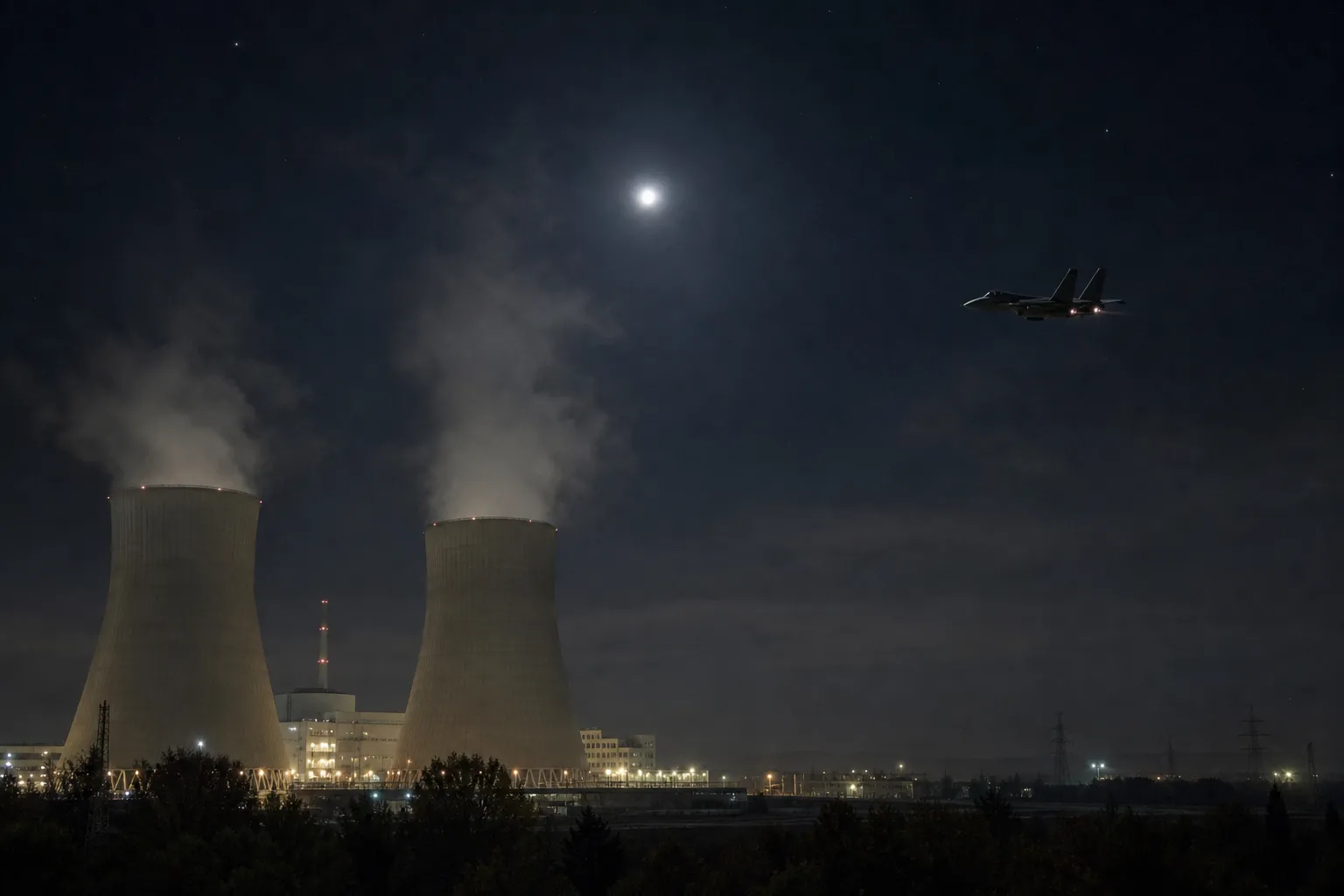
AI-rendered impression — luminous object hovering over Jaslovské Bohunice cooling towers, MiG-29 on intercept, November 2005 — UAP Archive / openai (gpt-image-1)
Credibility Assessment
Moderate
Military WitnessRadar CorroboratedMultiple WitnessesOfficial Report
Event Description
Observed Shape
Orb
Craft morphology

Non-Human Intelligence (NHI)
Reported Entities
No NHI encounter documented for this event.
Shortly before 18:00 on Saturday, November 19, 2005, a civilian observer spotted a glowing object hovering over the cooling towers of the Jaslovské Bohunice nuclear power plant in the Trnava District of western Slovakia. The Bohunice facility — one of the most strategically sensitive installations in the country, located in a legally designated no-fly zone — had been the site of anomalous aerial observations since the late 1980s. The witness immediately contacted the Trnava Regional Police, who in turn confirmed the report and forwarded it to the Slovak Ministry of Defence. At 18:45, the military operational duty officer at Sliač Air Base was notified, and by 18:52, a MiG-29 Fulcrum interceptor was airborne and en route.
Slovakia had joined NATO in 2004 and was in the process of decommissioning the Soviet-era VVER-440 reactors at Bohunice as a condition of EU accession. The plant was under strict security protocols, and the restricted airspace above it was actively monitored. The November 2005 incident therefore represented a serious institutional response: police, the Ministry of Defence, air traffic control, and military aviation all participated in what became a documented sequence of events, even though the official conclusion — that the sighting was an optical refraction of light in steam from cooling towers — was subsequently challenged by investigators and meteorologists.
The initial report came from a civilian who had technical knowledge of the plant (described in contemporaneous accounts as a former technician from the village of Dechtice, approximately nine kilometers from the facility). His report was treated seriously enough by Trnava police to warrant immediate escalation to the Ministry of Defence. Over the four-hour period from approximately 17:50 to 22:20 on the evening of November 19, dozens of residents from the municipalities of Jaslovské Bohunice, Žlkovce, Špačince, and other nearby villages independently reported observing luminous objects above the plant. A student housed in a university dormitory within visual range of the cooling towers provided a detailed contemporaneous account, describing "an enormously bright white source of light" hovering at a height inconsistent with either ground-based illumination or aircraft navigation lights. At least one member of the local police force was among the witnesses in the surrounding villages. The UFO club of Trnava, led by Miroslav Karlík, logged multiple independent reports from that night.
The initial object was described as a large, intensely white luminous form hovering above the cooling towers at an estimated height of several hundred meters. It was not blinking at a rate consistent with aircraft navigation lights and was not moving in a pattern consistent with a helicopter on approach or departure. The object appeared nearly stationary, with only slight vertical oscillation noted by some witnesses. At approximately 18:52, a second object was reported by the plant's security service, which was relayed to the MiG-29 pilot as an additional navigation target. Ground radar at the military airfield detected the primary object at approximately 700 metres altitude. When the MiG-29 arrived in the area at approximately 19:10 — roughly ten minutes after 19:00 — the pilot reported that the object appeared to extinguish its light as the aircraft approached, and his first radar passes produced no visual confirmation. Several minutes later, the pilot confirmed visual contact with a second object and attempted to close the distance; the object reportedly moved away from him faster than he could match. The Slovak Army subsequently announced that all observations had ceased and that the scramble had been stood down.
The official Slovak military explanation — that the sighting was caused by refraction of light in steam from the cooling towers — was examined by independent researchers and found to be physically inconsistent with the conditions that night. A spokesperson for the Slovak Hydrometeorological Institute stated that their radars, which operate on entirely different wavelengths than military surveillance radar, could not capture optical phenomena; this was offered to explain why meteorological radar showed nothing. However, military radar does not capture optical phenomena at all — it detects solid or dense objects — meaning that the ground radar tracking of the object at 700 metres altitude constitutes detection of a physical target, not an optical illusion. The Trnava astronomical observatory confirmed it had been imaging the evening sky around 18:00 and detected no unusual meteorological features that could produce the described optical effect. The pilot's two radar contacts — both acknowledged by the Slovak Army spokesperson Milan Vanga before the meteorological explanation was adopted — are inconsistent with the refraction hypothesis. The refraction of cooling-tower steam cannot produce a radar return.
Ground-based military radar at Sliač Air Base tracked an unknown aerial object above the Bohunice facility at approximately 700 metres altitude prior to the MiG-29's arrival. The MiG-29 pilot himself reported multiple radar contacts during his patrol of the area, which were acknowledged in the initial military press release before the official explanation shifted to meteorological causes. No physical traces were recovered. The Slovak Hydrometeorological Institute's inability to confirm the sighting on their radar is explained by the different wavelength incompatibility with optical phenomena — but this does not negate the military radar tracking, which operates on frequencies sensitive to solid objects.
The Slovak Armed Forces confirmed the scramble publicly through spokesman Milan Vanga. The official position, issued after the incident, was that the object had been "a specific meteorological phenomenon caused by refraction of light in steam exiting the cooling towers." Vanga stated that "the armed forces will not be investigating the matter further." The Trnava police publicly confirmed having received and relayed the report to the Ministry of Defence, and trnavská policejní mluvčí Martina Kredatusová was quoted in Pravda newspaper. The Slovak Ministry of Defence did not release the pilot's full mission report. The incident was covered extensively by Slovak daily Pravda, Czech news outlet Aktuálně.cz, and the Slovak news portal 24hod.sk on the day of and following the event.
The rapid shift from an initial military acknowledgment of radar contacts to the meteorological explanation within the same press cycle has been noted by researchers. Independent Czech-Slovak UFO researcher Jaroslav Mareš documented the inconsistency in detail on the badatele.net platform, noting that the timeline of police notification (50 minutes after first sighting), the military's confirmed radar tracking, the pilot's confirmed visual contact with a second object, and the hydrometeorological institute's own disclaimer about optical phenomena in radar data all contradict the official explanation. No witnesses were questioned or pressured, but no follow-up investigation was conducted.
The Jaslovské Bohunice incident is significant for several reasons. It is one of the few documented cases in central Europe in which a military interceptor was scrambled in response to an anomalous aerial object over a nuclear facility, with ground radar tracking confirmed in contemporaneous press statements. The proximity to an active nuclear power plant — a pattern observed in other countries including the United States, France, and the United Kingdom — raises the operational security question of why UAP appear to concentrate near nuclear installations. The case also illustrates the typical institutional response cycle: immediate escalation, military scramble, public acknowledgment of radar and visual contact, followed by rapid adoption of a prosaic explanation that does not survive technical scrutiny. Slovakia's location in central Europe, near major air corridors and adjacent to both NATO and former Warsaw Pact infrastructure, makes credible UAP events from the region of strategic analytical interest.
5 Observables Detected
Instantaneous Acceleration
Hypersonic Velocity
Low Observability
Trans-Medium Travel
Anti-Gravity Lift
Suspicious Activity
Intelligence Agency
Cover-up Actions
Men in Black
Disinformation
Witness Suppression
Sources
mediaPravda (Slovak daily) — 'Nad atómkou zasahovala stíhačka,' November 20, 2005media24hod.sk — 'Sme vydaní napospas agresorom zvrchu' (timeline analysis), 2005mediaBadatele.net — Jaroslav Mareš investigation: 'UFO nad Jaslovskými Bohunicemi: Armádní vysvětlení definitivně padlo'mediaAktuálně.cz — 'Střet u atomové elektrárny: Jak slovenský MiG-29 honil UFO nad Jaslovskými Bohunicemi,' August 2025