Close EncounterCold War
Socorro New Mexico Landing
Apr 24, 1964
Socorro, New Mexico, USA
Physical trace evidence at the Socorro landing site, April 24, 1964 — landing leg impressions documented by US Army and FBI investigators — Wikimedia Commons / Public Domain
Credibility Assessment
High
Law EnforcementPhysical EvidenceOfficial ReportMultiple Witnesses
Event Description
Observed Shape
Disc
Craft morphology

Non-Human Intelligence (NHI)
Reported Entities
Unknown

2 BeingsObserved
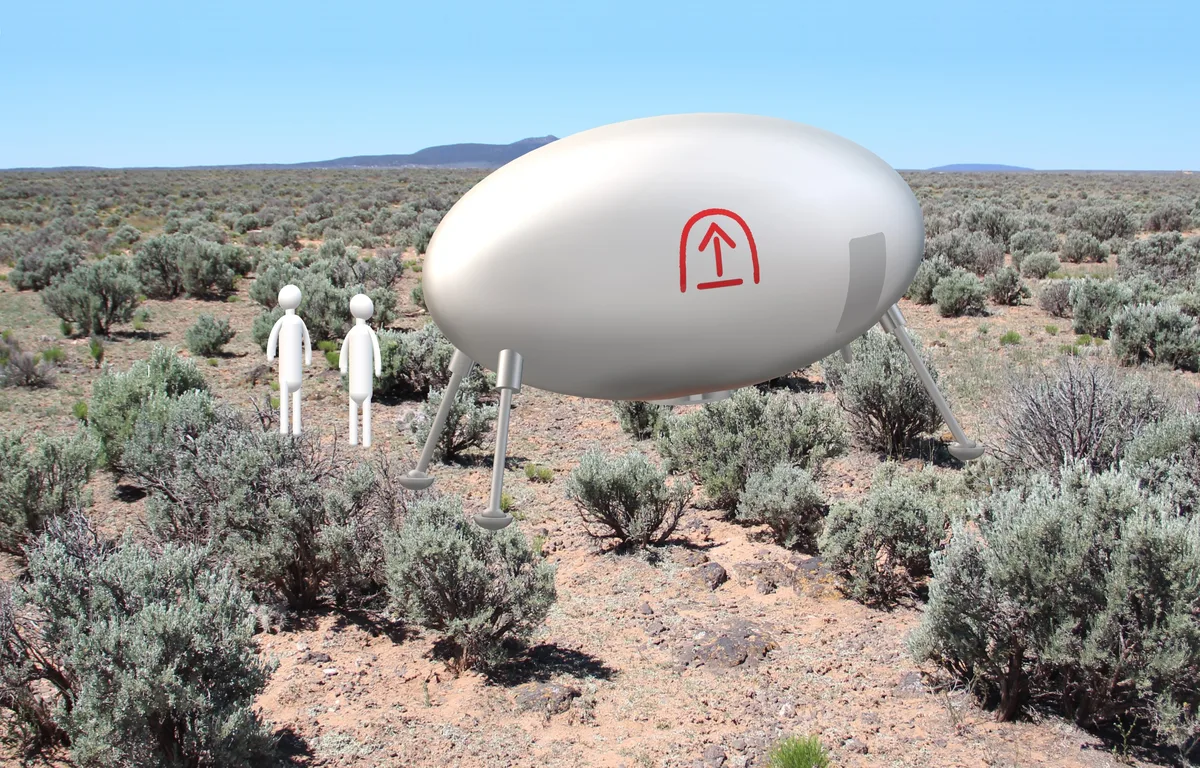
Two small figures in white coveralls observed near the landed craft. They appeared startled when Zamora crested the ridge and retreated into the craft before it departed.
At approximately 5:45 PM on April 24, 1964, Lonnie Zamora — a Socorro, New Mexico police officer with a well-established reputation as a skeptic — was in pursuit of a speeding vehicle on Old Rodeo Road when he heard a loud roar and observed a blue-orange flame descending toward a gully south of the highway. Concerned that a dynamite shack in the area might have exploded, Zamora broke off the vehicle pursuit and drove toward the sound.
Cresting a low ridge on a dirt road, Zamora observed a white, egg-shaped craft resting on the desert floor approximately 150 to 200 meters away, supported on four landing legs. Standing beside it were two small figures in white coveralls who appeared startled when they became aware of Zamora's approach. They re-entered the craft. Zamora got out of his patrol car and moved toward the object on foot. The craft emitted a sharp roar and a flame shot from beneath it; Zamora retreated, fearing an explosion. The object rose to approximately six meters, hovered briefly in silence, then accelerated horizontally to the southwest and disappeared beyond a mountain. The entire visual observation lasted approximately two to three minutes.
US Army Captain Richard Holder, commanding officer at White Sands Missile Range, arrived at the site within hours and led an immediate forensic survey. Four distinct impressions from the landing legs were found pressed into the earth, along with burn marks in the soil and greasewood brush directly beneath the object's departure point. The impressions were measured and photographed. The US Air Force dispatched Project Blue Book's chief scientific consultant, Dr. J. Allen Hynek, who traveled to Socorro and conducted an extensive field investigation. The FBI also deployed an agent to examine the physical evidence.
Hynek, who had spent years rationalizing UAP reports as misidentifications, described the Socorro case as one of the most credible and physically evidenced cases he had ever personally investigated. He found Zamora's reputation in the community beyond question and the physical trace evidence inconsistent with any hoax or conventional aircraft. The case remains classified as 'unknown' in Project Blue Book records and is cited in virtually every serious academic treatment of physical trace UAP evidence as a benchmark for evidential quality.
5 Observables Detected
Instantaneous Acceleration
Hypersonic Velocity
Low Observability
Trans-Medium Travel
Anti-Gravity Lift
Suspicious Activity
Intelligence Agency
Cover-up Actions
Men in Black
Disinformation
Witness Suppression