SightingModern Era
Tajik Air Boeing 747 Crew Observes Maneuvering UAP for 40 Minutes — 1994
January 27, 1994
Over Kazakhstan / Uzbekistan border
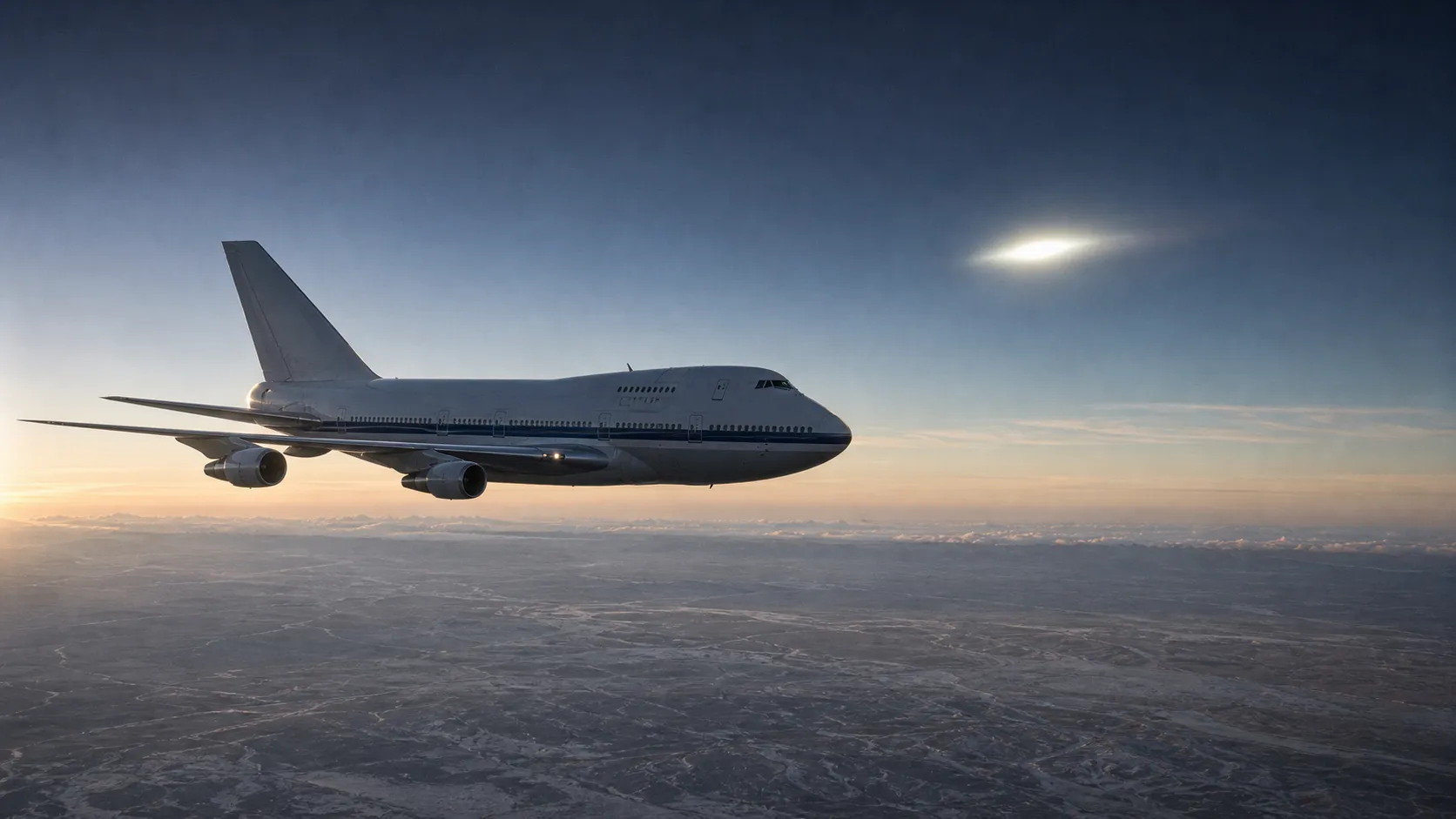
AI-rendered impression — luminous object executing high-speed maneuvers alongside Boeing 747SP at 41,000 feet over Central Asian steppe, January 1994 — UAP Archive / openai (gpt-image-1)
Credibility Assessment
High
Pilot WitnessMultiple WitnessesPhoto EvidenceGovt. AcknowledgmentOfficial Report
Event Description
On January 27, 1994, at approximately 41,000 feet altitude and at coordinates 45°N, 55°E — over Kazakhstan, near the border with Uzbekistan — the three-member American crew of a Tajik Air Boeing 747SP witnessed an extraordinary aerial object for approximately 40 continuous minutes. The flight was operating from Tajikistan when the encounter occurred. The primary observer, Tajik Air chief pilot and former Pan Am captain Ed Rhodes, reported the event directly to the US Embassy in Dushanbe, Tajikistan, on January 29, 1994 — two days after the sighting. Embassy official Escudero then drafted an official unclassified cable sent to the State Department in Washington (Department for OES/S), the US Embassy in Moscow, the US embassies in Tashkent, Ashgabat, Almaty, Beijing, and Bishkek, as well as the CIA (WASHDC 0224) and the Defense Intelligence Agency (DIA, WASHDC 0232). The cable, classified under TAGS TSAP and EAIR, was subject: TAJIK AIR PILOTS REPORT UNIDENTIFIED FLYING OBJECT.
The cable was subsequently released through government FOIA channels and has been archived at the Computer UFO Network (CUFON), nicap.org, and multiple other UFO documentation archives. It constitutes one of the cleanest examples of a formal US government document reporting a named professional pilot's UAP encounter with corroborating crew witnesses, physical evidence (photographs), and anomalous propulsion signatures (contrails at extreme altitude).
Tajikistan had only recently emerged as an independent nation following the 1991 dissolution of the Soviet Union and was engaged in a civil war at the time. The employment of former Pan Am crew by Tajik Air represented one of the early post-Cold War aviation partnerships in Central Asia. Captain Rhodes and his colleagues brought decades of professional flight experience across the Pacific and Atlantic, making their assessment of the object — compared explicitly to thousands of observed natural phenomena during their careers — particularly credible.
Captain Ed Rhodes: Chief pilot of Tajik Air, American citizen (amcit), former Pan Am captain with extensive high-altitude flight experience over the Pacific and Atlantic. He was the primary observer and photographer.
Two unnamed American pilot colleagues: Both professional aviators with careers in commercial aviation, including time at Pan Am. All three crew members were flying at the time of the encounter and confirmed Rhodes's account.
The US Embassy official named Escudero authored the cable reporting the incident and confirmed the pilots' account, adding his own considered judgment: "We have no opinion and report the above for what it may be worth." This cautious diplomatic framing is consistent with a genuine anomalous report rather than a hoax.
The encounter began as a bright light of enormous intensity approaching from over the eastern horizon at great speed and at an altitude significantly higher than the aircraft's 41,000-foot cruising level. The crew watched the object for approximately 40 continuous minutes as it maneuvered. The maneuvers described by Captain Rhodes included:
— Circles
— Corkscrews
— Instantaneous 90-degree turns executed at rapid speed under what Rhodes estimated as very high G-forces
— A final departure in which the object adopted a horizontal high-speed course and disappeared over the horizon
Rhodes described the light emitted by the object as having a "bow wave" resembling a high-speed photograph of a bullet in flight — a dense central luminosity surrounded by a larger trailing wave of heat or light. Approximately 45 minutes after the initial sighting, as the sun was rising, the Boeing 747 flew beneath contrails left behind by the object's maneuvers. Rhodes estimated the altitude of these contrails at approximately 100,000 feet — well above the top of the operational envelope for any known conventional aircraft and above the altitude at which atmospheric moisture/density would support contrail formation by conventional propulsion. The contrails traced the circles, corkscrews, and directional changes that the crew had observed the object executing.
Several aspects of the encounter are technically anomalous and cannot be attributed to known conventional aircraft or natural phenomena:
Altitude: Operation at or above approximately 100,000 feet (as implied by the contrail observations) is beyond the operational ceiling of any known commercial or military production aircraft in 1994, with the exception of the SR-71 Blackbird (which was being phased out), the U-2 (operational ceiling approximately 70,000 feet), or experimental aircraft not known to operate in Central Asian airspace.
Maneuverability: 90-degree instantaneous turns at high speed under extreme G-loading are impossible for any known aircraft without destroying the vehicle. The description matches the "instantaneous acceleration" characteristic that the US UAP Task Force identified as one of five key anomalous behaviors in UAP.
Contrail formation: At 100,000 feet, the atmosphere is too thin for the propulsion mechanisms of conventional aircraft to generate contrails. The formation of persistent contrail trails at that altitude implies an exotic propulsion mechanism — or the atmospheric characterization of the altitude was incorrect, which Rhodes himself addressed by noting "there is too little air/moisture at that extreme altitude to enable the creation of contrails by the propulsion mechanisms of ordinary aircraft."
Duration: 40 minutes of continuous high-G maneuvering far exceeds the fuel endurance and structural limitations of any known high-performance aircraft for such maneuvers.
Captain Rhodes photographed the object using a pocket Olympus camera. The cable noted that photos would be forwarded to the Embassy and the Tajikistan desk at the State Department (Lowry Taylor) "if they come out." No public release of these photographs has been confirmed, suggesting they were retained within US government channels. The contrails left by the object's maneuvers at extreme altitude constituted persistent physical evidence of the encounter that was visually confirmed by the entire crew approximately 45 minutes after the initial sighting.
No radar confirmation is noted in the State Department cable, likely because at 100,000 feet the object would have been above the radar coverage of civil air traffic control facilities in the region. No EM effects on the aircraft systems were reported.
The US State Department transmitted an official cable (DUSHANBE 00259) on January 31, 1994, documenting the encounter. The cable was distributed to the State Department, CIA, DIA, and multiple US embassies in Central Asia. The cable was unclassified (UNCLAS). No follow-up investigation report has been made public. The photos referenced in the cable have not been publicly released.
No active suppression is documented. The cable itself is direct and unambiguous in its reporting. The embassy's neutral comment — "we have no opinion and report the above for what it may be worth" — suggests the US government received the report without dismissing it but also without apparently following up with any investigation visible in the public record. The non-release of the photographs may be significant.
The Tajik Air 1994 case is among the most formally documented UAP sightings in Central Asia. It combines named professional pilot witnesses with former major airline experience, a formal government document (State Department cable to CIA/DIA), photographic evidence, and anomalous technical signatures (100,000-foot contrails, 90-degree turns at high G). The case predates by more than two decades the renewed US government attention to UAP, and the maneuver profile described by Captain Rhodes — instantaneous acceleration and 90-degree turns — matches exactly the anomalous behavior categories identified by the Office of the Director of National Intelligence in its 2021 UAP Preliminary Assessment. The geographic area of Central Asia — the airspace over Kazakhstan and Uzbekistan — was repeatedly the site of documented Soviet-era UAP encounters with military aircraft, radar stations, and civilian aviation, making this case part of a coherent regional pattern.
5 Observables Detected
Instantaneous Acceleration
Hypersonic Velocity
Low Observability
Trans-Medium Travel
Anti-Gravity Lift
Suspicious Activity
Intelligence Agency
Cover-up Actions
Men in Black
Disinformation
Witness Suppression
Sources
governmentUS State Department cable DUSHANBE 00259, January 31, 1994 — 'TAJIK AIR PILOTS REPORT UNIDENTIFIED FLYING OBJECT' — distributed to CIA (WASHDC 0224), DIA (WASHDC 0232), and multiple US embassies. Archived at CUFON.mediaNICAP database — UFO Maneuvers Near B-747, January 27, 1994, Kazakhstan, Volume II UFO EvidencemediaOpenminds.tv — 'Airplane pilot UFO encounters in the USSR & CIS' (full cable transcript)