SightingCold War
Thimphu Blue Object — Bhutan, 1968
February 21, 1968
Thimphu, Bhutan
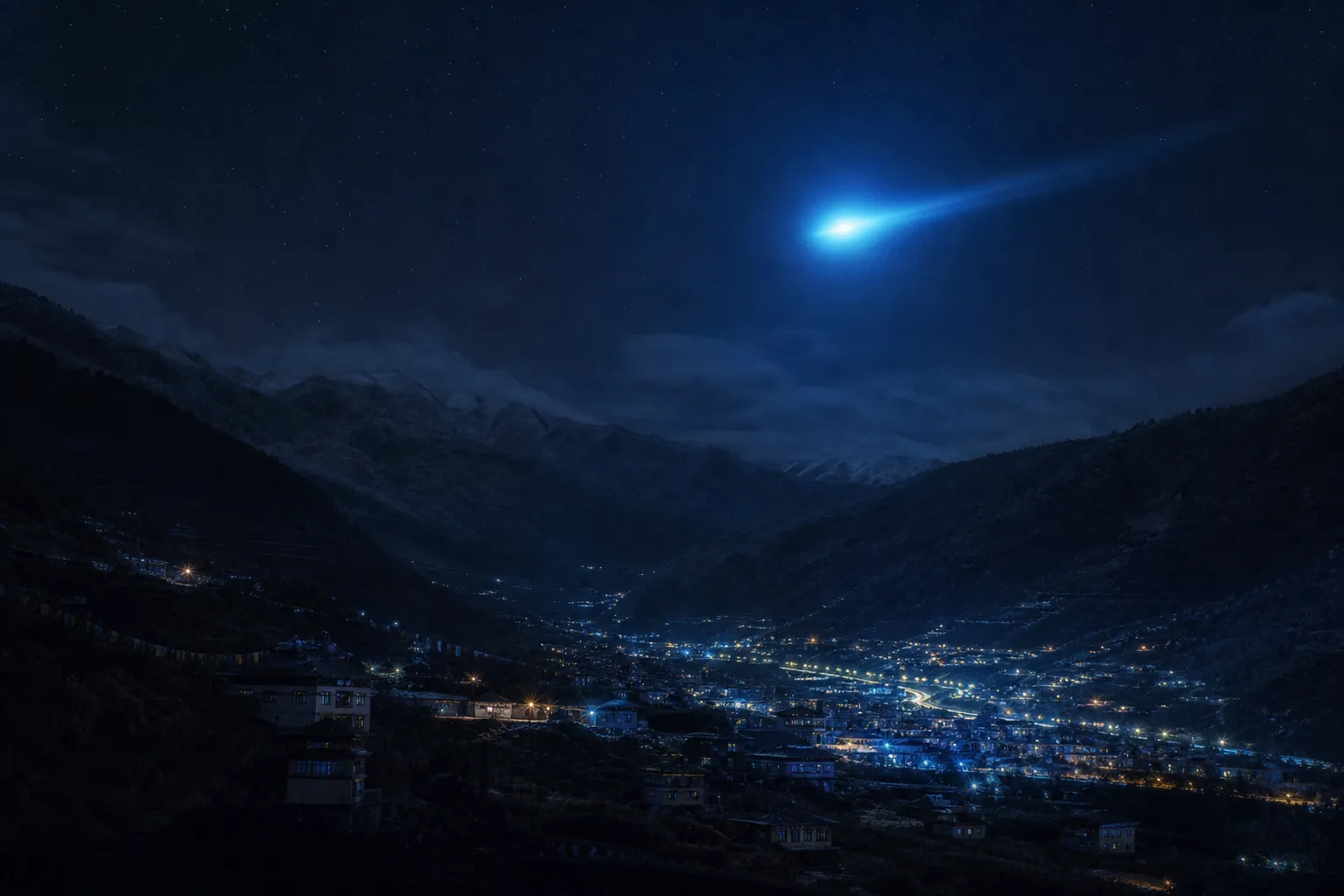
AI-rendered impression — a silent blue-glowing aerial object illuminating the night sky above a remote Himalayan valley, snow-capped peaks in the background, Bhutan 1968 — UAP Archive / openai (gpt-image-1)
Credibility Assessment
Low
Govt. AcknowledgmentHistorical DocumentOfficial Report
Event Description
Observed Shape
Sphere
Craft morphology

Non-Human Intelligence (NHI)
Reported Entities
No NHI encounter documented for this event.
On the night of February 21, 1968, at approximately 9:30 PM, an aerial object of unusual character was observed over Thimphu, Bhutan's capital city, situated in a high Himalayan valley at roughly 2,300 metres elevation. The object emitted a blue glow intense enough to "brighten the area" and moved at high speed in complete silence. The sighting was reported to American intelligence channels and formally included in a classified CIA investigation covering six Himalayan aerial events between February 19 and March 25, 1968. Bhutan in 1968 was a remote, diplomatically isolated Himalayan kingdom with no radar infrastructure, no civil aviation authority, and no military air arm — making the CIA's formal documentation of the event all the more significant: there was no domestic investigative apparatus to file competing or corroborating reports.
The CIA report does not name individual witnesses for the Thimphu sighting. Given Bhutan's limited population and the extreme isolation of Thimphu in 1968, the report's inclusion of the event implies it was considered credible by the intelligence source network channelling reports to the CIA station responsible for the region. The specific detail about the object moving "east to west" — and the CIA analyst's editorial note that due east of Thimphu is Indian territory, suggesting the more plausible origin direction was northeast (Tibet) — indicates the report was written by someone with geographic knowledge of Bhutan's strategic position, elevating it above a routine unverified claim.
The object observed over Thimphu on February 21 was described as bluish in colour, moving at high speed, and completely silent. It was bright enough to illuminate the area around it — a characteristic noted in several of the CIA report's six regional sightings, which consistently described intense luminosity. The directional assessment in the CIA report is particularly notable: the document states the object moved "East to West," but the analyst added that because due east of Thimphu lies only Indian territory, "the direction of flight could well be from North-east to South-west, that is, from the direction of Tibet." This directional analysis suggests the object may have crossed the Himalayan crest from the Tibetan Plateau, traversed Bhutanese airspace, and continued southwest into the subcontinent. The time of 9:30 PM places it in darkness, making the described luminosity all the more remarkable to ground observers. The February 21 sighting preceded the physical impact event at Pokhara, Nepal by 33 days, and followed the February 19 sightings over northeastern Nepal and Sikkim by two days — placing Bhutan as an intermediate point in a possible northwest-to-southeast corridor of activity.
The combination of high speed, complete silence, and area-brightening luminosity distinguishes the object from any conventional aircraft operating in the region in 1968. Bhutan's airspace was not traversed by commercial aviation and no military aircraft of any nation was known to be operating over Thimphu that night. The object's apparent south-by-southwest transit from Tibet aligns with the general trajectory of the Pokhara debris impact event 33 days later, though no direct causal link has been established. The consistent low-observability pattern — bright luminosity but no engine noise — is shared across multiple sightings in the same CIA report and may indicate a common phenomenon.
No radar tracking, photographic evidence, or physical remains are documented for the Thimphu sighting. Bhutan had no radar infrastructure in 1968. The sole documented effect is the area-brightening luminosity noted by ground witnesses. In contrast, the March 25 Pokhara incident — the most physically evidenced event in the same CIA report — produced metallic debris recovered from a crater and subsequently removed by US government personnel under Project Moon Dust, establishing that at least one object in the 1968 Himalayan series had substantial physical reality.
The CIA compiled a Confidential Information Report dated April 11, 1968, formally titled "Sighting of Unidentified Flying Objects in Ladakh, Nepal, Sikkim and Bhutan." The report covered all six sightings, including the February 21 Thimphu event. The document was classified Restricted — the lowest formal US classification tier, but still outside public access — until April 2, 2001, when it was approved for release. It was part of a large-scale CIA CREST database declassification in 2017 that brought the report to wide public attention. No analysis or conclusion about the Bhutan sighting is recorded in the declassified portion of the report.
No active suppression is documented for the Bhutan sighting specifically. The CIA classification of the broader report until 2001 effectively kept the Thimphu event from public knowledge for 33 years. Bhutan itself had no mechanism to independently investigate or publicise the event, and neither the US nor the Bhutanese government has ever made a public statement addressing the February 21 sighting. The Kingdom of Bhutan did not formally enter the United Nations until 1971 and had minimal diplomatic contact with Western nations in 1968, reducing the likelihood of independent corroborating documentation emerging through diplomatic channels.
The 1968 Thimphu sighting represents the only government-documented UAP incident in the archival record for Bhutan. Its significance rests primarily on the document it is preserved in: a classified CIA intelligence report that spans five jurisdictions across the Himalayas, treating multiple sightings as a coordinated investigative subject rather than isolated curiosities. The CIA analyst's geographic reasoning about the Tibet-origin trajectory is a rare example of US intelligence applying directional analysis to a Himalayan UAP event during the Cold War. The case is best understood not in isolation but as part of the February–March 1968 Himalayan cluster, which collectively represents the most CIA-documented episode of aerial anomalies in South Asia during the Cold War era.
5 Observables Detected
Instantaneous Acceleration
Hypersonic Velocity
Low Observability
Trans-Medium Travel
Anti-Gravity Lift
Suspicious Activity
Intelligence Agency
Cover-up Actions
Men in Black
Disinformation
Witness Suppression
Sources
governmentCIA — 'Sighting of Unidentified Flying Objects in Ladakh, Nepal, Sikkim and Bhutan', April 11, 1968 (declassified 2001)mediaIBTimes India — 'Declassified CIA documents reveal 6 UFO sightings in India, Nepal and Bhutan', January 2017mediaSputnik International — 'From Tibet to Nepal: CIA Declassifies Files on UFO Sightings Over Himalayas', January 31, 2017