SightingModern Era
Operation Lightbeam — Tsarichina, Bulgaria, 1990–1992
December 1990 – November 1992
Tsarichina, Kostinbrod District, Bulgaria
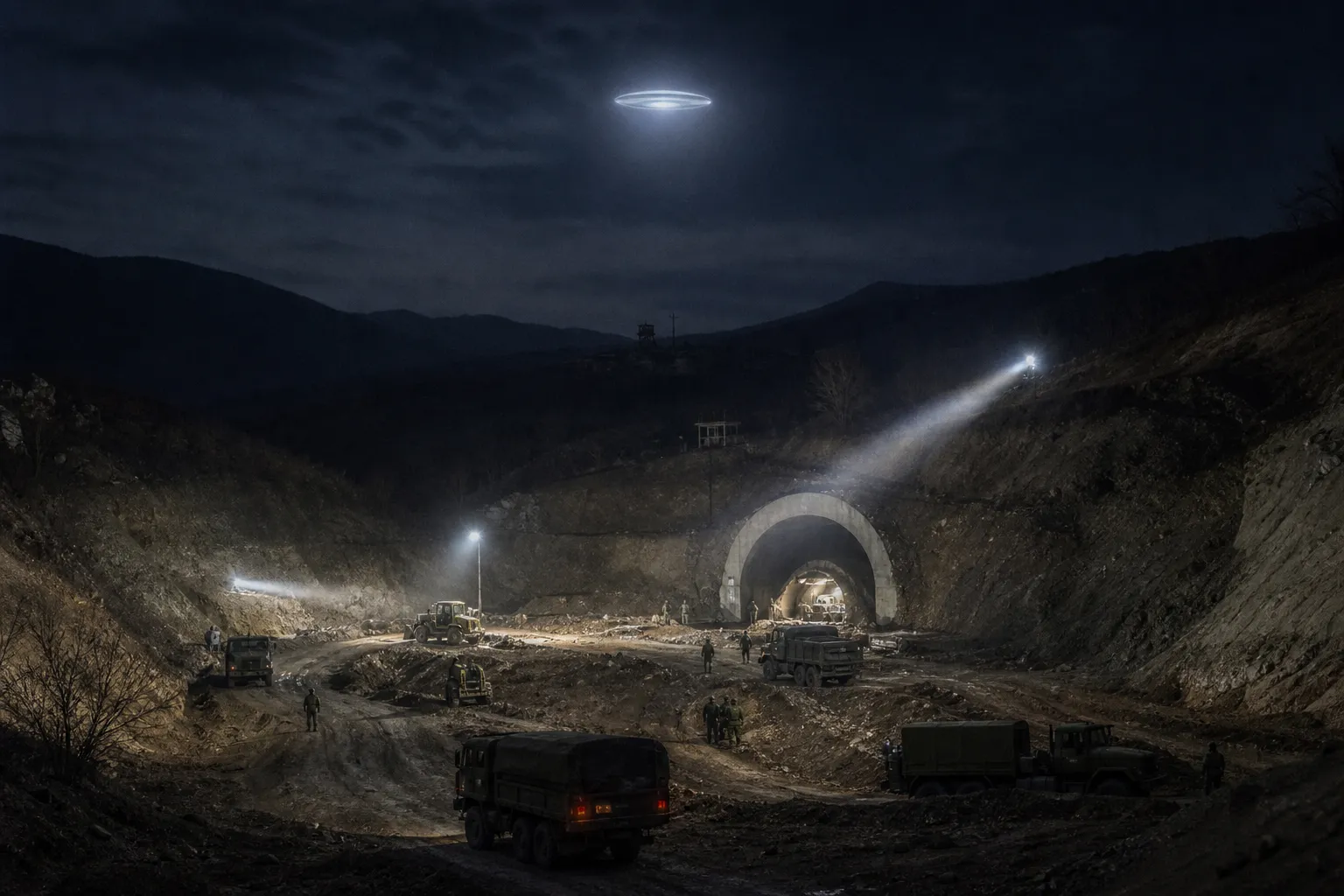
AI-rendered impression — a luminous object hovering above an open military excavation site at night in the Bulgarian countryside, searchlights illuminating the tunnel entrance below — UAP Archive / openai (gpt-image-1)
Credibility Assessment
Moderate
Military WitnessMultiple WitnessesGovt. AcknowledgmentOfficial Report
Event Description
On December 6, 1990, the Bulgarian Ministry of Defence initiated a classified excavation at Tsarichina, a small village in the Kostinbrod District of Sofia Province, approximately 30 kilometres northwest of Sofia. The operation, designated internally as "Operation Lightbeam" (Операция Светлинен Сноп), was predicated on intelligence from psychic consultants who had persuaded influential military officers that the site concealed either a monumental historical artifact, an extraterrestrial being, or a form of advanced technology of unknown origin. For nearly two years, military engineers, soldiers, and Ministry of Defence personnel maintained an active classified site. During this period, duty personnel logged 15 separate sightings of unidentified luminous objects appearing above the excavation. The operation was abruptly closed on November 19, 1992. Official documentation subsequently vanished from state archives.
The witnesses to the aerial phenomena were Bulgarian military personnel on duty at an active Ministry of Defence classified site. Their status as professional soldiers under operational conditions — not civilians making voluntary reports — gives their observations an institutional weight: these were people whose professional obligation was accurate threat assessment and reporting. The Bulgarian military does not publicly name the duty witnesses. The operation itself was confirmed by a 2007 bTV documentary that investigated the case and found that most Ministry of Defence documents had disappeared. Senior officers who initiated the operation held command ranks within the Bulgarian military structure. The psychic consultants who triggered the operation — though their methodology is unscientific — were formally embedded in the military planning process, indicating the operation's origin in a genuine institutional belief structure rather than individual eccentricity.
Across the nearly two-year operational period, Bulgarian Ministry of Defence personnel on duty at the Tsarichina site logged 15 separate appearances of unidentified luminous objects above the excavation area. The specific descriptions of each observation are not available in declassified sources; the aggregate count of 15 events is the figure confirmed by post-operation reporting. The phenomenon appears to have been associated with the active excavation period rather than the surrounding region generally — no comparable cluster of sightings from Tsarichina is documented before December 1990 or after November 1992. The objects were described as aerial in character — luminous phenomena observed above the site — consistent with the broader class of UAP often reported above active excavation or drilling operations in Eastern European Cold War-era cases.
The primary anomaly is the association between an active classified Ministry of Defence excavation site and a cluster of 15 UAP appearances during the operational period. While no individual sighting description is available in detail, the aggregate pattern — anomalous aerial phenomena clustering over an active classified site during a bounded operational period — is consistent with nuclear-site and missile-base UAP association patterns documented in US, Soviet, and French official records. The secondary anomaly is institutional: the Bulgarian Ministry of Defence, a professional military bureaucracy, committed personnel and equipment to a two-year excavation at a cost to taxpayers based partly on psychic intelligence — indicating that UAP-adjacent phenomena were considered sufficiently real by Bulgarian military leadership to justify extraordinary resource allocation.
No known radar, electromagnetic, or photographic record of the aerial appearances survives in publicly available documentation. The excavation itself constitutes a physical record: a 160-metre tunnel dug to 70-metre depth at a Ministry of Defence classified site is a documented physical consequence of the operation. The disappearance of the primary documentation from state archives constitutes a secondary physical evidence trail. A 2007 bTV documentary confirmed through interviews and archive investigation that records had vanished.
The Bulgarian Ministry of Defence formally initiated and funded the operation — it was not a rogue or unauthorised action. The operation ran under official classification for nearly two full years. It was terminated on November 19, 1992. No official explanation for the aerial phenomena logged during the operation was issued. The Ministry of Defence has not publicly acknowledged the 15 UFO appearances. Bulgarian state media did not report the operation during its active phase. The 2007 bTV documentary was the first major public accounting of the case.
The disappearance of "most of the military documents surrounding the event from government archives" — confirmed by bTV's 2007 investigation — constitutes evidence of systematic document suppression or destruction. Whether this was deliberate concealment or administrative loss during the post-communist transition period cannot be confirmed from available sources. The classification of the operation during its active phase ensured no public reporting. The institutional embarrassment of a two-year military excavation based on psychic intelligence that yielded nothing may have provided additional motivation for document removal. Regardless of motivation, the outcome — an active Ministry of Defence site with 15 logged UFO appearances and no surviving official documentation — represents an archivally significant suppression.
Tsarichina's significance to the UAP archive does not rest on the psychic framing that initiated the excavation — that framing is scientifically unserious. Its significance rests on three documented facts: (1) the Bulgarian Ministry of Defence committed to a two-year classified operation at the site; (2) military personnel on duty logged 15 unidentified aerial appearances during the operational period; and (3) the documentation has been destroyed or disappeared. These three facts together constitute a credible, government-sourced UAP data point for Bulgaria — one in which the witnesses are professional military personnel, the institutional response was authorised and classified, and the suppression of records is confirmed. The case is the single best-documented Bulgarian government-military UAP encounter available in open sources.
5 Observables Detected
Instantaneous Acceleration
Hypersonic Velocity
Low Observability
Trans-Medium Travel
Anti-Gravity Lift
Suspicious Activity
Intelligence Agency
Cover-up Actions
Men in Black
Disinformation
Witness Suppression