SightingCold War
Uruguayan Air Force Pucará Intercept — Over a Hydroelectric Dam, 1986
May 1986
Uruguay (dam location withheld)
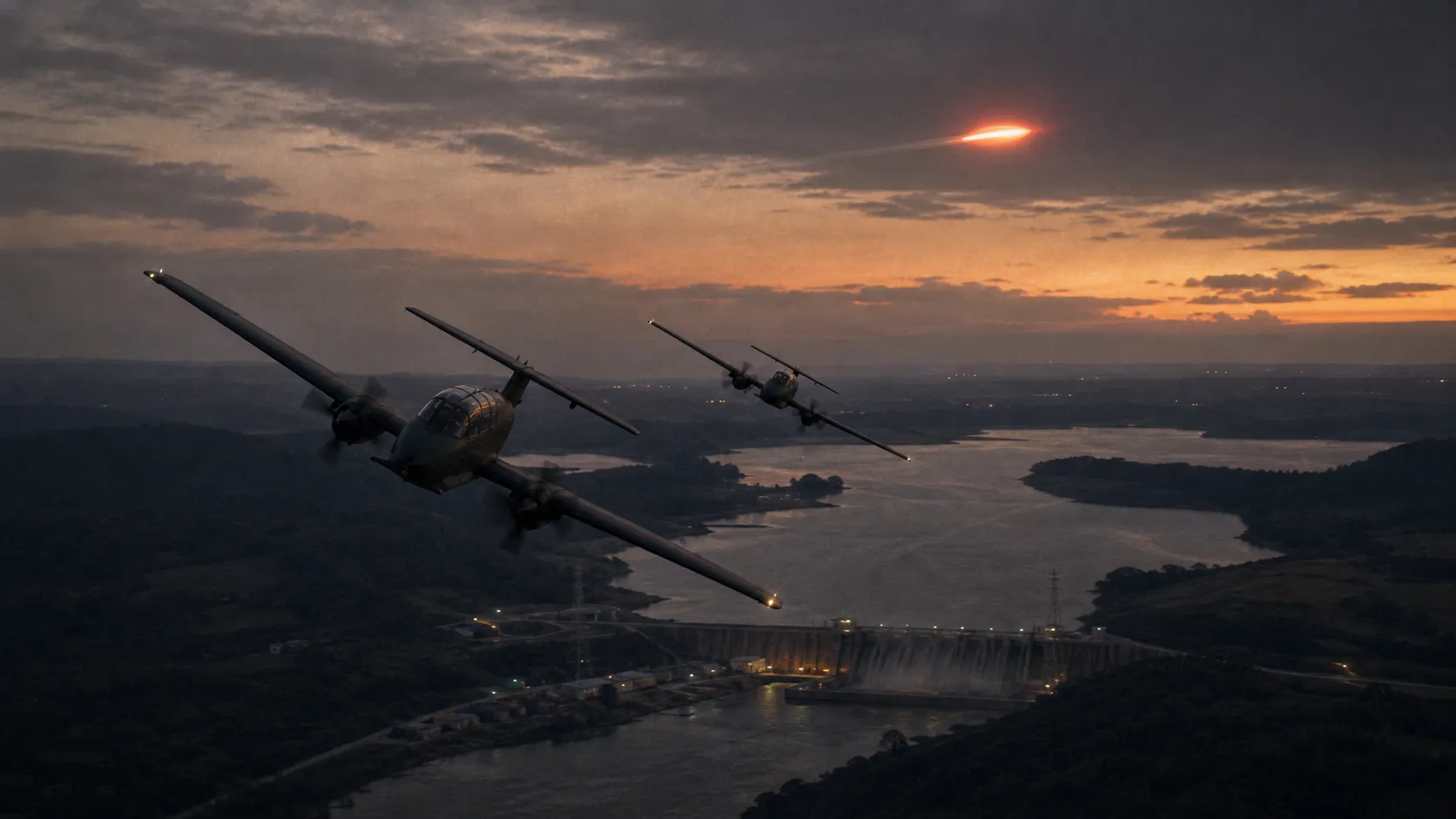
AI-rendered impression — two Uruguayan Air Force FMA IA 58 Pucará turboprop aircraft banking over a darkened river valley at dusk, a glowing red-orange disc accelerating away above them toward the western horizon — UAP Archive / openai (gpt-image-1)
Credibility Assessment
High
Military WitnessPilot WitnessGovt. AcknowledgmentOfficial ReportMultiple Witnesses
Event Description
In May 1986, Uruguay's Fuerza Aérea Uruguaya (FAU) scrambled two FMA IA 58 Pucará aircraft from routine patrol to intercept an unidentified aerial object detected maneuvering without authorization over a hydroelectric dam — a critical piece of national infrastructure. The intercept was conducted by four military pilots spread across the two aircraft. Neither platform could match the object's performance; after two failed attempts, the unknown object accelerated beyond the aircraft's capability and vanished. The escalation chain that followed — from the pilots to the commander, to the Defense Minister, to the President — documents the event as one of the most seriously treated UAP encounters in Latin American Air Force history. CRIDOVNI, Uruguay's official Air Force UAP commission founded in 1979 and among the world's oldest government UAP bodies, subsequently investigated the case and designated it the most extraordinary of the 40 encounters in its history rated as genuine after rigorous screening of over 2,200 total reports.
Four commissioned Uruguayan Air Force pilots were aboard the two Pucará aircraft, giving this case an exceptionally strong witness profile for a regional incident. All four were trained military aviators on an active duty patrol mission. Their combined testimony was consistent: all observed the same sequence of color changes, acceleration profile, and final departure. Crucially, flight data from both aircraft — duration records, altitude, airspeed logs — was preserved as institutional documentation of the encounter and made available to CRIDOVNI investigators. Colonel Ariel Sanchez of CRIDOVNI, himself a military officer, described this case in a 2012 interview as "the most shocking event" in the commission's history, citing both the multiple credible military witnesses and the object's demonstrated performance anomalies.
The object was first observed maneuvering over the hydroelectric dam — a location of strategic sensitivity that prompted the immediate dispatch of military interceptors. As the Pucará aircraft approached for the first intercept attempt, the object was emitting a yellow glow. As it began to accelerate in response to the interception, its color transitioned from yellow to orange and then to red — a progression consistent with other documented high-speed UAP color-change reports. The object's maximum acceleration reached an estimated 1,000+ km/h, described as double or more the Pucará's own maximum speed of approximately 400–500 km/h. A second intercept attempt was made; the object repeated the color-change and acceleration sequence. At the conclusion of the second pass it departed westward at "incredible speed," vanishing from view. No sound consistent with conventional jet propulsion was reported at the object's performance levels.
The color-change sequence — yellow to orange to red correlated with increasing speed — is not a characteristic of any known conventional aircraft and cannot be attributed to navigation lights or external illumination. The performance envelope of the object (1,000+ km/h acceleration, immediate departure beyond tracking range) exceeded any aircraft known to operate in South American airspace in 1986 and would be extraordinary for any aircraft in that period including the most advanced US and Soviet designs. The dam location has strategic implications: the object's presence over critical infrastructure, combined with its apparent awareness of the intercept attempts (acceleration and departure correlated with each intercept approach), suggests responsive behavior rather than passive flight.
Flight data from both FAU aircraft documenting the encounter was preserved and reviewed by CRIDOVNI investigators — a rare instance in regional UAP history where contemporaneous instrument records corroborate the pilot accounts. No radar data from ground stations is confirmed in available sources, which reflects the limited radar coverage infrastructure of Uruguay in 1986 rather than an absence of reporting. No physical trace evidence at the dam location is documented. The encounter's primary physical record resides in the combined flight logs and CRIDOVNI's official case file.
The escalation of this case through the Uruguayan military and civilian command structure was unusually thorough. The four pilots reported their findings directly to the FAU commander after the encounter. The commander escalated to the Minister of Defense. The Minister elevated the matter to the President of Uruguay. This three-step escalation to head-of-state level indicates that the professional military chain of command treated the incident with full seriousness. CRIDOVNI formally investigated, collected flight data, interviewed the four pilots, and classified the case at its highest level of strangeness — an "unconventional event with no scientific explanation." No public disclosure of the specific dam location was made, consistent with the security sensitivity of the infrastructure involved.
No active suppression or disinformation campaign has been documented for this case, in contrast to US and Soviet-era cases. Uruguay's approach through CRIDOVNI represents the opposite model: official acknowledgment, systematic investigation, and formal classification within a government research program. The withholding of the specific dam location reflects security protocol rather than evidence suppression, and the existence of CRIDOVNI's public record of the encounter itself prevents the classification of information management tactics that apply to cases handled entirely within national security frameworks.
This case is the single most significant UAP encounter officially documented by an accredited government UAP research body in South America. Uruguay's CRIDOVNI, established in 1979, is one of the world's oldest continuously operating official government UAP programs and among the most methodologically rigorous — applying a tiered classification system, preserving physical evidence, and maintaining a transparent public record of its findings. The designation of this case as CRIDOVNI's most extraordinary encounter in over three decades of operation, among more than 2,200 investigated reports, is itself a form of official credibility validation that no other case in the region possesses. The four military pilot witnesses, the preserved flight data, and the head-of-state escalation collectively constitute a documentation record that meets a professional journalist's standard of corroboration. The case's occurrence during the same week as Brazil's 1986 Official UFO Night — in which the Brazilian Air Force scrambled multiple aircraft across the country — implies a regional pattern of activity that has never received coordinated official explanation.
5 Observables Detected
Instantaneous Acceleration
Hypersonic Velocity
Low Observability
Trans-Medium Travel
Anti-Gravity Lift
Suspicious Activity
Intelligence Agency
Cover-up Actions
Men in Black
Disinformation
Witness Suppression
Sources
governmentFuerza Aérea Uruguaya — CRIDOVNI Official Commission (fau.mil.uy)mediaThe UFO Chronicles — 'Uruguay Air Force Openly Researches UFOs — Interview with Colonel Ariel Sanchez (Part I)'mediaThe UFO Chronicles — 'Interview with Colonel Ariel Sanchez (Part IV)'mediaOpen Minds TV — Interview with Col. Ariel Sánchez of CRIDOVNI