SightingIndustrial Era
Vancouver City Hall UFO Photograph
Oct 8, 1937
Vancouver, British Columbia, Canada
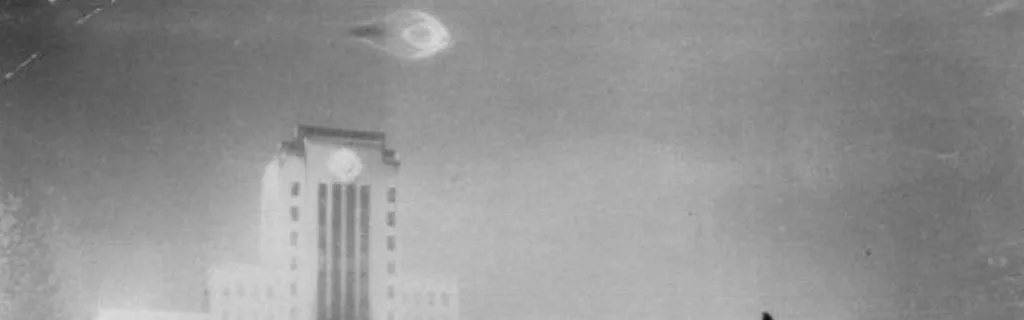
The 1937 Lamoureux photograph — a disc-shaped object captured hovering over Vancouver City Hall on October 8, 1937, one of the earliest authenticated UAP photographs in the world — Leonard Lamoureux / public domain
Credibility Assessment
Moderate
Photo EvidenceMultiple Witnesses
Event Description
Observed Shape
Disc
Craft morphology

Non-Human Intelligence (NHI)
Reported Entities
No NHI encounter documented for this event.
On October 8, 1937 at approximately 11:00 AM, Leonard Lamoureux photographed what appeared to be a structured, disc-shaped metallic object hovering above Vancouver City Hall. The photograph was taken under clear daylight conditions and shows a clearly defined circular craft with apparent dome structure and surface detail. The image stands as one of the earliest authenticated UAP photographs in Canadian history — and among the earliest in the world.
What makes the Vancouver City Hall photograph historically remarkable is its date: 1937. It predates Kenneth Arnold's 1947 sighting — the event commonly regarded as the beginning of the modern UAP era — by a full decade. It was taken before the term "flying saucer" had entered any language, before Hollywood had established a visual vocabulary for spacecraft, and before any mass media contagion could have shaped what witnesses expected to see. Lamoureux had no cultural template for what he photographed.
The photograph was preserved and eventually submitted to early UFO researchers. It was examined by investigators who noted that the object's apparent altitude, size relative to the building, and the lighting conditions were consistent with a three-dimensional object rather than a lens artefact, bird, or conventional aircraft. The image was included in major early Canadian UAP archives and has been reproduced in multiple research publications.
Vancouver in the late 1930s was a rapidly industrializing Pacific port city with significant military significance. RCAF Station Sea Island was operational nearby, and the region was increasingly important to Pacific defense planning. Any unidentified craft over Vancouver's civic center would have been of immediate security interest had military authorities been aware.
The Vancouver City Hall photograph belongs to a category of pre-Arnold cases that researchers consider particularly important because they cannot be explained by cultural contagion or the post-Arnold reporting wave. Other well-documented pre-Arnold cases include the 1933 Magenta, Italy retrieval and the 1941 Cape Girardeau retrieval — events that collectively suggest the UAP phenomenon was present and active decades before public awareness.
As one of the few surviving photographic records from this era, Lamoureux's image provides a direct visual reference point for the consistency of UAP morphology: the dome-topped disc shape documented in Vancouver in 1937 is identical to descriptions and photographs collected from around the world over the following eight decades.
5 Observables Detected
Instantaneous Acceleration
Hypersonic Velocity
Low Observability
Trans-Medium Travel
Anti-Gravity Lift
Suspicious Activity
Intelligence Agency
Cover-up Actions
Men in Black
Disinformation
Witness Suppression
Sources
mediaNICAP Historical Photographic Cases
academicVallee, J. — Passport to Magonia (1969)