SightingCold War
Wonsan-Sunchon B-29 UFO Incident
Jan 29, 1952
Wonsan / Sunchon, North Korea
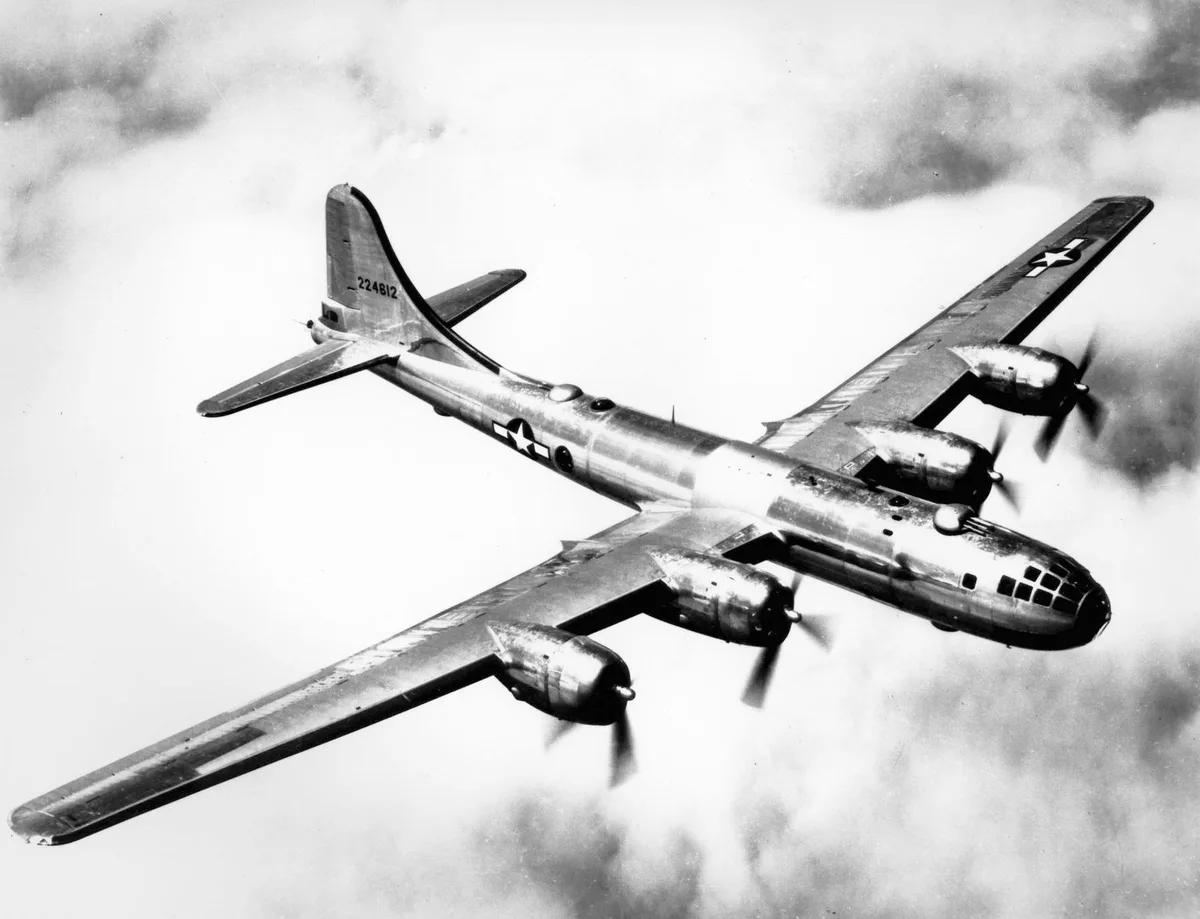
Boeing B-29 Superfortress — a crew aboard this aircraft type encountered and reported a disc-shaped UAP over North Korea on July 10, 1952 — US Air Force / Public Domain
Credibility Assessment
High
Military WitnessMultiple WitnessesOfficial ReportHistorical Document
Event Description
Observed Shape
Orb
Craft morphology

Non-Human Intelligence (NHI)
Reported Entities
No NHI encounter documented for this event.
On July 10, 1952, a Boeing B-29 Superfortress of the United States Air Force was conducting a bombing mission over the industrial port of Wonsan, North Korea, when the crew encountered an unidentified aerial object that defied any conventional explanation available to military intelligence analysts of the period. Flying at approximately 20,000 feet over the target area, crew members observed a bright, disc-shaped object approaching from starboard at a speed far exceeding any aircraft in the inventory of any nation.
The object appeared metallic and reflective, with no visible exhaust, markings, or control surfaces consistent with either American or Soviet aircraft types known to be operational in 1952. It paced the B-29 briefly — matching the heavy bomber's speed and altitude — before accelerating away at a rate impossible for any jet aircraft of the era. The encounter was documented and reported through US Air Force military intelligence channels and became part of the extraordinary volume of UAP reports generated by military aviation during the Korean War.
The incident fell within the most intense UAP wave of the Cold War era. The summer of 1952 produced a global surge of documented aerial phenomena, culminating in the Washington D.C. radar-visual incidents of late July 1952, when multiple unidentified objects were simultaneously tracked by Washington National Airport radar, Andrews AFB radar, and Bolling AFB radar, while being visually confirmed by commercial and military pilots — an event that directly alarmed the Joint Chiefs of Staff and prompted congressional inquiry. B-29 crews — among the most experienced and technically qualified aircrews in the USAF at the time — filed multiple reports during the Korean War period that Project Blue Book analysts could not explain as conventional aircraft, atmospheric phenomena, or sensor artifacts.
Air Force Chief of Staff General Hoyt Vandenberg personally intervened in Project Blue Book's methodology in 1952, reportedly concerned that the volume and credibility of reports posed genuine national security questions that the project's existing framework was inadequate to address. The Wonsan-Sunchon B-29 encounter is one of dozens of well-documented Korean War-era cases that reflect this period's extraordinary density of military UAP encounters, and exemplifies the challenge that 1952 presented to official explanatory frameworks.
5 Observables Detected
Instantaneous Acceleration
Hypersonic Velocity
Low Observability
Trans-Medium Travel
Anti-Gravity Lift
Suspicious Activity
Intelligence Agency
Cover-up Actions
Men in Black
Disinformation
Witness Suppression