
Credibility Audit
4 factors- Military Witness+3
- Multiple Witnesses+2
- Historical Document+1
- Official Report+1
- 0–3
- 4–7
- 8–11
- 12–16
- 17+
DoD Observables
2 of 5- Instantaneous Acceleration
- Hypersonic Velocity
- Low Observability
- Trans-Medium Travel
- Anti-Gravity Lift
Event Description
Craft morphology
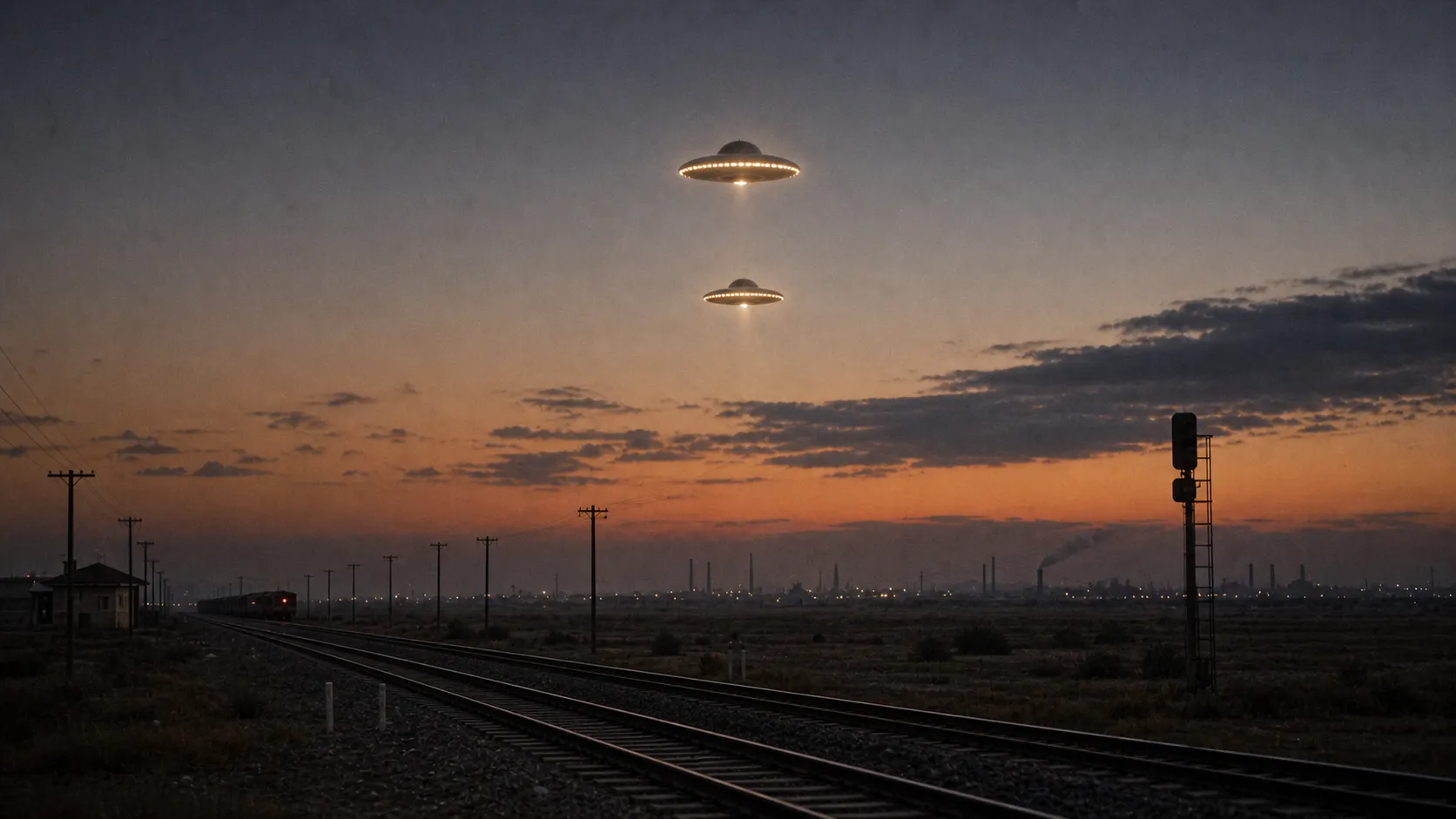
Shortly after sunset on October 4, 1955, a train carrying a small American congressional delegation rolled through the Transcaucasus region of the Soviet Union near Alyat station, approximately forty kilometers south of Baku in what is today Azerbaijan. Without warning, the most senior U.S. legislator on military affairs witnessed what he would describe — to CIA debriefers, Air Force intelligence officers, and ultimately the agency's daily intelligence bulletin — as two unconventional disc-shaped aircraft taking off from a point near the rail line and flying over the train. The incident generated twelve classified government reports and was withheld from the public for thirty years.
Three individuals witnessed the sighting. Senator Richard Brevard Russell Jr. (Democrat, Georgia), then in his third term as chairman of the Senate Armed Services Committee, was among the most powerful legislators in Washington and a figure whose credibility and discretion were beyond institutional reproach. Traveling with him were Lieutenant Colonel E. U. Hathaway, his military aide, a serving U.S. Army officer with operational experience; and Ruben Efron, the delegation's interpreter. Russell was the first to notice the objects and alerted Hathaway, who came to the window in time to observe the first object. Efron arrived at the window too late to clearly see the first craft but had an unobstructed view of the second. All three independently described consistent characteristics.
Approximately ten minutes after leaving Alyat station, at roughly 7:00 p.m. local time, Russell spotted what he initially described as a greenish-yellow ball rising rapidly from a point approximately one to two miles south of the rail line. As he called Hathaway over, the first object ascended almost vertically at what witnesses estimated as a relatively slow initial speed, reaching an altitude of roughly 6,000 feet before its horizontal velocity increased sharply as it headed north. The outer rim of the craft was observed revolving slowly to the right, and the disc carried a visible dome or raised structure on top. The edge of the disc glowed pinkish-white; the rotation of the luminous perimeter gave, in one witness's words, "the appearance of a pinwheel." Approximately one minute after the first craft cleared the area, a second object performed identical maneuvers from the same ground location — ascending vertically, rotating, accelerating north, and disappearing from view. Efron's account, collected separately, confirmed the absence of any audible engine sound or visible exhaust flame or trail: "the object gave the impression of gliding." Visibility conditions were reported as excellent.
The vertical take-off profile and subsequent rapid horizontal acceleration of both objects exceeded the demonstrated performance envelope of any Soviet jet aircraft known to U.S. intelligence in 1955. The absence of audible engine noise at close range — both objects passed directly over or very near the train — was inconsistent with jet propulsion of any type then in service. The sequential repetition of identical maneuvers by two craft from the same launch point within one minute suggested coordinated controlled behavior rather than meteorological phenomena. The glowing, slowly revolving outer rim with no conventional navigation light pattern matched no aircraft type in either Soviet or Western inventories.
No radar tracking was obtained during the incident; the witnesses were passengers on a civilian rail train and had no access to air defense systems. No photographic or film record was made. No physical landing traces or debris were collected. The primary evidentiary record consists of the contemporaneous testimony of three credible witnesses, cross-examined independently by U.S. Air Force attaché Colonel Timothy Ryan in Prague on October 13, 1955 — nine days after the sighting.
Senator Russell's group reported the sighting to Colonel Ryan at the U.S. Embassy in Prague on October 13, 1955. Ryan's formal intelligence report was transmitted to Washington, where it was included in the CIA's daily intelligence bulletin approximately two weeks after the incident — a publication circulated to the most senior levels of the U.S. government, including the White House. The CIA's Herbert Scoville Jr., Assistant Director for Scientific Intelligence, personally reviewed the case and conducted additional interviews with Russell. Scoville's final written assessment, preserved in the declassified record, stated that the testimony "does not in my opinion support the theory that the Russians have developed saucer-like or unconventional aircraft," speculating that the objects might have been conventional jet aircraft performing a steep climb or an experimental short take-off design. The incident was documented across twelve classified reports filed by CIA, FBI, and U.S. Air Force Intelligence. All were marked TOP SECRET. They were declassified in 1985 under FOIA requests, thirty years after the event.
Senator Russell declined all public discussion of the incident. In January 1956, responding to a private inquiry about what he had seen in the Soviet Union, he wrote that government agencies had advised him not to publicize the matter "at this time." He maintained that silence publicly for the remainder of his life. His aide Colonel Hathaway, when directly asked about the sighting by CIA debriefers, insisted that he remained convinced the objects were not any form of known aircraft, yet no statement from him ever appeared in the public record during his lifetime. Scoville's reassuring conclusion — that the objects were probably conventional jets in a steep climb — was the agency's way of containing the information within classified channels without opening a formal investigation that would require broader disclosure. The thirty-year classification timeline ensured no contemporary public scrutiny was possible.
The Alyat sighting stands as one of the most credibly sourced Cold War UFO cases in the Western documentary record. The primary witness was not a junior enlisted soldier or a civilian with uncertain credibility: Russell was a four-term senator, chairman of the most powerful military oversight committee in the U.S. Congress, and a figure whose word carried institutional authority. The incident occurred in denied Soviet territory, which precluded any follow-up investigation of the site or any corroboration from Soviet sources. The CIA's response — careful documentation followed by bureaucratic minimization — mirrors the pattern seen in other contemporaneous government UAP cases, including the 1952 Washington flap and the 1957 RB-47 intercept. The case also represents the earliest known documented UAP sighting in what is today independent Azerbaijan, occurring during a period when Soviet Azerbaijan housed significant petroleum infrastructure and military installations near Baku.
Sources
- governmentCIA Declassified Intelligence Report — Senator Russell UFO Sighting, Transcaucasus, October 1955 (declassified 1985)
- mediaUFO Evidence — 'U.S. Senator Richard Russell Sees Disc-Shaped UFO in USSR, October 13, 1955'
- mediaThinkAboutItDocs — '1955: U.S. Senator Richard Russell Sees UFO in USSR'
- mediaEnigma Labs — Soviet Union, October 1955 (Senator Russell Russia Sighting)