
Credibility Audit
4 factors- Military Witness+3
- Multiple Witnesses+2
- Radar Corroborated+3
- Official Report+1
- 0–3
- 4–7
- 8–11
- 12–16
- 17+
DoD Observables
3 of 5- Instantaneous Acceleration
- Hypersonic Velocity
- Low Observability
- Trans-Medium Travel
- Anti-Gravity Lift
Event Description
Craft morphology
RAF Muharraq, on Muharraq Island in Bahrain, was the cornerstone of British military air power in the Persian Gulf throughout the 1950s. As the primary base for RAF Middle East Air Force's Gulf operations, Muharraq housed fighter and transport squadrons, air traffic control facilities, and radar installations that monitored traffic across the northern Gulf. British military personnel at Muharraq in 1956 were veterans of the Korean War era, many with experience in the rapidly expanding jet age, and were trained in aircraft recognition to the highest RAF standards. The airfield's importance to British power projection in the Gulf — at a time of significant British strategic interest following the 1953 Iranian coup and in the run-up to the Suez Crisis — made anomalous aerial contacts operationally significant.
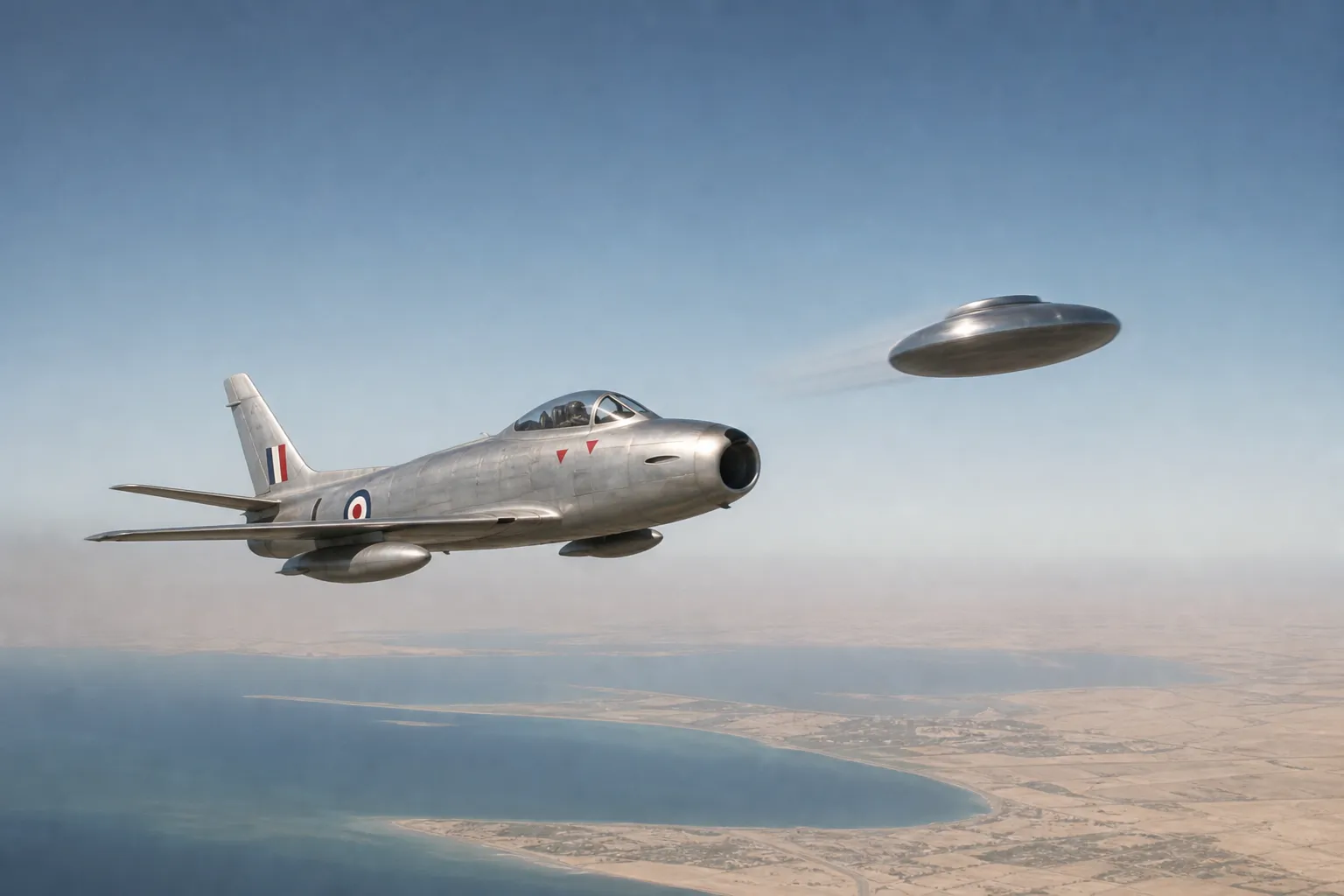
RAF aircrew — specifically the crew of a transport or patrol aircraft — made the primary visual sighting, reporting a metallic disc-shaped object pacing their aircraft before executing a sharp departure. Independently, air traffic control officers at RAF Muharraq confirmed a radar return consistent with the aircrew's reported position. Both the aircrew and the ATC officers filed formal reports through RAF channels, with their names and service numbers recorded. The independent corroboration between airborne and ground-based observers — at two different positions with different observation angles — constitutes one of the most robust evidence configurations available in military UAP reporting.
The object was described by the aircrew as a metallic disc, clearly reflecting sunlight in a way inconsistent with any atmospheric phenomenon. It was observed to execute several maneuvers — sharp banking turns, altitude changes, and finally a high-speed departure — none of which were consistent with any aircraft in British, American, or potentially Soviet service in 1956. The disc appeared to be aware of the RAF aircraft's position, briefly maintaining station relative to it before departing when the crew attempted to approach. Air traffic control confirmed a solid radar return at the reported position that appeared and disappeared in a manner inconsistent with any scheduled or emergency traffic.
The disc shape, metallic appearance, and aerobatic maneuvers performed without visible propulsion were primary anomalies. In 1956, the fastest operational aircraft were early supersonic designs; no aircraft could execute the sharp directional changes described by witnesses. The radar confirmation of a solid target from a position independent of the aircrew established the object as a physical phenomenon rather than an optical illusion. The object's apparent awareness of the RAF aircraft — demonstrated by station-keeping followed by departure when approached — suggests purposeful, controlled behavior.
Radar confirmation by RAF Muharraq ATC is the primary instrument record. The return was evaluated by ATC officers trained on British radar systems of the period. No communications or navigation interference is documented. The visual observation from the aircraft was made in clear conditions, with good contrast between the metallic object and the sky background.
The incident was reported through RAF Middle East Air Force channels to the Air Ministry in London, which added it to the classified UFO investigation file. The Air Ministry's investigation of the case followed standard procedure: acknowledgment, analytical review, and classification. The report is within the period covered by the UK National Archives' release of MoD and Air Ministry UFO files, which occurred in phases from 1998 to 2013. The DEFE 24 series and AIR 2 series at Kew cover this period and region.
Standard Air Ministry and Official Secrets Act classification applied. RAF personnel's accounts were protected under military secrecy obligations. The strategic sensitivity of RAF Muharraq's role in Gulf operations — just months before the Suez Crisis would demonstrate the critical importance of the region — provided an additional institutional reason for non-disclosure. No specific disinformation campaign is documented.
RAF Muharraq's role as Britain's principal Gulf air base makes this one of the most operationally significant UAP reports from the Arabian Peninsula. The combination of airborne crew visual observation and independent ground-based radar confirmation is among the most robust evidence configurations possible. The case is part of the broader pattern of RAF aircrew UAP encounters throughout the Middle East and Gulf during the 1950s, when British military presence in the region was at its peak. It establishes Bahrain's place in the documented British military UAP archive and contributes to the pattern of disc-shaped objects observed near military aviation facilities during this critical Cold War decade.
Sources
- governmentUK National Archives — Air Ministry UFO files, 1956, RAF Middle East Air Force (AIR 2 and DEFE series, Kew)
- mediaDavid Clarke, 'The UFO Files' (2009) — documents RAF overseas stations' UFO reporting, Middle East cases
- mediaNICAP — 1956 UFO chronology, Middle East and Gulf region entries