
Credibility Audit
6 factors- Military Witness+3
- Multiple Witnesses+2
- Radar Corroborated+3
- Govt. Acknowledgment+4
- Official Report+1
- Law Enforcement+2
- 0–3
- 4–7
- 8–11
- 12–16
- 17+
DoD Observables
3 of 5- Instantaneous Acceleration
- Hypersonic Velocity
- Low Observability
- Trans-Medium Travel
- Anti-Gravity Lift
Event Description
Craft morphology
On the evening of November 29, 1989, two officers of the Belgian Gendarmerie — Warrant Officers Heinrich Nicoll and Hubert Von Montigny — were on routine patrol near the town of Eupen, approximately twelve kilometers from the German border, when they observed a field illuminated as brightly as a football pitch. Pulling over on the N68, they watched a triangular platform move silently overhead at low altitude, its three corner lights blazing white and a central light pulsing orange-red. The sighting lasted over thirty minutes. It was the opening event of what would become the most extensively documented mass UFO wave in European history, running from November 1989 through April 1990.
The founding witnesses, Nicoll and Von Montigny, were sworn law-enforcement officers whose contemporaneous reports were filed through official Gendarmerie channels and forwarded to the Belgian Air Force. On November 29 alone, 30 groups of civilian witnesses and three separate groups of police officers filed reports; at least 13 witnesses that first night were serving law-enforcement personnel. Over the full eighteen-month wave, SOBEPS (Société Belge d'Etude des Phénomènes Spatiaux) collected 2,600 written witness statements from a pool estimated at 13,500 individual sighters. The witness pool included serving military officers, civil aviation pilots, engineers, and scientists. On March 30, 1990 — the most dramatic night of the wave — gendarmerie Captain Piron and his patrol independently confirmed a triangular object before any official scramble was ordered.
Witnesses across the wave consistently described a large, flat, dark triangular craft carrying three bright white lights — one at each vertex — and a single red or orange light at or near the center that pulsed at irregular intervals. The objects were reported as utterly silent even at low altitude, estimated by ground observers at 200–500 meters. Multiple witnesses described the craft as larger than a Boeing 747, with a matte-black non-reflective surface. During the night of March 30–31, 1990, gendarmerie officers in the Wavre area reported observing the same configuration of lights making "short jerky movements" while hovering before accelerating. Ground radar at Semmerzake tracked at least one return consistent with a slow-moving object that subsequently demonstrated extraordinary acceleration. On that night the Control Reporting Center at Glons received reports of three unusual lights moving toward Thorembais-Gembloux, southeast of Brussels. Objects were independently tracked by radar at Bertem, Glons, and Bierset in Belgium, and also by Maastricht approach control in the Netherlands on December 5, 1989.
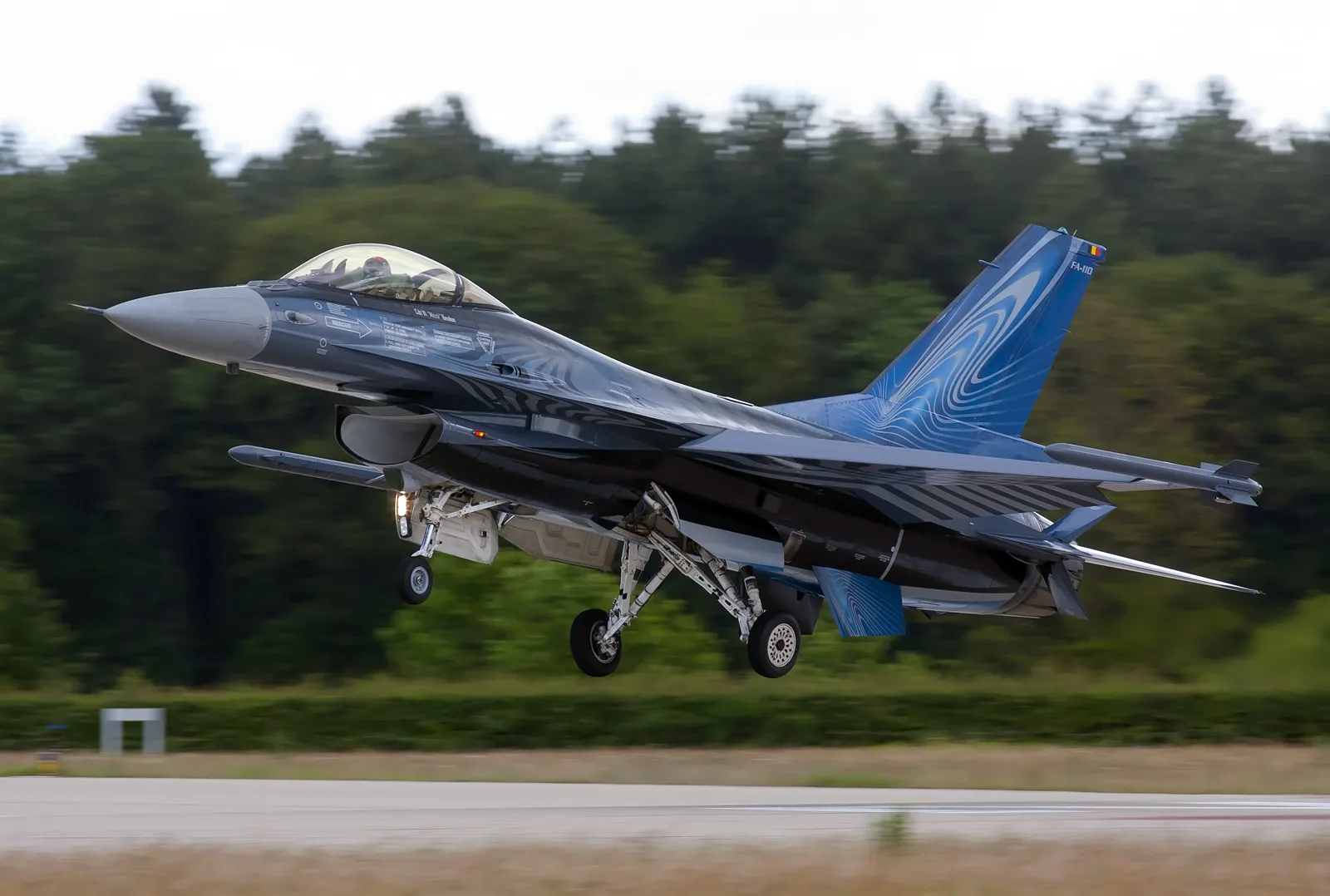
The most striking anomaly recorded during the March 30–31 intercept was a reported acceleration from approximately 240 km/h to over 1,800 km/h in seconds without any sonic boom — aerodynamically impossible for any known aircraft of the period, and consistent with the instantaneous_acceleration observable. The two F-16s from Beauvechain Air Base conducted nine separate intercept attempts over approximately one hour. Airborne radar locked on to a return three times; on each occasion the return disappeared from scope within seconds. One pilot observed an altitude change from 3,000 meters to less than 200 meters in under two seconds on radar, a descent rate impossible for any winged aircraft. No pilot achieved a visual confirmation. Throughout the wave, witnesses on the ground consistently reported zero acoustic signature at altitudes where a conventional aircraft or helicopter would be audible.
Ground-based radar at multiple NATO-operated stations tracked objects that did not squawk transponder codes. The Belgian Air Force officially confirmed at least three radar tracks during the March 30–31 intercept night, though subsequent analysis attributed some contacts to Bragg scattering; the status of the confirmed tracks remains disputed in the scientific literature. No electromagnetic interference with ground equipment was reported. No landing traces were documented. The Petit-Rechain photograph, released in April 1990 and widely reproduced, was later confirmed as a deliberate hoax by its creator, Patrick Maréchal, in a 2011 television interview — removing it entirely from the evidentiary record.
The Belgian Air Force took the unusual step of holding a public press conference on July 11, 1990, at which Major-General Wilfried De Brouwer presented the findings of the official investigation. He stated that the objects tracked by radar and reported by police officers were "a real phenomenon" that the Air Force was unable to identify. SOBEPS was formally permitted to collaborate with the Air Force, gaining access to radar tapes and pilot debriefs — an arrangement without precedent in Western European UFO investigation. Major Lambrechts authored an internal air force report acknowledging the unexplained radar tracks. The Belgian government did not pursue a formal parliamentary inquiry; the Air Force investigation was closed without explanation.
None documented. The Belgian military response was notable for its relative transparency compared to other NATO states. Officers Nicoll and Von Montigny were not subjected to career consequences for their initial report. The subsequent hoax photo caused significant confusion in press coverage but was not a state-sponsored disinformation campaign. No NDAs or witness intimidation were reported.
The Belgian UFO wave is the most thoroughly documented mass UAP event in European history and one of a handful globally in which a NATO air force officially acknowledged an unidentified aerial phenomenon while conducting active intercept attempts. The case established a protocol, however imperfect, for civil-military research collaboration that influenced subsequent French GEPAN/SEPRA methodology. The convergence of law-enforcement witness reports, multiple independent radar tracks, military intercept data, and an Air Force press conference acknowledgment places this case in the first tier of evidentiary quality worldwide. The wave's consistency of object description — triangle, silent, three white lights, central pulsing light — precisely mirrors the "black triangle" UAP archetype documented independently across the United States, United Kingdom, and Russia during the same period.
Sources
- governmentBelgian Air Force — Major-General De Brouwer press conference, July 11, 1990
- academicSOBEPS — 'Vague d'OVNI sur la Belgique' Vol. 1 (1991)
- mediaThe Week — '30 years later, we still don't know what happened during the Belgian UFO wave' (2019)
- mediaUFO Casebook — The Belgium UFO Wave, 1989