SightingModern Era
Budapest Reconnaissance Flight — Hungarian Military Pilot Films Silver Disc
September 29, 2001
Budapest, Hungary
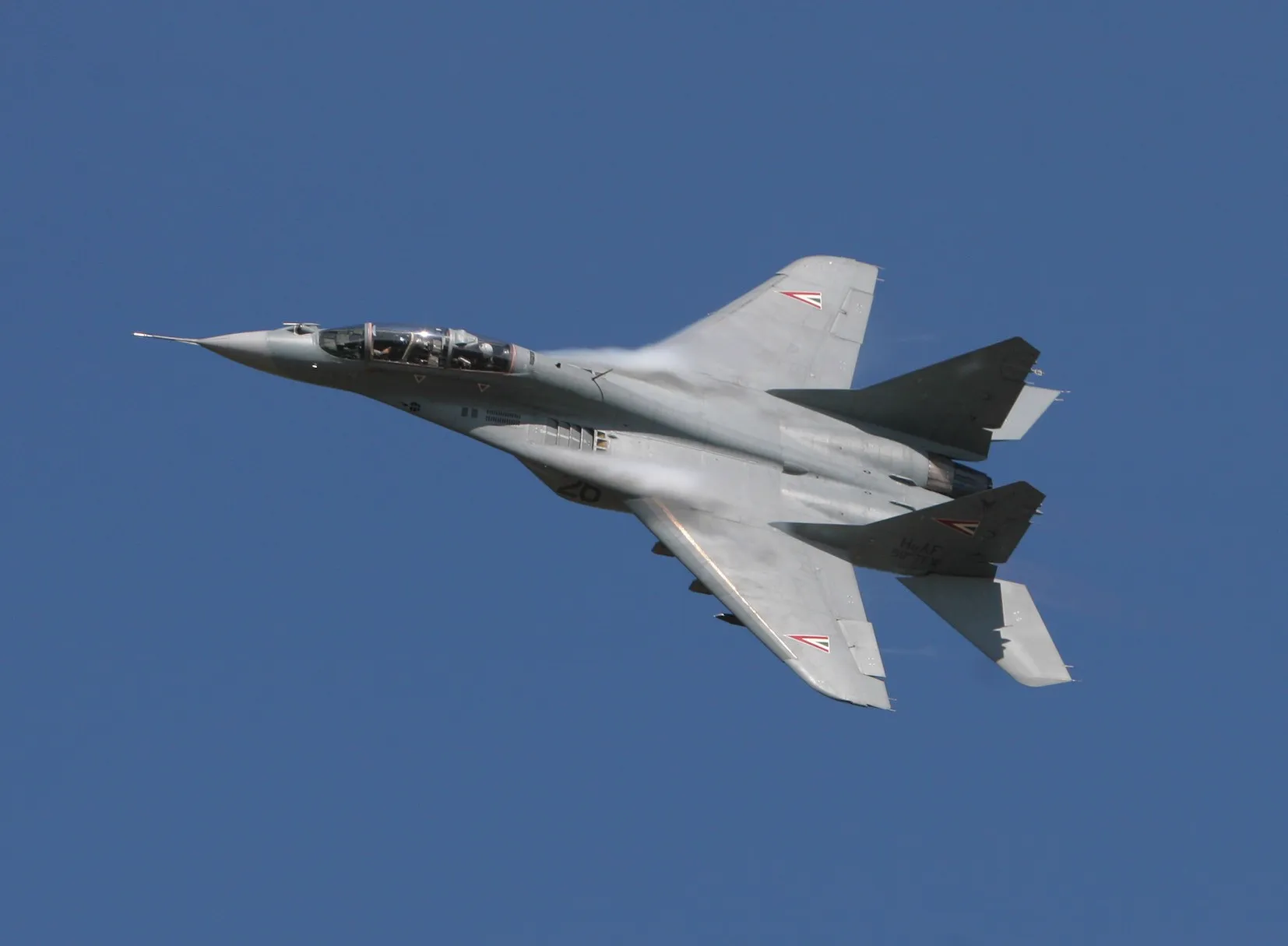
A Hungarian Air Force MiG-29UB at the Koksijde Airshow, 2005. The HUAF operated the MiG-29 from Kecskemét Air Base during the period of the 2001 Budapest sighting. — Coert van Breda / Wikimedia Commons (CC BY)
Credibility Assessment
Moderate
Pilot WitnessMilitary WitnessPhoto EvidenceOfficial Report
Event Description
Observed Shape
Disc
Craft morphology

Non-Human Intelligence (NHI)
Reported Entities
No NHI encounter documented for this event.
On the afternoon of September 29, 2001, an unnamed Hungarian military pilot was conducting a reconnaissance flight over Budapest when he observed and filmed a silver, disc-shaped object moving at speed through the cloud layer to his left. The pilot, who has declined to be publicly identified pending an official inquiry by the Hungarian Ministry of Defence, described the object as "a bright metal aircraft that was the shape of a perfect disk." Using the onboard camera equipment fitted to his reconnaissance aircraft, he captured video footage of the object as it approached, slowed, and then accelerated away out of frame. According to the pilot's own account, translated from Hungarian and first published by Rense.com in October 2001, he chose to film rather than pursue: "I was careful to film the object, not to try and chase it since I could not match its speed."
The footage, comprising at least three identifiable still frames, shows a metallic, flattened disc against a background of cumulus clouds. Multiple aviation experts who reviewed the still frames noted that the cloud formations behave consistently with normal cumulus development, lending credibility to the sequence as authentic and not reversed or fabricated. Analyst William Ristau, a pilot, concluded in correspondence published alongside the original Rense.com report that the Hungarian pilot's account was consistent with the visual evidence: the UFO was traveling faster than the reconnaissance aircraft and moved ahead of it before disappearing. A separate correspondent with thirty years of aviation experience and a background in air traffic control similarly assessed the images as showing a real, fast-moving object.
The pilot's legal situation introduced an unusual dimension to the case. Because the flight was not an official duty assignment — the pilot was transporting the aircraft as a personal favor to save the government money — he maintained that the video footage was his property rather than state property. He retained an attorney and sought the public release of the full video, hoping that the disclosure of still frames would accelerate that process. As of the published record in late 2001, the full video had not been officially released.
The Hungarian Ministry of Defence's response was carefully managed. Officials declined to answer questions about the video footage and stated there would be no official comment. However, when journalists privately provided the pilot's name, ministry representatives confirmed that the individual was indeed a serving member of the Hungarian Air Force and that he did fly photo-reconnaissance aircraft. That partial acknowledgment — confirming the witness's credentials without addressing the footage — is a notable feature of the institutional response.
The incident occurred less than three years after Hungary's accession to NATO on 12 March 1999 — a transformative period for the Hungarian Air Force. At the time, the HUAF operated a fleet of Mikoyan-Gurevich MiG-29 fighters based at Kecskemét Air Base. In 2001, the force was actively transitioning away from Soviet-era operational doctrine, receiving guidance from the German Luftwaffe which had experience flying MiG-29s in a Western context. Flight hours were severely constrained by maintenance and funding shortfalls — Hungarian MiG-29 pilots flew approximately 44 hours per year, compared to 200–250 for their NATO counterparts. In June 2001, just months before the sighting, the Hungarian government formally requested a possible sale of F-16 aircraft as part of the broader NATO interoperability push; later that year Hungary would sign an agreement to lease 14 JAS-39 Gripen fighters. The September 29 sighting, therefore, occurred during a period of active military aviation reform in Hungary, when its pilots were integrating into a new doctrinal framework while still flying legacy Soviet hardware.
The pilot's claim to sole ownership of the footage, combined with the Ministry of Defence's studied non-response, meant the full video never entered public circulation through official channels. The still frames published by Rense.com and subsequently reported on by UFO Insight and documented in the MUFON case database (case filed January 8, 2010) remain the primary public evidence. Kal Korff, a journalist and UAP researcher then based in Prague, subsequently acquired a copy of the video through the Hungarian government and became an associate of the pilot's legal representative, promising further analysis — though no comprehensive follow-up was published. The case was classified as a Hynek DD (Daylight Disc) sighting by UFO researchers and remains unresolved. No conventional explanation — blimp, balloon, drone, or misidentified aircraft — has been publicly demonstrated to account for the footage to the satisfaction of the pilot or independent aviation analysts who reviewed it.
5 Observables Detected
Instantaneous Acceleration
Hypersonic Velocity
Low Observability
Trans-Medium Travel
Anti-Gravity Lift
Suspicious Activity
Intelligence Agency
Cover-up Actions
Men in Black
Disinformation
Witness Suppression
Sources
mediaRense.com — "Spectacular Daylight UFO Over Hungary Filmed By Military Pilot", October 22, 2001witnessPilot account (anonymous) via Hungarian press, translated and published by Rense.com, 2001mediaUFO Insight — "Lesser-Known UFO Sightings With Photographic Evidence" (Marcus Lowth, January 2024)mediaMUFON Case Database — Hungary, sighting date 2001-09-29, case filed January 8, 2010mediaThink About It Docs — "Disk-Shaped Object Photographed by Military Pilot in Hungary", 2013