Close EncounterModern Era
Romanian MiG-21 Lancer Struck by Unidentified Objects Over Transylvania
October 31, 2007
Near Gherla, Transylvania, Romania
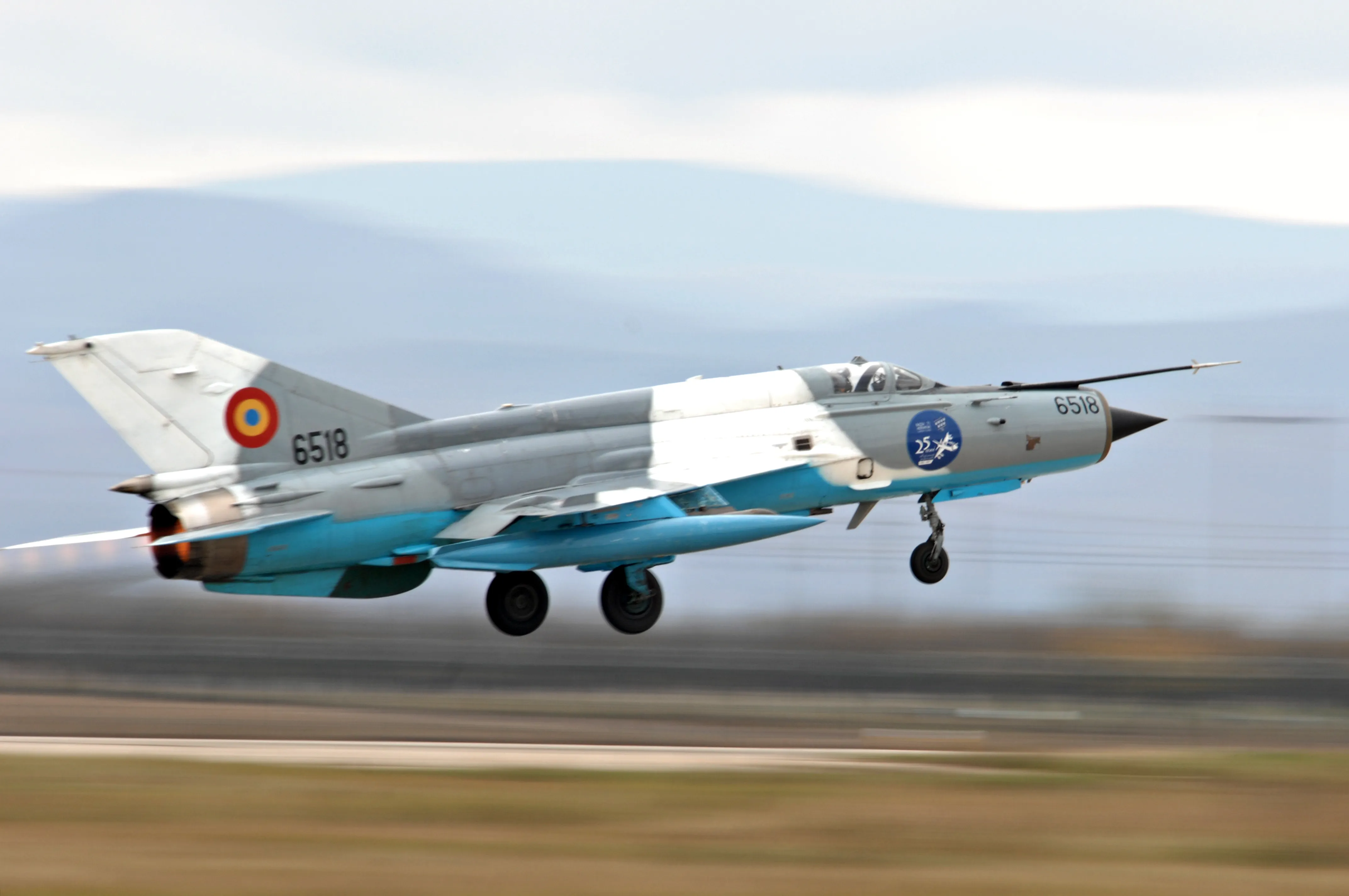
A Romanian Air Force MiG-21 LanceR takes off from Air Base 71 at Câmpia Turzii — the same base and aircraft type involved in the October 2007 incident — during NATO exercise Dacian Thunder 2009. — U.S. Air Force photo by Senior Airman Benjamin Wilson / USAF (public domain)
Credibility Assessment
High
Military WitnessPilot WitnessPhysical EvidenceVideo EvidenceMultiple WitnessesOfficial Report
Event Description
On October 31, 2007, a Romanian Air Force MiG-21 Lancer fighter jet operating on a routine check flight over the Transylvania region was struck by four unidentified flying objects at an altitude of approximately 6,300 to 6,500 meters (roughly 20,700 feet), traveling at approximately 800 to 850 kilometers per hour. The aircraft belonged to the 71st Air Base Wing at Câmpia Turzii — the primary Romanian combat aviation installation in north-central Transylvania. The pilot, Lieutenant-Colonel Marin Mitrica, reported that the objects appeared suddenly from beneath an overcast cloud layer and struck his aircraft from the right side without warning. Two aircraft were conducting the training exercise at the time, making Mitrica one of at least two military airmen in the immediate vicinity during the encounter.
The impact was severe. The cockpit canopy was shattered by the collision, and shrapnel ricocheted into the cockpit — striking Mitrica's oxygen mask and perforating his flight helmet, causing facial injuries. Despite the damage, Mitrica maintained control of the aircraft and successfully returned it to base. The plane was one mechanical failure away from an unrecoverable situation, but the pilot's training and the structural integrity of the airframe prevented a crash.
Romanian Defense Ministry officials subsequently confirmed the incident publicly and released footage recorded by the onboard camera system of the aircraft. The camera captured what investigating officer Lieutenant-Colonel Nicolae Grigorie described as "two solid bodies, which are not translucid." The objects passed through the camera frame so rapidly that analysts determined they were visible for only approximately 67 milliseconds — a duration consistent with objects moving at extreme velocity relative to the aircraft. Because of this brevity, no definitive shape could be extracted from the footage.
The official investigation systematically eliminated conventional explanations. Grigorie stated publicly: "They couldn't be birds because there are no birds in Europe able to fly so high." Ice formations were ruled out because the sky at altitude was clear, not overcast, at the point of impact. Meteorite fragments were excluded based on trajectory and impact characteristics. Rocket launches and ground artillery fire were investigated and dismissed. Debris from another aircraft was also ruled out, as no other aircraft was reported in the area at the time. Four separate UFOs were detected in total; however, the onboard camera captured footage clearly depicting two of the solid impacting objects.
The significance of the 2007 incident must be understood within Romania's NATO accession context. Romania formally joined NATO on March 29, 2004, just three years before this encounter. The Romanian Air Force was at that time in a transitional phase — still operating the Soviet-era MiG-21 LanceR, a significantly modernized variant of the original MiG-21 produced through a collaboration between Romania's Aerostar Bacău and the Israeli defense company Elbit Systems. Between 1993 and 2002, approximately 111 Romanian MiG-21 airframes were upgraded under the LanceR program to three sub-variants: LanceR A (ground attack), LanceR B (dual-seat trainer), and LanceR C (air superiority). The LanceR C variant — the air superiority model to which Mitrica's aircraft most likely belonged — received a modern Israeli Elta EL/M-2032 multi-mode radar and new avionics, bringing a 1960s Soviet airframe into rough parity with late Cold War Western fighters. It was this upgraded variant that Romania relied upon as its primary air defense asset during the 2004–2016 period before F-16s entered service.
From August to November 2007 — the same period as this incident — Romania deployed four MiG-21 LanceR aircraft to lead NATO's Baltic Air Policing mission in Lithuania, Estonia, and Latvia. The 71st Air Base at Câmpia Turzii was, at the time of the encounter, not only the home of Romania's frontline fighters but a NATO-integrated facility actively supporting alliance air policing responsibilities. This context renders the official confirmation of the incident, and the public release of onboard footage, particularly noteworthy: the Romanian Ministry of National Defence was not a peripheral observer but a full NATO member state operating alliance-integrated air defense infrastructure when it publicly acknowledged that an unexplained encounter had damaged one of its combat aircraft.
Following the investigation, the Romanian military reportedly referred the case to the Security Committee of European Air Forces for further review, an institutional step suggesting the matter was treated as operationally significant rather than merely anomalous. No subsequent public conclusion was issued by that body. No classification of witnesses was reported, and no evidence of suppression or NDA imposition has surfaced in open-source records. The incident received modest international press coverage in June 2008 — approximately seven months after it occurred — when the Defense Ministry publicly released the video, suggesting the initial investigation period had concluded before public disclosure was authorized.
The case remains officially unresolved. It occupies a relatively rare category in military aviation UAP encounters: an incident in which physical evidence of impact (aircraft damage, pilot injury, onboard video) is confirmed by official government statements, all prosaic causes were formally excluded by the investigating authority, and the case was escalated to a multinational European military body — yet no final explanation was ever publicly furnished. The 67-millisecond detection window on the onboard camera, combined with the absence of any known aircraft or projectile in the vicinity, makes conventional debris or bird-strike explanations difficult to sustain against the available evidence.
5 Observables Detected
Instantaneous Acceleration
Hypersonic Velocity
Low Observability
Trans-Medium Travel
Anti-Gravity Lift
Suspicious Activity
Intelligence Agency
Cover-up Actions
Men in Black
Disinformation
Witness Suppression
Sources
governmentRomanian Defense Ministry — official confirmation and video release, June 2008mediaWikinews — "Romanian fighter jet hit by UFOs" (2008)mediaUPI — "UFOs hit Romanian plane" (June 6, 2008)mediaAero-News Network — "Romanian MiG-21 Struck By UFOs"mediaHotNews.ro — Romanian-language primary report near Gherla