SightingCold War
Caracal Airfield Radar + MiG-17 Intercept — Romania, Summer 1957
Summer 1957
Caracal Airfield, Olt County, Romania
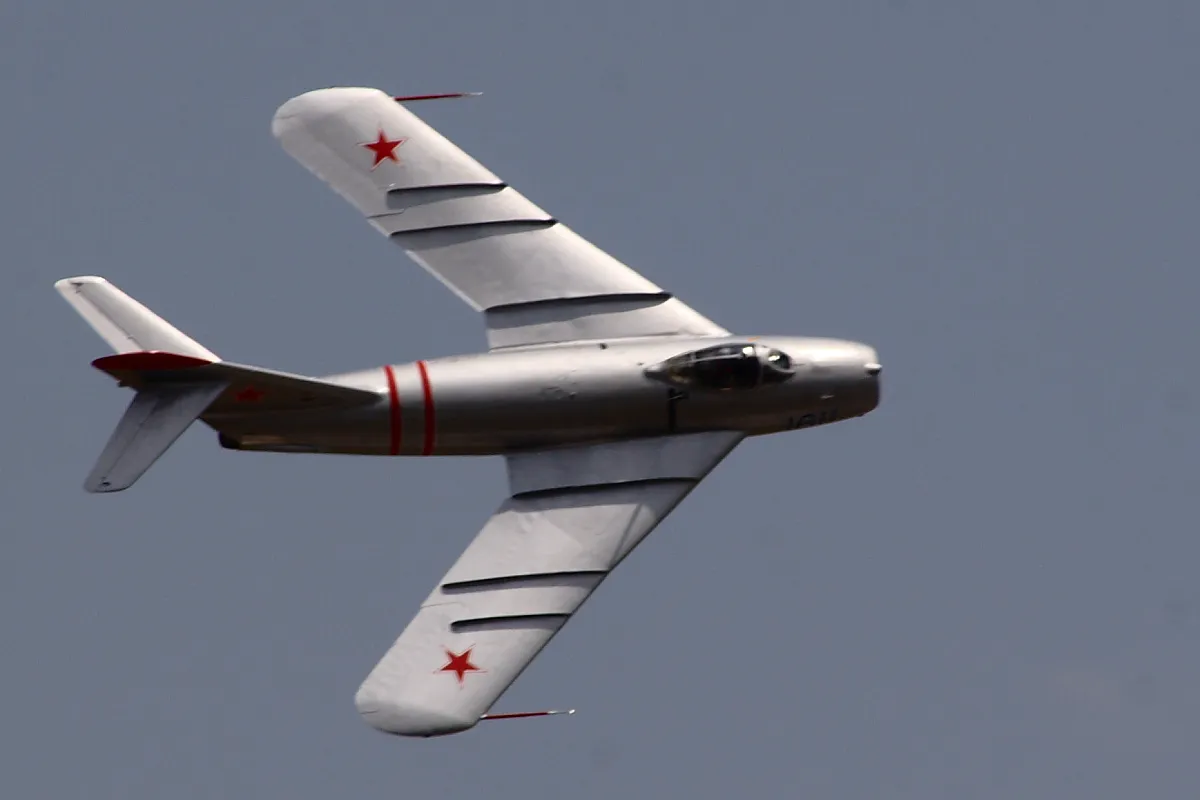
A MiG-17F in flight — the same variant scrambled from Craiova to intercept the unidentified radar contact over Caracal in the summer of 1957 — Robert Lawton / Wikimedia Commons (CC BY-SA 2.5)
Credibility Assessment
Moderate
Radar CorroboratedMilitary WitnessPilot WitnessOfficial Report
Event Description
On a summer evening in 1957, Romanian Air Force personnel at the backup airfield of Caracal — located in Olt County in the Oltenia plain of southern Romania, roughly 120 kilometers from Bucharest — found themselves at the center of one of the most credible and best-documented Cold War UAP encounters from the Warsaw Pact world. The airfield served as an emergency diversion strip for the main airbase at Craiova and was staffed on the night in question with a skeletal crew whose duties included flight management support for any aircraft requiring emergency assistance. What unfolded over the next several minutes became a deeply unsettling encounter that the principal witness, flight leader Captain Mihai Bărbuțiu, kept largely to himself for nearly six decades.
Bărbuțiu, born in Arad in 1929, was by 1957 an experienced Romanian Air Force aviator who had held his pilot's brevet since 1951. On the evening in question he had been assigned as flight leader at Caracal — a routine duty post. He was accompanied at the mobile flight control station by a sergeant named Gigartù, a conscript from the Bucharest area described by Bărbuțiu as well-trained and composed. Their flight operations center was a large ZIS six-wheel military truck parked adjacent to the runway, serving as the mobile command post. At some point in the evening, Bărbuțiu was urgently alerted by radio to proceed to the station: radar operators in the area had acquired an unidentified target. The radar return was anomalous from the outset — the object appeared and disappeared on scope, refusing to maintain a consistent return, which immediately ruled out any conventional aircraft of the era. Ground radar stations were tracking the contact but could not obtain precise positional data.
To investigate and intercept, a MiG-17 fighter was scrambled from the Craiova air base. The aircraft was flown by Captain Adalbert Bodis — a colleague of Bărbuțiu's who later retired to Cluj-Napoca as a commander. The MiG-17 used was almost certainly a radar-equipped variant: Romania had received Soviet MiG-17PF all-weather interceptors as part of Warsaw Pact military assistance programs, and Bărbuțiu specifically noted that the MiG-17 was "the first aircraft of the Romanian Air Force with its own radar." Bodis radioed back ground controllers as he pursued the target, reporting alternately that he had acquired the contact and then that it had vanished. The target was refusing to cooperate with either ground radar or the airborne intercept system. At Caracal, Bărbuțiu and Sergeant Gigartù monitored the radio exchange and could hear Bodis's mounting difficulty holding the target.
Then the object appeared directly to them — arriving from the direction of Deveselu, approaching from the rail line to the southwest. As it neared the command post, Bărbuțiu's instinct was tactical: uncertain whether it might be a foreign military aircraft of unknown origin, he and Gigartù took cover beneath the ZIS truck, sheltering behind its large wheels. What struck him immediately was the silence. There was no engine noise whatsoever. When he risked a look, he saw what he described as a circular luminous field approximately 50 to 100 meters in diameter — not a point source of light but a broad, diffuse illumination that lit the entire ground below it as brightly as daylight. He could see individual blades of grass in the light. The object's solid form was not visible above the beam; looking into it was like looking into a floodlight — only the light itself was perceptible, not its source. The entire episode lasted approximately twenty seconds before the light extinguished and Bărbuțiu re-emerged from beneath the truck.
He immediately radioed Bodis, who was still airborne, to report that the object had passed directly over the Caracal command post heading east toward the Olt River valley and Slatina. Bodis altered course to pursue, but the contact was gone — he could not re-acquire it by eye or by onboard radar. After Bodis landed, the incident was discussed among the officers involved. The explicit instruction that followed was characteristically blunt for the Soviet-aligned military establishment of the time: the crew was advised to keep the matter between themselves. No formal written report was filed, at least none to which Bărbuțiu was ever made privy.
The geopolitical context of 1957 Romania makes the suppression of such an incident entirely predictable. Romania under Gheorghe Gheorghiu-Dej was a tightly controlled Warsaw Pact state, with its military forces fully integrated into Soviet command structures following the 1947 abolition of the monarchy. The Romanian Air Force flew Soviet-supplied aircraft maintained under Soviet technical standards, and its officers understood implicitly that reporting anomalous phenomena through official channels — particularly phenomena that neither ground radar nor airborne radar could explain — carried serious career and personal risks. The previous year, 1956, had seen the brutal Soviet suppression of the Hungarian uprising, making every Warsaw Pact officer acutely aware of the consequences of being seen as politically unreliable or mentally unstable. In that environment, the informal instruction to "keep it among yourselves" was not a request.
The Caracal encounter was first documented publicly by Dan D. Farcaș — Romania's foremost UAP researcher and the president of ASFAN (Asociația pentru Studiul Fenomenelor Aerospațiale Neidentificate) — following a detailed interview with Bărbuțiu in Arad on March 4, 2015, conducted in part for a television program hosted by Sorin Ghilea on TV Arad. Bărbuțiu, then 86 years old and long retired from both military and civilian aviation (he flew the AN-24 and TU-154B for Romanian civil aviation until 1979), delivered a sober and technically precise account that Farcaș published in Romanian and later synthesized in English on the ASFAN website. The case is notable for its multi-element structure: ground radar acquisition of an anomalous target, an airborne intercept attempt by a radar-equipped fighter, and a simultaneous close visual observation by a credentialed officer and an NCO on the ground — all occurring within a few minutes of each other. No satisfactory conventional explanation has been proposed.
5 Observables Detected
Instantaneous Acceleration
Hypersonic Velocity
Low Observability
Trans-Medium Travel
Anti-Gravity Lift
Suspicious Activity
Intelligence Agency
Cover-up Actions
Men in Black
Disinformation
Witness Suppression
Sources
witnessMihai Bărbuțiu — personal testimony to Dan D. Farcaș, Arad, March 4, 2015; TV Arad interview with Sorin Ghilea
academicDan D. Farcaș / ASFAN — 'Four UAP Encounters of a Romanian Fighter Pilot', asfanufo.ro; Romanian original: 'Intalniri ale unui pilot militar cu obiecte neidentificate'academicDan D. Farcaș / ASFAN — Romanian-language full account, asfanufo.ro/istorie/177