
Credibility Audit
5 factors- Military Witness+3
- Pilot Witness+3
- Photo Evidence+2
- Official Report+1
- Govt. Acknowledgment+4
- 0–3
- 4–7
- 8–11
- 12–16
- 17+
DoD Observables
3 of 5- Instantaneous Acceleration
- Hypersonic Velocity
- Low Observability
- Trans-Medium Travel
- Anti-Gravity Lift
Event Description
Craft morphology
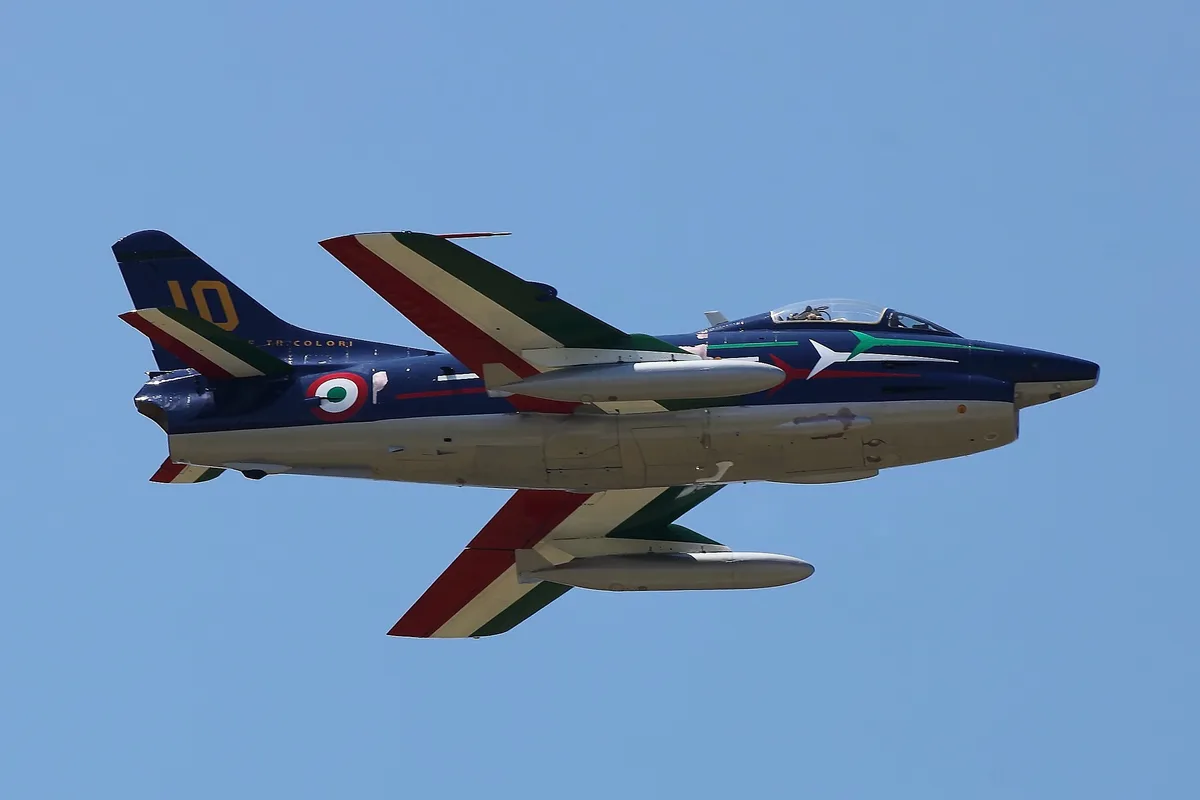
On June 18, 1979, Italian Air Force Lieutenant Giordano Cecconi was conducting a photo-reconnaissance mission in a Fiat G.91 jet aircraft over the Adriatic Sea near Treviso, in northeastern Italy. Flying at approximately 8,000 feet at around 460 knots, Cecconi observed an unidentified object in his vicinity and made multiple passes to obtain photographs using his aircraft's reconnaissance camera — producing several clear images of a metallic, disc-shaped craft with a raised dome on its upper surface.
The object appeared solid and structured, with no visible wings, rotors, engine exhaust, or markings of any kind. In the photographs, the craft appears dark metallic with a defined rim and a central upper protrusion. Cecconi estimated the object to be approximately six to nine meters in diameter. During his multiple passes, the object maintained a relatively stable position in the surrounding airspace. After being photographed, it departed at high speed. The conditions — daylight, clear visibility, a trained military pilot, and an aircraft equipped with reconnaissance camera systems — represent an unusually favorable evidence-gathering scenario for a UAP encounter.
Upon landing, Cecconi reported the encounter to base authorities and the photographs were formally analyzed by the Italian Air Force. The case was subsequently investigated by Centro Italiano Studi Ufologici (CISU) and reviewed by the Italian Senate's UAP investigative commission. The Italian Air Force's formal finding was that the object was of unknown origin and could not be attributed to any known aircraft or technology. The conclusion was reached after analysis of the photographs and Cecconi's testimony by military aeronautical experts.
The Cecconi photographs became among the most studied military-source UAP images in European history. Unlike many UAP photograph cases from this era, the Cecconi encounter combined excellent environmental conditions, a credentialed military witness with immediate access to a reconnaissance camera, and a formal military investigation that reached an explicitly inconclusive finding rather than offering a dismissive conventional explanation. The Italian Air Force's willingness to acknowledge the case without an attribution sets it apart from most Cold War-era military UAP responses.
Sources
- governmentItalian Air Force official investigation report, 1979
- witnessLt. Col. Giancarlo Cecconi, Italian Air Force