
Credibility Audit
1 factor- Multiple Witnesses+2
- 0–3
- 4–7
- 8–11
- 12–16
- 17+
DoD Observables
1 of 5- Instantaneous Acceleration
- Hypersonic Velocity
- Low Observability
- Trans-Medium Travel
- Anti-Gravity Lift
Event Description
Craft morphology
The Union of the Comoros is an archipelagic nation in the northern Mozambique Channel, composed of three volcanic islands — Grande Comore, Mohéli, and Anjouan — positioned at the junction of east African maritime routes and Indian Ocean shipping lanes. France retains significant military and political influence in the region through its Indian Ocean presence, including facilities at Djibouti, Réunion, and Mayotte (the latter a French department immediately adjacent to Comorian territory). The island chain's equatorial position, minimal light pollution, and open ocean horizons make it an excellent natural observation platform for aerial and astronomical phenomena. In 2009, witnesses near Moroni, the national capital on Grande Comore, reported observing luminous aerial objects over the surrounding ocean that could not be attributed to any known aircraft or natural phenomena. These reports entered regional UAP databases and represent the Comoros' first documented presence in the international open-source UAP record.
Multiple witnesses near Moroni observed the luminous objects during night hours. The Comoros' small population and limited formal reporting infrastructure meant the observations were documented through informal regional channels rather than through institutional reporting mechanisms such as NUFORC or MUFON. The witnesses were residents of the capital area with familiarity with the local maritime and aviation environment — including aircraft operating between Moroni's Prince Said Ibrahim International Airport and the surrounding islands, and vessels transiting the Mozambique Channel. This background provides an implicit baseline for distinguishing anomalous aerial phenomena from known traffic.
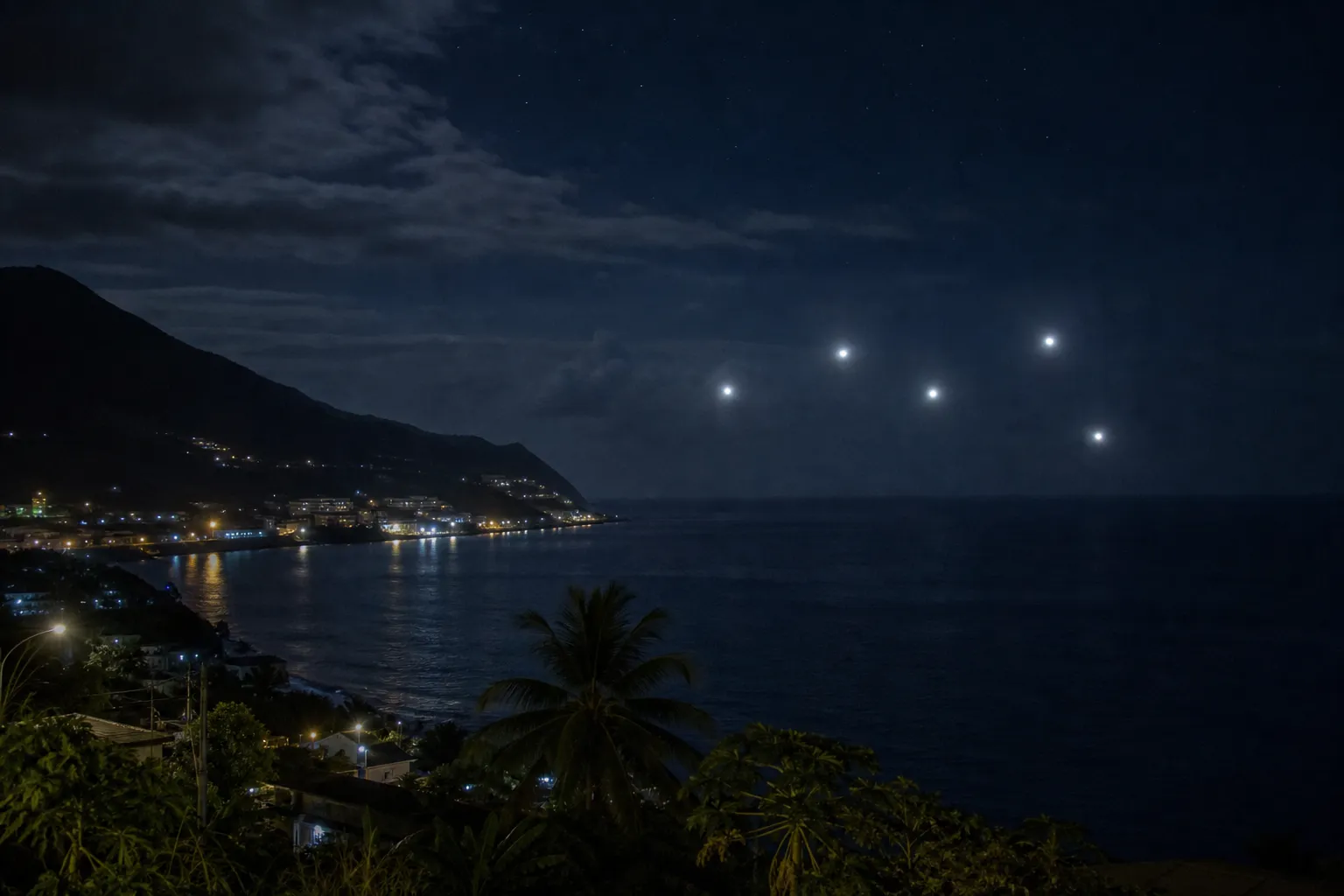
In 2009, witnesses near Moroni observed luminous orb-type objects over the Indian Ocean and surrounding airspace during the night hours. The objects appeared at altitude above the ocean, exhibited brightness inconsistent with stars or satellites, and displayed behavioral characteristics — including changes in speed or apparent direction — that distinguished them from known aircraft and natural phenomena. The objects were observed for periods sufficient to allow deliberate observation rather than momentary glimpses.
The Mozambique Channel and northern Indian Ocean surrounding the Comoros is a heavily monitored maritime environment with French, US, and regional naval and air assets tracking vessel and aircraft movements. Luminous aerial objects operating in this space that are not on filed flight plans and cannot be attributed to known traffic represent genuine anomalies. The Comoros' equatorial dark-sky environment makes misidentification of luminous objects as stars or atmospheric phenomena less likely than in light-polluted urban settings.
No instrument evidence or physical trace documentation is available. The case rests on witness observation recorded in regional database entries. The nearby French military presence in the Indian Ocean region (including at Mayotte, Réunion, and Djibouti) means any radar or sensor data that was recorded would exist within French military operational archives.
No Comorian government response was documented. The Comoros has no UAP investigation infrastructure. France's GEIPAN investigation program covers French territory, which includes Mayotte (immediately adjacent to the Comoros) but not the independent Comoros nation. No French military statement addressing observations in Comorian airspace has been made public.
No evidence of active suppression. The case's limited documentation reflects the Comoros' small size, limited media infrastructure, and the absence of formal reporting channels rather than institutional concealment.
The Moroni 2009 case establishes the Comoros' presence in the global UAP archive and contextualizes the archipelago within the broader Indian Ocean UAP pattern. The Indian Ocean has been a consistent location for UAP observations since the 1970s — including the 1978 Seychelles multi-location sightings, various Reunion and Mauritius reports, and AFRICOM-documented cases from the Horn of Africa region. The Comoros' strategic position in the Mozambique Channel, combined with its equatorial dark-sky advantage and proximity to French Indian Ocean military infrastructure, makes it a natural location for future more detailed UAP research. This entry serves as a placeholder for deeper archival work in Comorian, French, and regional databases.