
Credibility Audit
5 factors- Military Witness+3
- Radar Corroborated+3
- Govt. Acknowledgment+4
- Official Report+1
- Historical Document+1
- 0–3
- 4–7
- 8–11
- 12–16
- 17+
DoD Observables
3 of 5- Instantaneous Acceleration
- Hypersonic Velocity
- Low Observability
- Trans-Medium Travel
- Anti-Gravity Lift
Event Description
Craft morphology
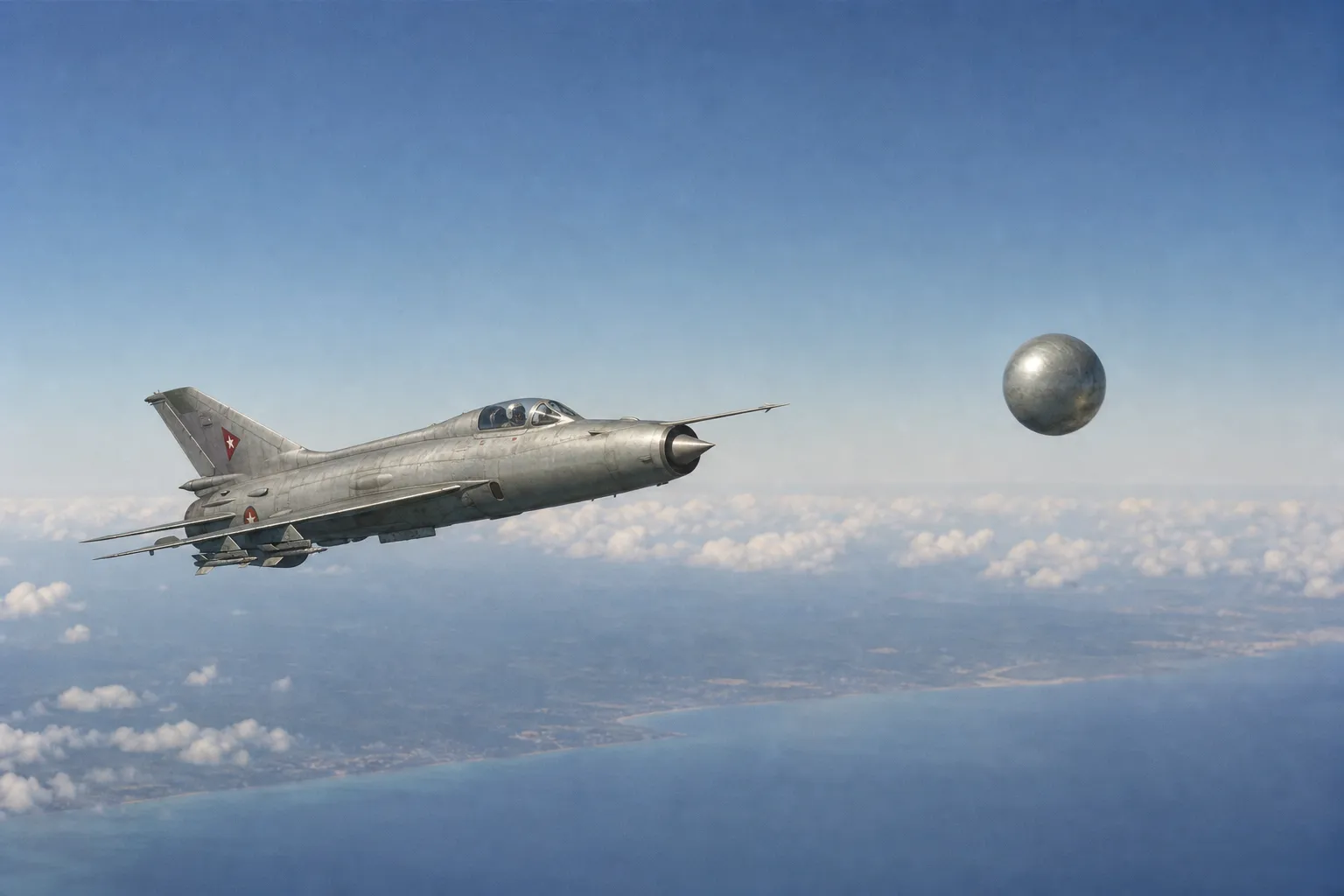
In March 1967, a metallic sphere penetrated Cuban airspace from the northeast and triggered a full military intercept response by Cuba's air defense network. The encounter ended with the disintegration of a MiG-21 supersonic jet fighter in clear air with no visible cause. The entire engagement was monitored in real time by US Air Force signals intelligence personnel stationed at Detachment "A" of the 6947th Security Squadron at Naval Air Station Key West, Florida. The resulting intelligence reporting was promptly classified, and all physical evidence was ordered delivered to NSA headquarters. The account surfaced publicly in 1978 when an anonymous USAF security specialist disclosed the incident to UFO researcher Stanton Friedman. Subsequent FOIA requests by Citizens Against UFO Secrecy produced ten classified documents confirming that the events had occurred and that the government had gone to considerable lengths to keep them quiet.
The primary US witnesses were Spanish-speaking SIGINT intercept operators assigned to Detachment "A" of the 6947th Security Squadron, approximately 15–20 personnel who monitored Cuban military communications full-time during the Cold War. These were trained intelligence specialists performing active duty electronic surveillance — among the most credible categories of military witness available. The Cuban side produced at minimum two MiG-21 pilots (the flight leader, whose aircraft was destroyed, and his wingman who survived and transmitted the account to ground control) plus the Cuban air defense radar controllers who initially detected the object and directed the intercept. The USAF source who disclosed the incident in 1978 was described as a security specialist with direct operational knowledge of the event. FBI agents visited investigator Robert Todd in July 1978 to warn him about the classified nature of the information, confirming through their behavior that the underlying documents existed.
Cuban air defense radar detected an unidentified bogey approaching from the northeast at approximately 33,000 feet (10,000 meters), traveling at close to Mach 1 (660 mph). Cuban ground control vectored two MiG-21 interceptors to the target. On reaching visual range, both pilots reported seeing a bright metallic sphere with no visible markings, windows, exhaust ports, or structural appendages of any kind. The object's size relative to the intercepting fighters was not precisely reported in available documents. Ground control instructed the flight leader to arm his air-to-air missiles and destroy the target. The pilot acknowledged, confirmed radar lock, and reported readiness to fire. Within seconds of that transmission, the wingman reported that the flight leader's aircraft had exploded — he initially said "exploded," then corrected himself: the plane had "disintegrated." No smoke, no flame, and no apparent weapon discharge from the UFO were reported. Debris fell into the ocean. The sphere then accelerated from Mach 1 to an indeterminate higher speed, climbed from 33,000 feet to approximately 98,000 feet, and departed on a southwest heading in the direction of South America.
The central anomalies of this case are the instantaneous destruction of the MiG-21 without any visible weapon discharge — no missile, no directed energy beam, no explosion on the sphere — and the object's subsequent acceleration from near-sonic to hypersonic speeds while climbing from 33,000 to 98,000 feet. The Soviet-built MiG-21 was the most capable interceptor in the Cuban inventory and was among the frontline fighters of the Warsaw Pact; its destruction without apparent cause in clear air with a second witness present eliminates most conventional explanations. The sphere's featureless surface and absence of any propulsion exhaust are inconsistent with any 1967-era aircraft design, Soviet or American. The climb to 98,000 feet exceeds the operational ceiling of any fighter aircraft of that period.
Cuban air defense radar tracked the object through the entire encounter and confirmed its positions and vectors to the intercepting pilots. This constitutes radar corroboration of the visual sightings. The physical destruction of the MiG-21 — wreckage falling into the ocean — constitutes physical evidence of an energetic event, though the mechanism remains unknown. No electromagnetic effects on the surviving aircraft are documented in the available sources. The NSA reportedly received all tapes and intercept recordings from Detachment "A," meaning primary instrument data exists in classified archives.
Within hours of the incident, Detachment "A" received orders to ship all tapes and pertinent data to NSA headquarters and to record the Cuban aircraft loss in squadron files as due to "equipment malfunction." The US Air Force later stated that the security specialist's testimony would be "classified Secret in its entirety." When researcher Robert Todd submitted FOIA requests to the Air Force, CIA, NSA, and Navy in 1978, ten classified documents were identified as responsive — a significant body of institutional record for a single incident. FBI agents visited Todd's home on July 28, 1978, warned that the information was classified, and indicated that penalties up to life imprisonment applied. One agent dismissed the substance of the events as "bullshit" while simultaneously warning Todd of criminal exposure — a contradiction that researchers have noted as itself suggestive of compartmentalized awareness. NICAP maintains an archival record of the incident, and the CAUS FOIA litigation produced partial document releases confirming the incident's classification status.
The suppression machinery in this case is unusually well documented: the immediate reclassification order, the "equipment malfunction" cover designation, the NSA seizure of all physical recordings, the Air Force's blanket Secret classification of witness testimony, and the FBI's personal visit to warn a civilian researcher of criminal consequences. The combination of these actions — across four separate agencies (Air Force, NSA, CIA, FBI) — constitutes a coordinated institutional response of a kind rarely documented this completely for a single UAP incident. The anonymous source who disclosed the event in 1978 did so at significant personal legal risk, and the FBI's intervention demonstrated that the risk was real.
The 1967 Cuban MiG-21 incident is among the most operationally significant UAP cases of the Cold War for several reasons. First, it involves the apparent destruction of a military aircraft in an intercept scenario — the most extreme category of UAP threat encounter, exceeding in severity any documented case in which weapons systems merely malfunctioned. Second, the US SIGINT intercept of the engagement means that American intelligence agencies obtained real-time data on the event through validated technical means, separate from Cuban reporting. Third, the multi-agency suppression response — documented through FOIA, FBI visit records, and the classification history — demonstrates that the US government treated the event as a significant intelligence matter rather than a noise case. Fourth, the Cuba-US relationship in 1967 meant that both adversarial governments had independent intelligence interest in any unauthorized intrusion into Cuban airspace; the American monitoring of a Cuban military emergency response is, in itself, corroborating documentation of an extraordinary event.