
Credibility Audit
3 factors- Multiple Witnesses+2
- Expert Witness+2
- Photo Evidence+2
- 0–3
- 4–7
- 8–11
- 12–16
- 17+
DoD Observables
2 of 5- Instantaneous Acceleration
- Hypersonic Velocity
- Low Observability
- Trans-Medium Travel
- Anti-Gravity Lift
Event Description
Craft morphology
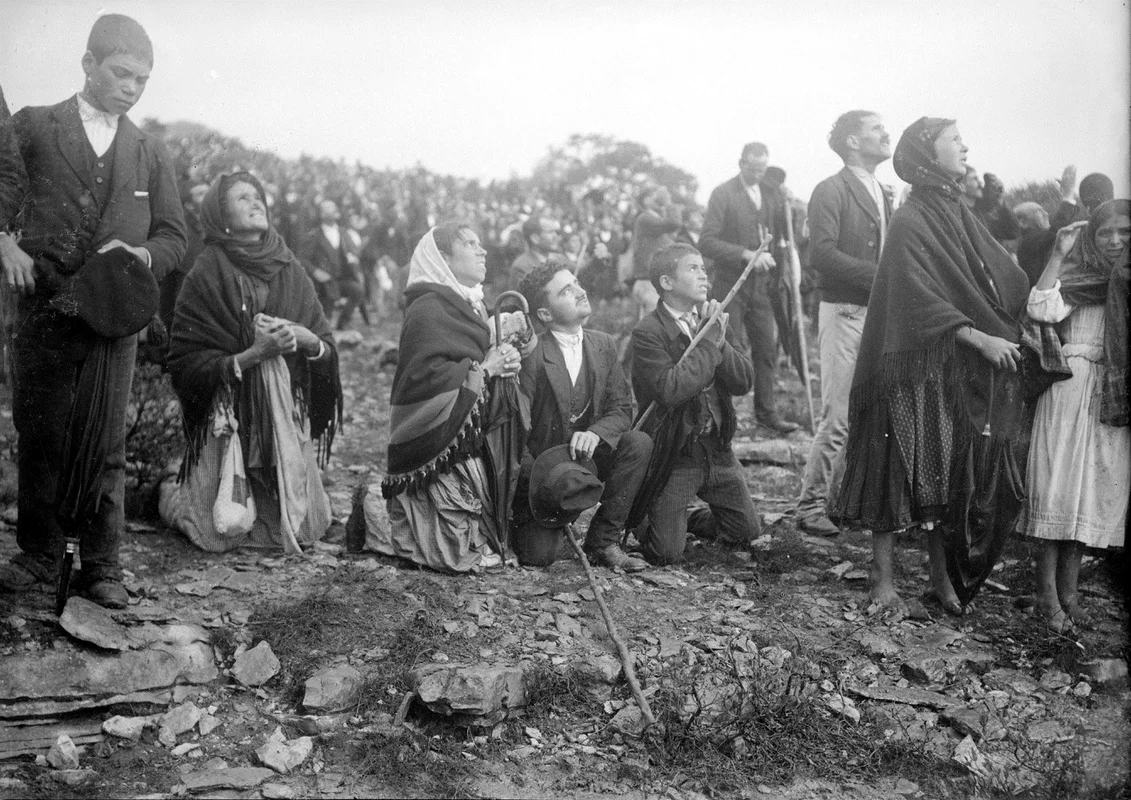
On October 13, 1917, an estimated 30,000 to 100,000 people gathered in a field outside the village of Fátima in central Portugal, responding to a prediction by three shepherd children — Lúcia Santos and her cousins Jacinta and Francisco Marto — that a miraculous event would occur at noon on that date. What followed became known as the Miracle of the Sun and remains one of the most extensively witnessed anomalous events in recorded history.
Witnesses reported that the rain suddenly stopped, the clouds parted, and a luminous disc appeared in the sky — described by multiple independent observers as spinning, pulsing, radiating concentric rings of color, and changing position dramatically. The object reportedly descended in a zigzag pattern toward the crowd before ascending again. Many witnesses reported that their rain-soaked clothing had become instantly dry, and some described a wave of heat accompanying the object's descent. These physical effects — the drying of wet clothing and the sensation of heat — are among the case's more remarkable elements because they were reported not only by religious pilgrims but also by secular observers with no motivation to embellish religious experience.
Among the crowd were secular journalists from Lisbon newspapers who had traveled specifically to debunk the predicted miracle. Their published accounts in O Século and Ilustração Portuguesa on October 15, 1917, reported genuine confusion and amazement at what they observed — reports that carry particular weight precisely because the journalists had come as skeptics. Two of the three children — Francisco and Jacinta — died in the 1918–1920 influenza pandemic. Lúcia became a Carmelite nun and lived until 2005, consistently maintaining the accuracy of her account.
Jacques Vallée, the astronomer and computer scientist whose work on UAP classification is among the most rigorous in the field, analyzed the Fátima event in detail and concluded that the phenomenon as described — a spinning, multicolored disc maneuvering toward and away from a crowd, generating physical effects and lasting approximately ten minutes — is structurally identical to UAP reports from other cultural contexts when the religious interpretation is set aside. Vallée proposed the event as a key example of how the same underlying phenomenon is interpreted through the cognitive and cultural frame available to the observer at the time.