
Credibility Audit
5 factors- Multiple Witnesses+2
- Pilot Witness+3
- Official Report+1
- Govt. Acknowledgment+4
- Photo Evidence+2
- 0–3
- 4–7
- 8–11
- 12–16
- 17+
DoD Observables
2 of 5- Instantaneous Acceleration
- Hypersonic Velocity
- Low Observability
- Trans-Medium Travel
- Anti-Gravity Lift
Event Description
Craft morphology
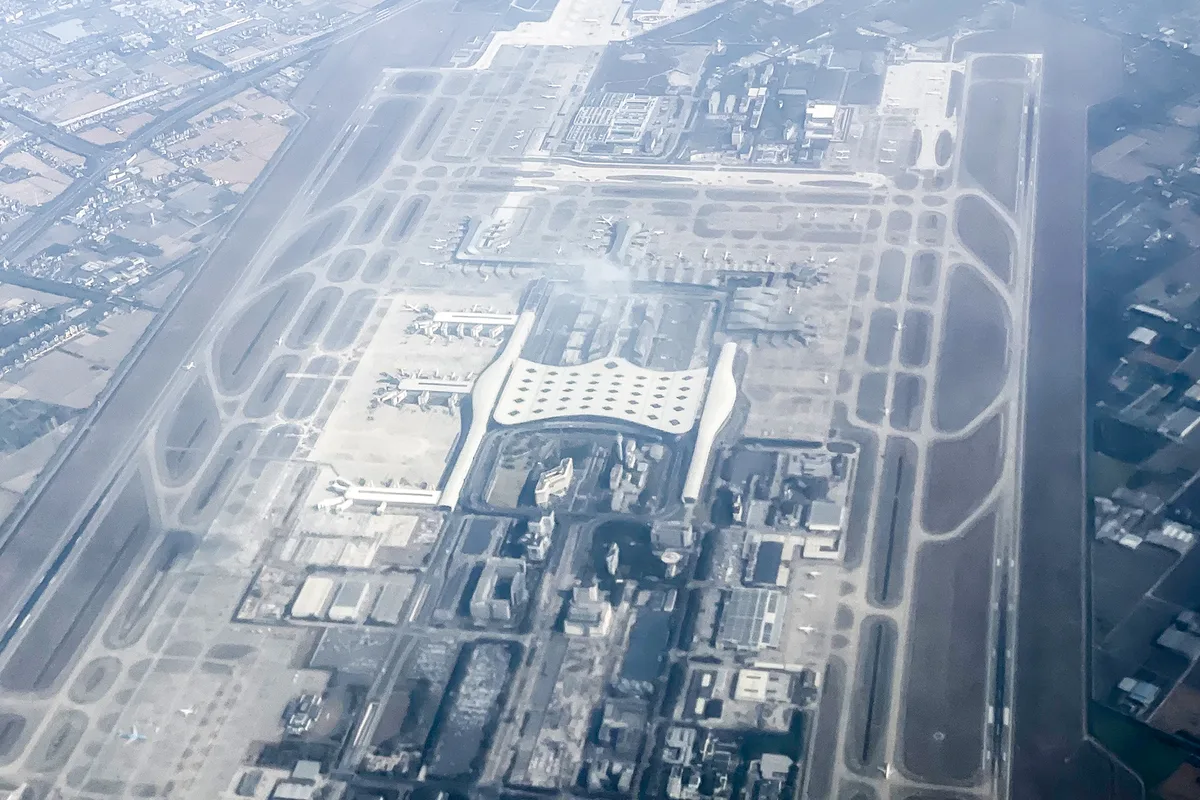
On the evening of July 7, 2010, Hangzhou Xiaoshan International Airport — one of the busiest airports in eastern China, serving more than 20 million passengers annually — was forced to close its runway and divert 18 incoming flights after air traffic controllers detected an unidentified object in controlled airspace above the airport. The closure lasted approximately one hour and resulted in delays affecting an estimated 2,000 passengers.
The unidentified object was detected independently by ATC radar systems and confirmed visually by multiple ground personnel. Photographs taken by witnesses on the ground showed an elongated luminous object with a bright central body and streaks of light — images that circulated rapidly on Chinese social media and were reproduced by international news outlets including the BBC and CNN. Multiple witnesses filed statements with Chinese aviation authorities. The scale of the disruption — a full international airport closure with radar contact — established the event as impossible to dismiss as an isolated misperception.
Chinese military authorities conducted an investigation and initially issued a statement that the object was not a military aircraft. A subsequent statement from Chinese officials suggested the sighting may have been caused by a private aircraft with illegally installed lighting systems — an explanation widely regarded as inadequate by aviation professionals and researchers, since no such aircraft was identified, no pilot was located or prosecuted, and the explanation did not account for the radar signature or the scale of the ground photographs. The investigation was not made public in detail.
The Hangzhou incident was one of several Chinese airport closure events attributed to unidentified aerial phenomena in the 2010 to 2012 period, including a separate closure at Baotou Airport in Inner Mongolia in September 2010. Its operational significance is the clearest of any Chinese airport UAP case: the object did not merely attract attention from observers, but directly caused the shutdown of a major international aviation hub through the professional judgment of trained air traffic controllers working with calibrated radar systems. No conventional explanation has been officially confirmed.