
Credibility Audit
4 factors- Military Witness+3
- Multiple Witnesses+2
- Historical Document+1
- Official Report+1
- 0–3
- 4–7
- 8–11
- 12–16
- 17+
DoD Observables
2 of 5- Instantaneous Acceleration
- Hypersonic Velocity
- Low Observability
- Trans-Medium Travel
- Anti-Gravity Lift
Event Description
Craft morphology
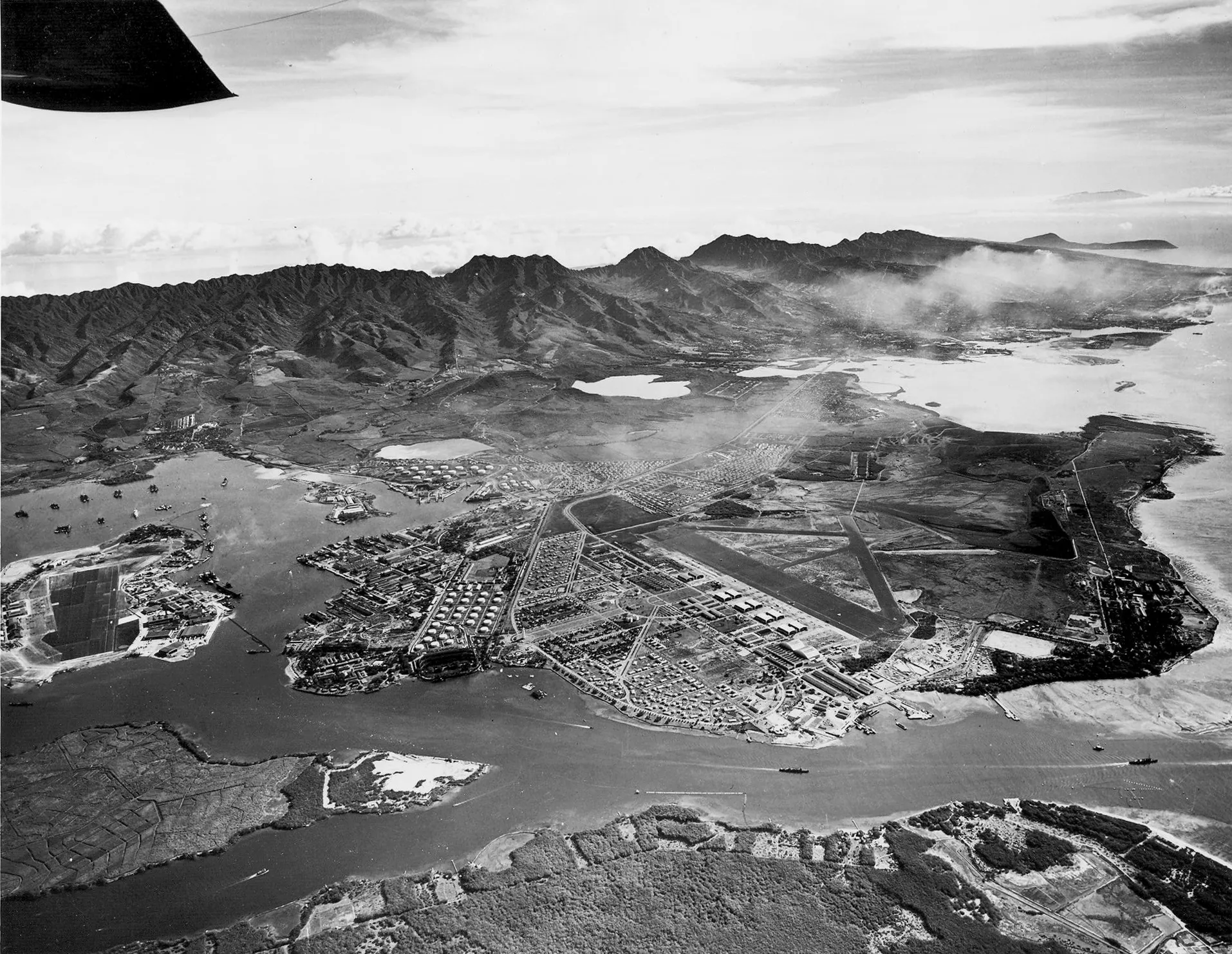
On the afternoon of January 4, 1949, at approximately 2:00 PM local time, USAF Captain Paul R. Stoney — a pilot stationed at Pacific Command Headquarters — observed an unidentified object maneuvering over Hickam Army Airfield on the island of Oahu, Hawaii. The sighting lasted approximately fifteen minutes in clear daylight conditions, giving Stoney and ground personnel at Pacific Command HQ an extended and unobstructed view.
Stoney described the object as flat and white with a matte upper surface, roughly the size of a T-6 trainer aircraft in apparent span. It was observed at an altitude of approximately 3,000 feet, initially circling in a controlled pattern. Throughout the observation, the object performed a series of deliberate maneuvers: 360-degree turns, sharp 90-degree direction changes, and a rhythmic side-to-side oscillating motion that Stoney described as "rhythmical undulation" executed in cyclical repetitions. The flight characteristics — particularly the sharp angular turns without any visible banking or deceleration curve — were inconsistent with any propeller or early jet aircraft of the period.
Ground personnel at Pacific Command HQ corroborated the sighting. The object was observed continuously throughout its fifteen-minute presence over the base before it departed by climbing steeply to the northeast, accelerating until it passed out of visual range. No sound was reported at any point during the encounter.
The incident was formally documented by the U.S. Air Force under Project Grudge, the predecessor to Project Blue Book, as case BBU 275. The investigating officer assigned to the case explicitly praised Captain Stoney for his "level-headedness and integrity," an unusual commendation that reflects the seriousness with which the report was treated within official channels. Even J. Allen Hynek, the Air Force's scientific consultant on UAP matters — and a consistent skeptic throughout the early Blue Book years — noted this as "a rare case wherein the witness had really seen a flying disc," an admission that stood out given his general disposition toward mundane explanations.
The Hickam 1949 encounter holds significance as one of the earliest well-documented post-war military UAP reports from the Pacific theater. It predates the major 1952 UFO wave and the subsequent Washington, D.C. radar incidents by three years, yet exhibits many of the same flight characteristics that would define credible military UAP encounters throughout the Cold War era: a qualified military observer, extended observation time, controlled non-ballistic maneuvers, and an absence of any conventional explanation in the official investigative record. The case remains unresolved in the Project Blue Book archive, which is maintained at the National Archives.
Sources
- governmentProject Blue Book / Project Grudge case BBU 275 — U.S. Air Force, 1949
- academicNICAP case directory — Hickam Field, January 4, 1949