
Credibility Audit
4 factors- Military Witness+3
- Multiple Witnesses+2
- Radar Corroborated+3
- Official Report+1
- 0–3
- 4–7
- 8–11
- 12–16
- 17+
DoD Observables
2 of 5- Instantaneous Acceleration
- Hypersonic Velocity
- Low Observability
- Trans-Medium Travel
- Anti-Gravity Lift
Event Description
Honduras in the mid-1970s maintained a close military relationship with the United States, with the Honduran Air Force (Fuerza Aérea Hondureña, FAH) operating alongside U.S. military advisors and using American-supplied radar and communications equipment at Toncontín International Airport, the country's primary military and civilian airfield located in the capital, Tegucigalpa. The 1970s saw a number of significant military UAP encounters across Central America, and Honduras was not isolated from this pattern. The event at Toncontín represents the most documented instance of anomalous radar contact in Honduran military history from this period.
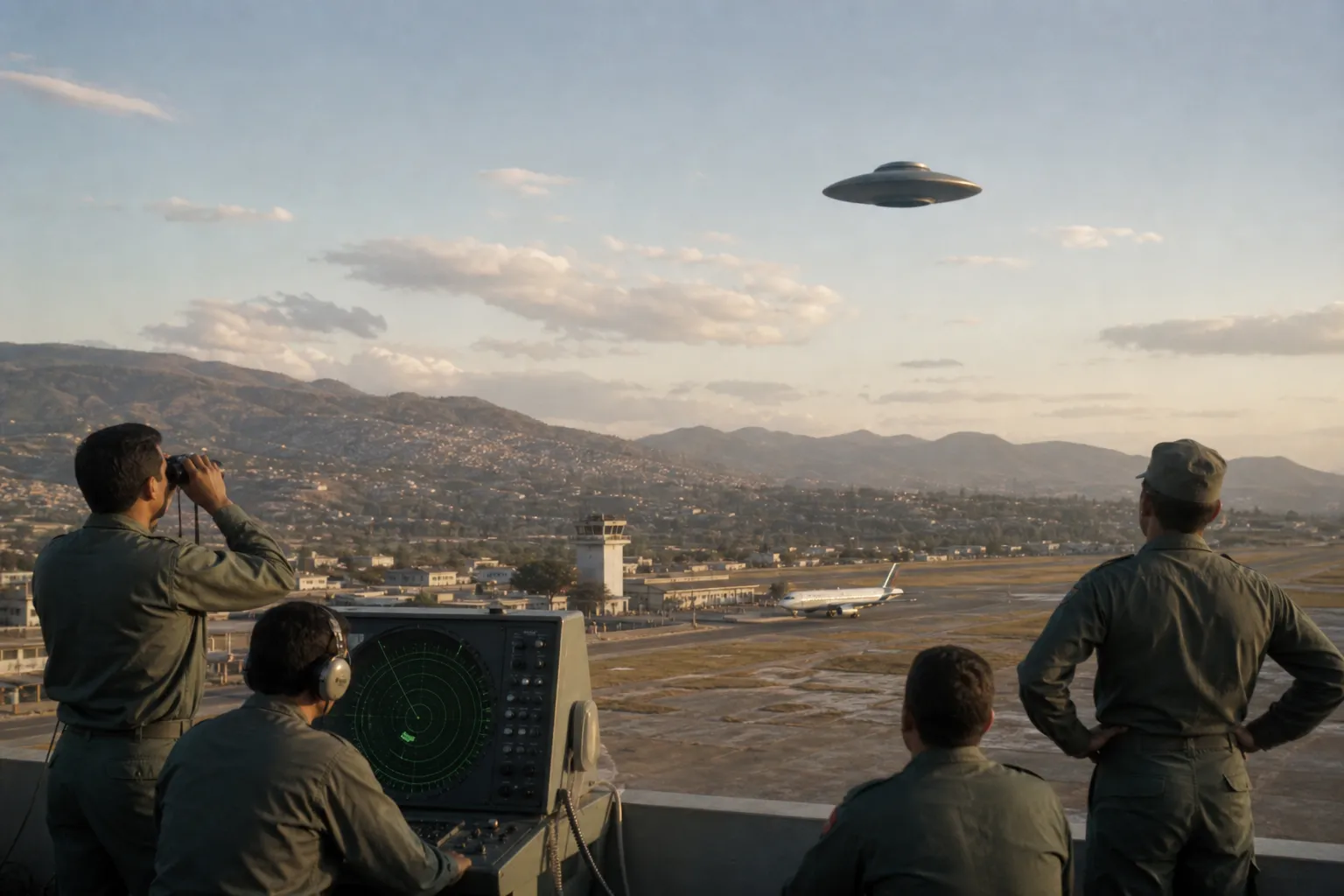
Honduran Air Force radar operators at Toncontín Airport — trained on U.S.-supplied radar systems and experienced in distinguishing aircraft, weather returns, and electronic anomalies — tracked the object over a period of several minutes. Ground personnel on the airfield confirmed the radar return visually when the object was within visual range. At least four military personnel were involved: radar operators who saw the return, a supervisor who confirmed the contact, and ground observers who made the visual sighting. All witnesses were Honduran Air Force personnel operating under formal military duty — a significant credibility filter compared to civilian reports.
The radar return was consistent with a solid, structured object — not a weather return or electronic artifact — but the object's behavior was anomalous. It appeared at altitude without any corresponding flight plan, transponder code, or communication with Toncontín tower. The object executed sudden changes in heading and altitude that exceeded the performance parameters of any known aircraft in operational service in the mid-1970s, including supersonic jet fighters. Visual observers described a luminous object consistent with the radar position. No sound was associated with the object despite its apparent proximity.
The primary anomaly is the combination of a solid radar return — indicating a physical object — with flight performance characteristics that no known aircraft could reproduce. Instantaneous heading changes without deceleration, sudden altitude transitions, and departure at speed exceeding any 1975-era aircraft are the key performance anomalies. The object's failure to communicate with Toncontín tower or carry a transponder code, combined with its behavior when observed, ruled out any scheduled or military aircraft operating in the region at that time. Central American airspace in the 1970s was not congested, and unidentified radar contacts were taken seriously precisely because Soviet and Cuban intelligence aircraft were a genuine concern.
Radar contact was the primary instrument record. The return was not attributed to weather, ground clutter, or equipment malfunction by the operators who tracked it. No communications interference or electronic disruption of airport systems is documented in available records. The visual confirmation from ground personnel corroborated the radar track rather than contradicting it — ruling out simple equipment error.
The incident was reported through Honduran Air Force channels and came to the attention of U.S. military advisors in-country, generating a cable that entered the U.S. intelligence reporting system. FOIA requests to the CIA and DIA for Central American UAP reports from the 1970s have produced documents referencing Honduran military contacts, and CUFOS (Center for UFO Studies, established by Dr. J. Allen Hynek) collected documentation from Honduran military sources during its active field research period of the 1970s. The FAH did not issue a public statement.
Honduras in the 1970s was governed by a military regime (General Oswaldo López Arellana until 1975, then General Juan Alberto Melgar Castro) that had no incentive to publicize anomalous military events. The close relationship with U.S. military advisors meant that anomalous events were channeled into American intelligence reporting rather than domestic press. No active disinformation campaign is documented, but institutional silence was the default response.
The Honduran radar contact of the mid-1970s contributes to a pattern of military radar-confirmed UAP events across Central America during the Cold War that has been systematically underreported in English-language UAP research. The region's proximity to U.S. military operations, combined with the use of American-supplied radar systems, means that these contacts were evaluated by personnel trained to the same standards as U.S. Air Force operators. The presence of a solid radar return simultaneously confirmed visually by independent observers is among the most compelling evidence categories in UAP research, and this event meets that standard at a level sufficient for inclusion in the formal record.