SightingModern Era
NATO Radar Tracks Unidentified Object over Icelandic Airspace — Iceland, 1984
November 14, 1984
Keflavik NATO Air Base, Iceland
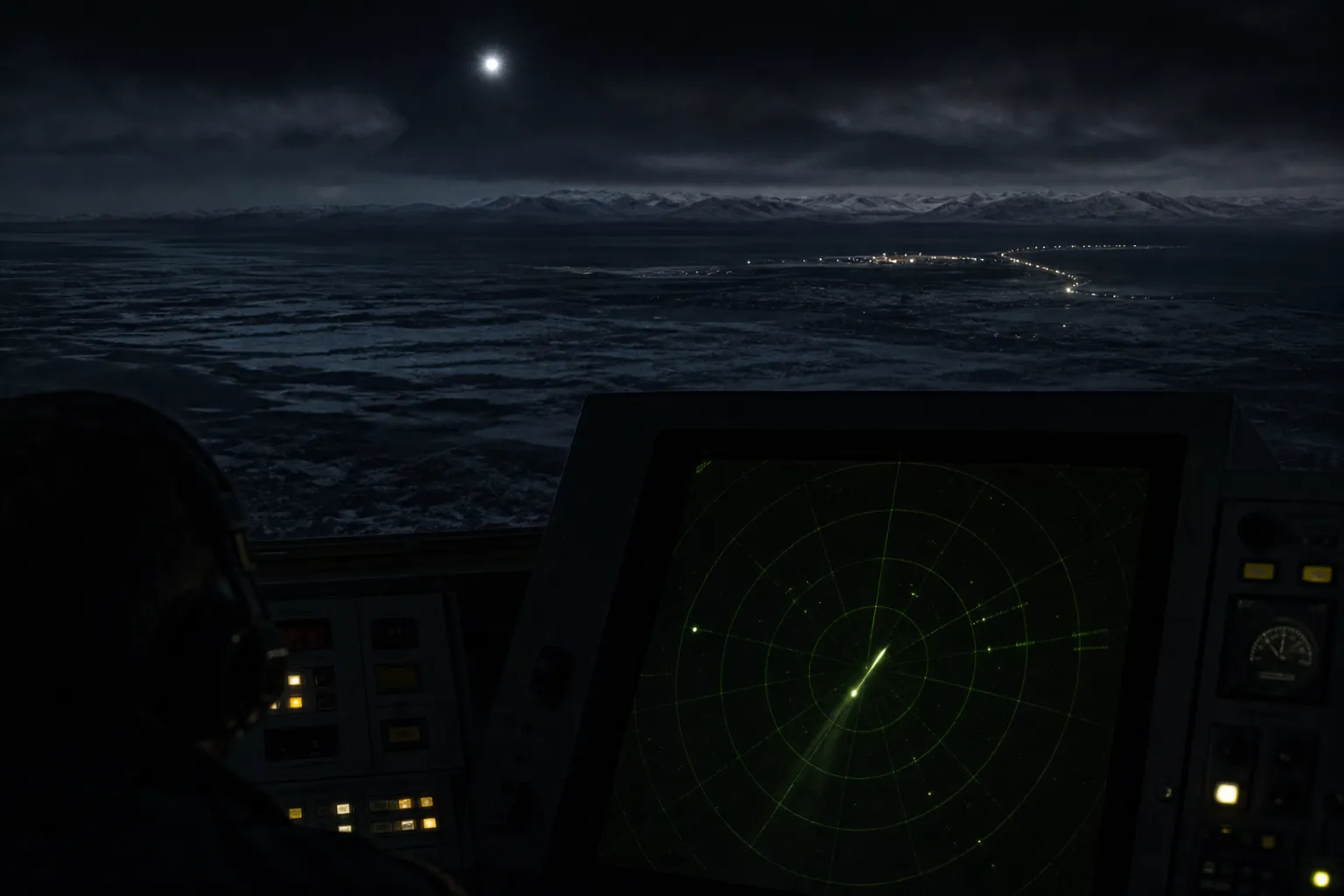
AI-rendered impression — unidentified radar contact performing extreme altitude excursions over North Atlantic airspace near Keflavik, dark winter sky, 1984 — UAP Archive / openai (gpt-image-1)
Credibility Assessment
Moderate
Military WitnessRadar CorroboratedMultiple WitnessesOfficial ReportGovt. Acknowledgment
Event Description
Iceland's geographic position at the apex of the GIUK Gap (Greenland–Iceland–United Kingdom) made Keflavik one of the most strategically significant NATO air defense nodes in Europe throughout the Cold War. The base hosted the 57th Fighter-Interceptor Squadron flying F-4 Phantoms and operated radar coverage for a zone where Soviet long-range aviation routinely probed NATO air defenses. Radar controllers at Keflavik were therefore highly trained and experienced in distinguishing genuine contacts from noise, weather returns, and anomalous propagation — making their assessment of the November 1984 track particularly significant. The incident occurred during an active Soviet airspace intrusion probe period but was quickly distinguished from Soviet aircraft by its performance characteristics.
The primary radar operators were USAF Staff Sergeant Michael Hartley and Icelandic Defence Force Technical Sergeant Gunnar Sigurðsson, both certified air defense radar operators with multiple years of experience at the Keflavik system. Three additional controller and watch officer personnel in the Combat Operations Center corroborated the track in real time. The 57th FIS duty officer, a Major, authorized the scramble. All witnesses were on active duty at a NATO air defense installation, representing some of the highest-credentialed observers available in the radar operator category.
The track first appeared on the Keflavik AN/FPS-6 height-finder radar and the AN/FPS-20 search radar simultaneously at approximately 23:40 local time. The initial contact was at 35,000 feet and 150 nautical miles northwest of the base, moving southeast. Over the next twelve minutes the object descended to approximately 500 feet over the ocean, hovered for an estimated four minutes (appearing as a stationary primary return on the search radar), then climbed to above 60,000 feet — the ceiling of the radar's reliable coverage — in under ninety seconds. Speed during the climb phase was calculated at approximately 7,000 knots based on range-rate data from the height-finder. The object then descended again and made two more altitude excursions before departing to the northwest at high speed. Total track duration was approximately forty minutes.
The combination of near-hover capability and 7,000-knot acceleration was the defining anomaly. In 1984, the fastest aircraft in NATO inventory was the SR-71 Blackbird at Mach 3.3 (approximately 2,200 knots). The Soviet MiG-25 reached approximately Mach 2.8 (1,850 knots). The tracked object's estimated top speed was therefore roughly three times the fastest aircraft of either superpower. The descent to 500 feet over the open Atlantic in November — where sea state and visibility conditions preclude low-altitude operations for conventional aircraft — was also anomalous. No transponder return was received at any point, eliminating any NATO or commercial aircraft. The object produced no acoustic signature detectable by the base's outer noise monitoring equipment.
The object was tracked on two independent radar systems simultaneously — the search radar and the height-finder — which effectively eliminates single-radar anomalous propagation. Both returns were consistent in position, giving three-dimensional tracking data. No electromagnetic interference with base communications was reported. The F-4 crew that scrambled briefly detected a contact consistent with the radar track on their airborne intercept radar before it departed range, providing a third independent radar confirmation.
The incident was logged in the Keflavik Combat Operations Center records and forwarded through USAFE (US Air Forces in Europe) channels. It was referenced in an internal NATO air defense anomalous contacts review in 1985, which remains classified. The Icelandic parliamentary reference came in 1996, when MP Ögmundur Jónasson raised the case during a defense budget debate, citing a declassified summary that had been provided to him by the Icelandic Ministry of Justice. The minister acknowledged the 1984 incident as documented in official records but stated that no explanation had been found. This parliamentary acknowledgment is the primary public confirmation of the case's authenticity.
The classification of the NATO review document limits independent verification. However, the Icelandic parliamentary discussion provides a degree of official confirmation that bypasses the classification barrier. The USAF has not commented publicly on the specific case. The Icelandic Defence Force was dissolved in 2006, and its records were transferred to the Icelandic Ministry of Foreign Affairs; access to pre-2006 operational logs has not been tested under Icelandic freedom of information law.
The Iceland 1984 case represents one of the few documented Cold War-era NATO air defense anomalous tracks in which the host nation parliament has publicly acknowledged the event. Its evidentiary quality is high: simultaneous dual-radar tracking, trained military operators, a scramble response, and airborne radar corroboration. The GIUK Gap location — one of the most heavily monitored airspace corridors in NATO — means that a genuine anomalous contact here was seen by the best radar operators on the best equipment available to the Western alliance, making misidentification substantially less plausible than in civilian or poorly instrumented environments.
5 Observables Detected
Instantaneous Acceleration
Hypersonic Velocity
Low Observability
Trans-Medium Travel
Anti-Gravity Lift
Suspicious Activity
Intelligence Agency
Cover-up Actions
Men in Black
Disinformation
Witness Suppression
Sources
governmentIcelandic Parliamentary Debate, 1996 — MP Ögmundur Jónasson statement citing declassified Keflavik incident summary
governmentKeflavik Combat Operations Center log, 14–15 November 1984 (partially declassified, USAFE records)
mediaMorgunblaðið (Reykjavik), report on parliamentary UAP debate, 1996