
Credibility Audit
3 factors- Military Witness+3
- Pilot Witness+3
- Official Report+1
- 0–3
- 4–7
- 8–11
- 12–16
- 17+
DoD Observables
3 of 5- Instantaneous Acceleration
- Hypersonic Velocity
- Low Observability
- Trans-Medium Travel
- Anti-Gravity Lift
Event Description
Craft morphology
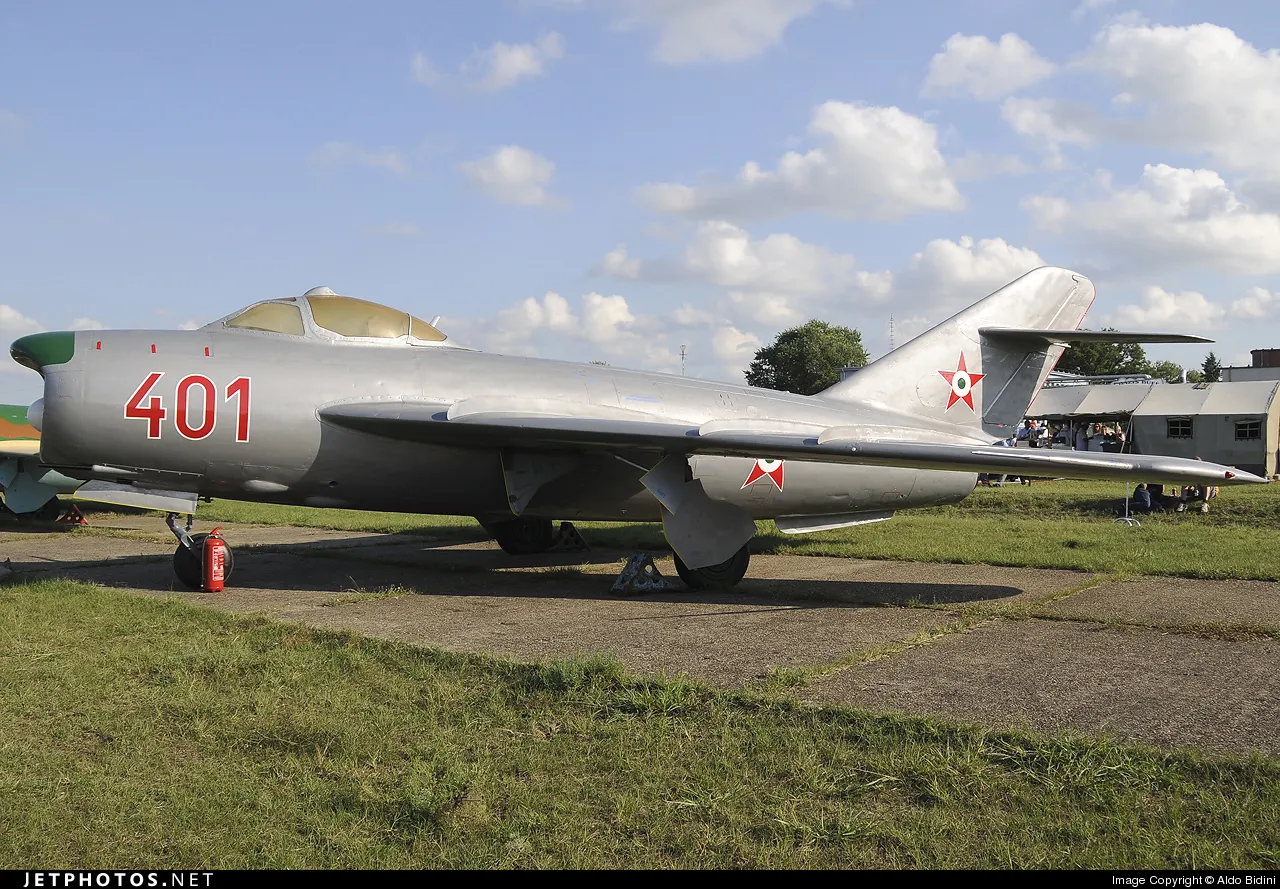
Shortly before midnight on July 21, 1959, an experienced Hungarian Air Force pilot took off from Taszár airbase in southwestern Hungary on a routine nighttime patrol mission. Flying a MiG-17PF — a radar-equipped all-weather interceptor variant — Colonel Gyula Knoll climbed to 4,000 meters over the airspace above Kaposvár, the regional capital of Somogy County. The skies were clear and the conditions were textbook for night operations. What followed over the next several minutes would remain classified by personal oath for decades, and would become one of the most credible and well-documented pilot UAP encounters in Cold War Eastern Europe.
Knoll noticed a moving light approaching from the east, slightly above his altitude. Assuming it might be another aircraft, he contacted his flight controller by radio to ask whether any other Hungarian aircraft were operating in his airspace. The answer came back negative — he was alone. Before he could process the response, the object closed the remaining distance with extraordinary speed. As it passed directly over his cockpit, it flooded the interior with an intense, undifferentiated white light — described by Knoll as far brighter than any aircraft navigation lamp, with no identifiable positional color pattern. In his own words, the illumination was "as bright as daylight." The object then continued westward on a heading toward Austria.
Ordered by his flight controller to investigate, Knoll pushed his throttle to maximum and initiated a climbing pursuit. He reached approximately 800–900 km/h as he closed toward the luminous form. When he was nearly level with it and attempted to acquire it on his onboard radar for lock-on, the object reacted instantly — accelerating away at a velocity that Knoll later estimated as roughly ten times the speed of sound, far beyond any known aircraft in 1959 or since. It receded and disappeared into the star field within seconds. Knoll broke off pursuit, mindful of the Austrian border nearby, and returned to base. His radio communications throughout the incident were recorded on magnetic tape at the flight operations center.
After landing, Knoll briefed his supervising flight controller in person and verbally elaborated that the object's propulsion was beyond anything human engineering could produce. His superiors recorded the report and asked no further questions. No official investigation was opened, no public statement was issued, and Knoll received an implicit but unmistakable signal: speak of this outside trusted circles and your flying career ends. Hungary in 1959 was a country barely three years removed from the brutal Soviet suppression of the 1956 uprising. The Hungarian People's Army flew Soviet-supplied aircraft and reported upward through a Warsaw Pact chain of command that regarded UFO reports from subordinate air forces with acute political sensitivity. The Hungarian Academy of Sciences' official position was that such phenomena were "Western capitalist ideology and subversion," and any pilot who publicly endorsed such claims risked being labeled politically unreliable or mentally unfit.
Knoll remained silent for the better part of four decades. When he eventually began speaking publicly — and later published a book, "UFO — Az elhallgatott valóság" (UFO: The Suppressed Reality) — he was in his late eighties, long retired, and beyond the reach of institutional consequences. His account drew wide attention in Hungary, where it was covered by major outlets including Ripost and Blikk, and he became a recurring figure at UFO research gatherings. The NoManZone.com English-language synthesis of Hungarian UAP history identifies his Kaposvár encounter as "the earliest example of such unexplained encounters in Hungary" on record. Multiple Hungarian-language sources — including the investigative archive site Rejtélyek Szigete, which published excerpts from Knoll's book in 2014 — confirm the date, altitude, aircraft type, and essential flight characteristics of the object.
The case carries particular weight for several reasons. Knoll was not a novice: within a year of the encounter, he was selected as the first commanding officer of Hungary's MiG-19PM interceptor squadron — the premier pilot from a pool of the country's twenty-five best airmen. He subsequently transitioned to the MiG-21, became an "Arany Koszorús" (Gold Wreath) first-class master pilot — Hungary's highest aviation qualification — and was the first Hungarian pilot to break the sound barrier in a public demonstration flight. His technical assessment that the object's acceleration was impossible for any human-manufactured aircraft carries the authority of a man who spent decades flying supersonic interceptors at the limits of contemporary performance. The behavior of the object — sudden closure from distance, extreme luminosity with no discernible navigation lights, instant acceleration to hypersonic escape velocity in response to an attempted radar lock — aligns closely with the five performance observables later codified by the U.S. Department of Defense's UAP Task Force.
Sources
- witnessKnoll Gyula — UFO: Az elhallgatott valóság (UFO: The Suppressed Reality), Sprinter, 1990s; excerpted at Rejtélyek Szigete, February 7, 2014
- mediaRipost — 'Évtizedekig hallgatott róla az ezredes: ufók léptek a magyar légtérbe', October 24, 2019
- mediaNoManZone.com — 'UFO Sightings in Hungary', January 15, 2025