
Credibility Audit
5 factors- Govt. Acknowledgment+4
- Military Witness+3
- Multiple Witnesses+2
- Historical Document+1
- Official Report+1
- 0–3
- 4–7
- 8–11
- 12–16
- 17+
DoD Observables
2 of 5- Instantaneous Acceleration
- Hypersonic Velocity
- Low Observability
- Trans-Medium Travel
- Anti-Gravity Lift
Event Description
Craft morphology
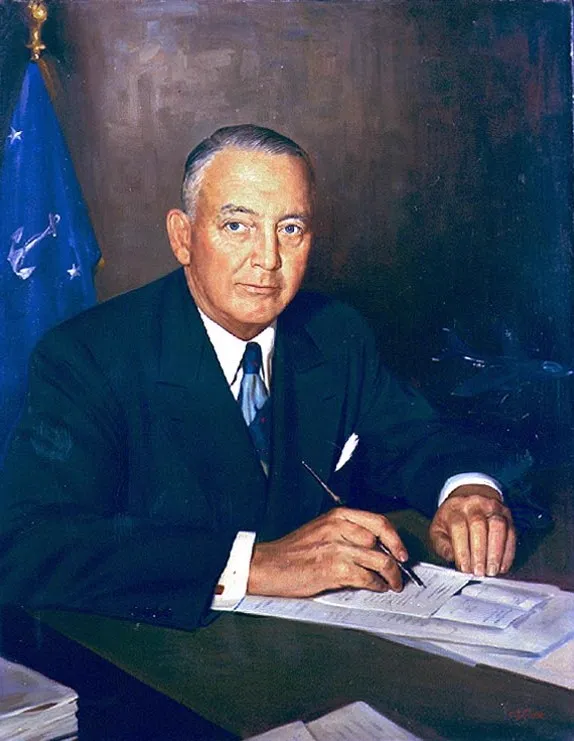
In March 1952, Secretary of the Navy Dan A. Kimball was flying between Pearl Harbor, Hawaii and Guam accompanied by his pilots and crew when two disc-shaped objects approached his aircraft and conducted a sustained close-proximity observation. The objects flew alongside the aircraft, then accelerated away at a speed that witnesses estimated at 1,500 to 2,000 miles per hour. They did not linger — they departed rapidly upward and out of sight.
What made the encounter extraordinary was what happened next. Admiral Arthur W. Radford, Commander of the United States Pacific Fleet and Kimball's senior naval counterpart, was flying in a second aircraft approximately 50 miles behind. The same two objects — or objects indistinguishable from them — intercepted Radford's aircraft. They circled it multiple times at close range before again departing at high speed. The objects had covered the 50-mile gap between the two aircraft in under two minutes, implying a transit speed in excess of 1,500 mph — far beyond any manned aircraft capability of the period. Multiple crew members aboard both planes served as corroborating witnesses.
Kimball reported the encounter publicly on at least one occasion, speaking to an audience of Navy officers and air cadets at Naval Air Station Pensacola. The incident was also documented in a May 5, 1952 article in the Boston Traveler by journalist Bill Schofield. A record of the encounter was preserved in the Project Blue Book archive (MAXW-PBB9-1196) and Kimball's personal papers are held at the Harry S. Truman Presidential Library, which contain documentation of his March–April 1952 Far East trip.
The institutional consequence of this encounter was direct and documented. Kimball, frustrated by the Air Force's refusal to investigate Navy UAP reports or share findings from their own investigations, personally ordered the establishment of an independent Navy UAP investigation desk. This resulted in the creation of a formal naval UAP reporting office under Lieutenant Commander Fred Lowell Thomas at the Office of Naval Research in the spring of 1952. The Air Force's stonewalling of a Cabinet-level official following a firsthand encounter with an anomalous aerial object stands as one of the more remarkable episodes in the history of institutional UAP response.
Admiral Radford went on to become the third Chairman of the Joint Chiefs of Staff from 1953 to 1957 — one of the most senior military positions in the United States. The fact that two of the most senior naval officers in the Pacific theater both witnessed the same objects on the same journey, and that the Secretary of the Navy was compelled to establish an independent investigation as a direct result, gives this case a weight of institutional corroboration that few UAP incidents of any era can match.
Sources
- mediaBoston Traveler — Bill Schofield, 'Have You Heard', May 5, 1952
- governmentProject Blue Book archive — MAXW-PBB9-1196
- governmentDan A. Kimball Papers — Harry S. Truman Presidential Library, Box 3, Far East Trip March–April 1952
- academicNICAP case directory — Secretary Kimball / Admiral Radford, March 1952