USOWorld War II
Pawlu Zammit USO Encounter — South Malta, 1947
Early July 1947
20 miles south of Malta, Mediterranean Sea
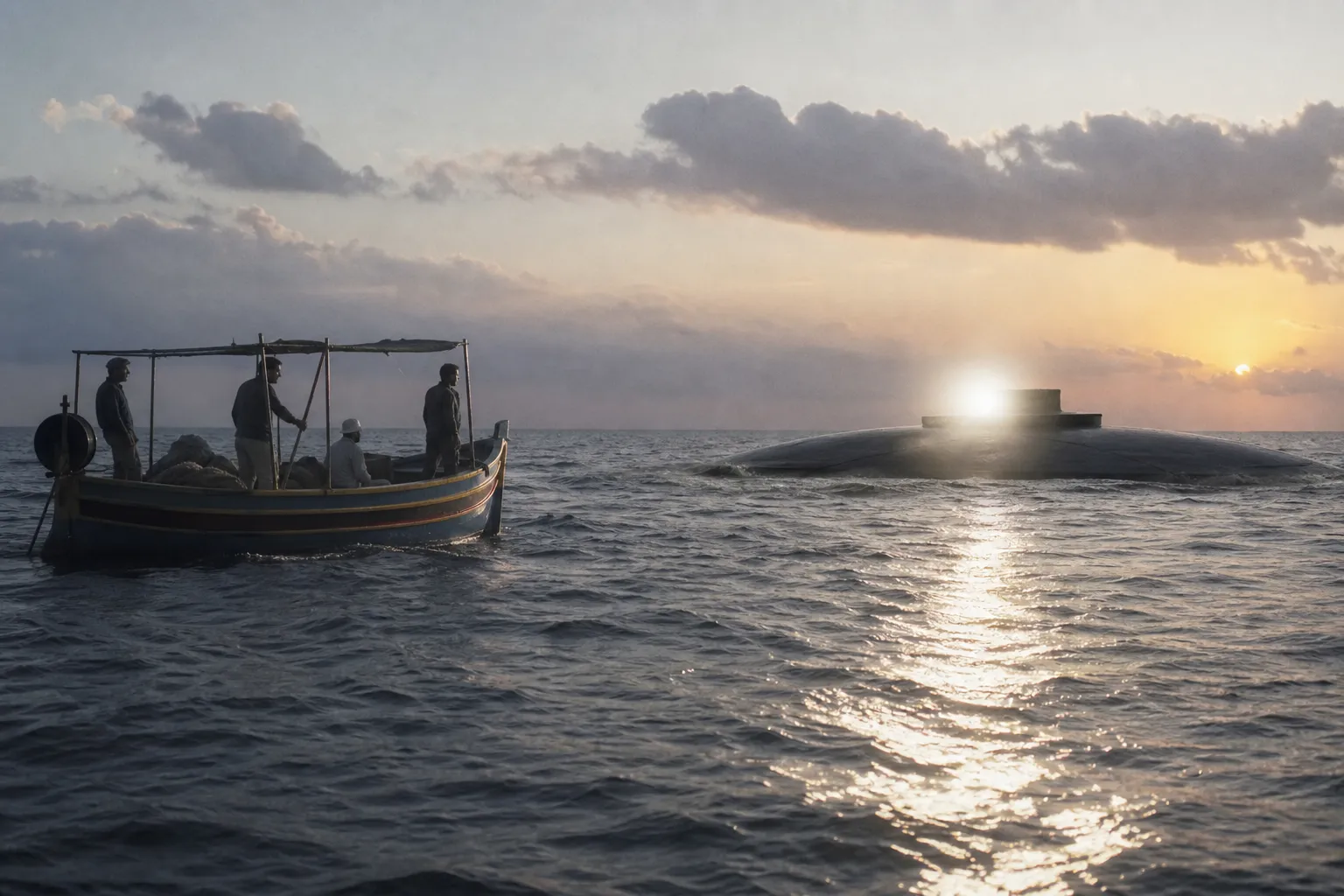
AI-rendered impression — a dark submarine-like object glowing intensely on the Mediterranean surface at dusk, a small fishing vessel nearby, small figures visible on the object's deck — UAP Archive / openai (gpt-image-1)
Credibility Assessment
Low
Multiple WitnessesHistorical Document
Event Description
Observed Shape
Cylinder
Craft morphology

Non-Human Intelligence (NHI)
Reported Entities
No NHI encounter documented for this event.
In the first week of July 1947, Maltese fisherman Pawlu Zammit was working with his crew approximately 20 miles south of Malta in the Mediterranean Sea. The men were engaged in the routine labour of hauling in fishing nets when they observed an anomalous object at the water's surface some distance from their vessel. The object resembled a submarine but was described by witnesses as having an appearance that struck them as distinctly non-military and non-natural — "more like a monster than a submarine." The event that followed — small humanoid figures emerging onto the object's deck, intense luminescence, and rapid submersion — constitutes one of the earliest formally documented USO (Unidentified Submerged Object) encounters in European maritime history. The incident occurred in the same extraordinary week of July 1947 that generated the Kenneth Arnold sighting, the Roswell incident, and hundreds of other aerial phenomena reports across the United States and Europe, a temporal clustering that makes independent corroboration across disparate global locations difficult to dismiss.
Pawlu Zammit and several crew members aboard a fishing vessel were the witnesses. Maltese fishermen operating 20 miles offshore were professional maritime workers with significant experience on Mediterranean waters and clear incentive to accurately identify marine vessels — submarines, surface craft, and other maritime objects were routine features of their professional environment. Malta in 1947 was a Royal Naval base — the centre of British Mediterranean Fleet operations — and fishermen in Maltese waters would have been extremely familiar with the appearance and behaviour of Royal Navy surface vessels and submarines. Their assessment that the object was not a conventional submarine carries vocational weight. The case was preserved and documented by Malta UFO Research (MUFOR), the primary Maltese UFO research organisation, which collected and archivises Maltese sighting reports.
As the fishing crew was raising nets at approximately 2:30 PM, they noticed an object floating on the water's surface at some distance from the vessel. The object had a dark, elongated, submarine-like profile. The crew began their engine and moved to depart, at which point a bright light from the object suddenly illuminated the surrounding water and the fishing vessel. In this illuminated period, small figures were observed moving on the object's exterior deck. The figures were described as roughly child-sized — "about the size of a 10-year-old boy" — and appeared to wear apparatus or harness around their waists. The crew could not distinguish fine details from the vessel's distance, but the figures were clearly observed moving across the object's surface. After a brief period, the figures entered the object through an opening. Once inside, the object began to emit an increasingly intense overall luminescence, becoming so bright that direct observation became difficult. The object then submerged, apparently intact, disappearing below the Mediterranean surface. No sound was associated with any phase of the event — neither the initial observation, the illumination sequence, the figures' movements, nor the submersion.
The core anomalies are: (1) a craft apparently capable of both surface flotation and rapid submersion without conventional submarine mechanics; (2) occupants of non-standard human proportions in non-standard attire performing activities on the exterior of the craft during an encounter with nearby witnesses; (3) the emission of blinding luminescence from the craft's surface immediately prior to submersion; and (4) the complete absence of sound throughout. A Royal Navy submarine in 1947 Maltese waters would have been immediately identifiable to professional local fishermen by its profile, markings, and operating sounds. The absence of any Navy investigation or acknowledgment of an active submarine in those waters, combined with the witnesses' explicit rejection of the submarine identification, aligns with the no_known_explanation status the case maintains in the MUFOR archive.
The blinding light emitted by the object constitutes a direct physical effect on the witnesses — temporary visual impairment or glare. No electronic, navigational, or engine effects on the fishing vessel are reported. No physical samples, photographs, or impressions were collected. The case pre-dates systematic physical evidence collection protocols in Maltese civilian UAP investigation. The sole instrumental corroboration available is the contemporaneous global context: July 1947 saw an unprecedented volume of similar encounter reports across the Northern Hemisphere, some of which involved water-going objects.
No official investigation by British Royal Navy Malta Command, the RAF Luqa facility, or Maltese civil authorities is documented. Given Malta's status as a Crown Colony and primary British Mediterranean Fleet base in 1947, any submarine activity in the area would have been under Royal Navy jurisdiction. The absence of any Navy response suggests either that the report was not communicated to authorities or that it was received and not actioned. Malta UFO Research (MUFOR) is the only institutional body known to have archived the account, having collected it through civilian testimony preservation.
No active suppression is documented. The case appears to have simply not reached official channels, or to have been noted and set aside during a period of institutional confusion about unprecedented aerial and aquatic phenomena. The 1947 global wave created reporting overload for military and civilian aviation authorities worldwide; Malta's case may have been lost in that larger context. The MUFOR archive was established decades after the original events, and relies on oral tradition and retrospective testimony preservation.
The Pawlu Zammit USO encounter is the best-documented historical UAP case attributable to Maltese territory. It combines maritime professional witnesses with a USO encounter profile — water-surface emergence, humanoid occupants, intense luminescence, silent submersion — that appears across multiple global cases from the same period (1940s–1950s), including the Soviet Navy USO files and the 1971 Bahamas USO case in the archive. Malta's position as a British Mediterranean naval hub in 1947 makes the absence of any conventional naval explanation more meaningful: these men knew what submarines looked like. The case is archived as a Tier-A historical record, notable for its temporal placement in the July 1947 global wave and its contribution to the Mediterranean USO pattern that recurs across the archive.
5 Observables Detected
Instantaneous Acceleration
Hypersonic Velocity
Low Observability
Trans-Medium Travel
Anti-Gravity Lift
Suspicious Activity
Intelligence Agency
Cover-up Actions
Men in Black
Disinformation
Witness Suppression