
Credibility Audit
3 factors- Multiple Witnesses+2
- Historical Document+1
- Official Report+1
- 0–3
- 4–7
- 8–11
- 12–16
- 17+
DoD Observables
1 of 5- Instantaneous Acceleration
- Hypersonic Velocity
- Low Observability
- Trans-Medium Travel
- Anti-Gravity Lift
Event Description
Craft morphology
On June 7, 1952, at approximately 13:00 local time, two witnesses near the Meknes air base in French Morocco observed an unidentified luminous object behaving in ways inconsistent with any known aircraft of the period. The sighting lasted long enough for the witnesses to make detailed observations, including a direct speed comparison with military jet aircraft operating in the same airspace. The event was subsequently documented in a CIA intelligence report titled "Flying Saucers in Spain and North Africa" and reported in the French-language newspaper Écho D'Alger on June 11, 1952.
According to the CIA FOIA report, one witness described seeing a bright spot in the sky moving at what was characterized as "lightning speed." The object emitted a white trail of smoke but produced no audible sound — notable given the proximity of an active military airfield where engine noise was the norm. The object executed a parabolic arc across the sky before coming to an apparent stop, then disappeared toward Ifrane, a town roughly 60 kilometers to the south. The entire trajectory was smooth and deliberate, lacking the irregular motion one might associate with atmospheric debris or balloon drift.
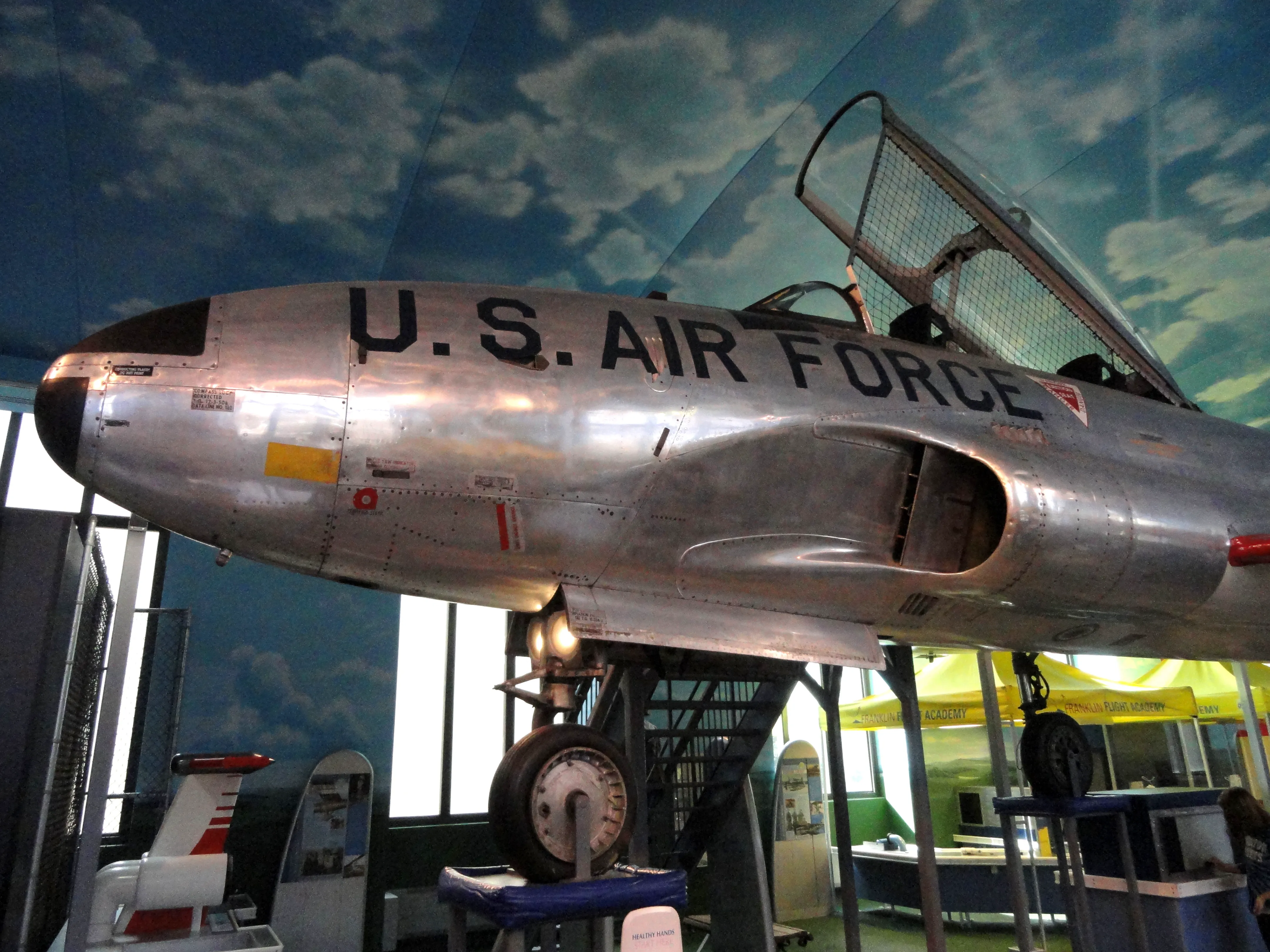
The evidentiary core of this case is the T-33 comparison. Lockheed's T-33 Shooting Star was the standard NATO jet trainer of the era, derived from the F-80 fighter. At cruise it achieved approximately 600 kilometers per hour (roughly 370 mph), with a maximum speed of around 966 km/h (600 mph) — fast by 1952 standards and immediately recognizable to anyone near an active NATO airfield. The witnesses had T-33s in view at the time of the sighting and explicitly described the unknown object as making the jets appear slow by comparison. This is not an abstract claim of anomalous speed: it is a calibrated, real-time comparison against a known reference aircraft operating in the same visual field. For investigators, it transforms a vague speed estimate into a meaningful data point. If the T-33s were flying anywhere near their cruise regime, the observed object was traveling at a velocity well beyond the capability of any propeller or jet aircraft publicly known to be operating in 1952.
The CIA's interest in this sighting was not isolated. The "Flying Saucers in Spain and North Africa" report, accessible via the CIA FOIA reading room (document 0000015465), compiled multiple UAP sightings from the region during the summer and fall of 1952. North Africa was strategically significant territory — French Morocco hosted American and French military installations as part of the broader NATO infrastructure in the Mediterranean theater. American intelligence services were monitoring the skies carefully during the height of the Cold War. The CIA's decision to document and archive this civilian report indicates it was treated as operationally relevant, not dismissed as a curiosity. The same year saw an extraordinary wave of UFO activity globally, including the famous July 1952 Washington DC radar-visual incidents, and the CIA's Robertson Panel was convened the following January specifically to assess whether the volume and pattern of sightings represented a national security concern.
The Meknes case stands on firmer evidentiary ground than most 1952 sightings for several reasons. First, the witnesses were located adjacent to an active military airbase, lending environmental context and a trained sense of airspace norms. Second, the T-33 speed comparison provides an objective, documentable performance anchor rather than relying solely on subjective impression. Third, the event was reported in a contemporaneous French-language newspaper and was independently collected into a CIA intelligence document — two separate chains of documentation originating from sources with no apparent coordination. Fourth, the sighting occurred at approximately 13:00 local time — broad daylight — significantly reducing the margin for optical misidentification of atmospheric phenomena such as meteors or celestial objects. The behavioral profile of the object (parabolic arc, apparent deceleration and stop, silent operation despite high speed) matches the flight characteristics described in the 2021 DoD UAP Task Force preliminary report's catalog of unexplained aerial phenomena.